

Sugarcane season kicks off strongly in Egypt

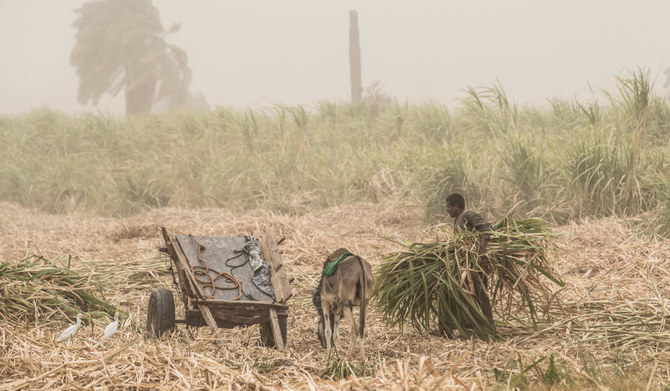
A farmer carries sugarcane in Egypt's southern city of Luxor. (AFP file photo)
Short Url
Updated 22 January 2023
Follow

Sugarcane season kicks off strongly in Egypt

  • Abdel Fattah Mahmoud Abdullah told Arab News: “The Armant sugar factory receives more than 1.15 million tons of sugar cane every year, and produces around 110,000 tons of sugar … and around 50,000 tons of molasses”

CAIRO: The sugarcane harvesting season has begun in Egypt, with the governorate of Upper Egypt in the country’s south a key cultivation site.

“The target is to receive approximately 7.7 million tons of sugarcane during the current harvest season to produce about 850,000 tons of sugar,” Maj. Gen. Essam El-Din El-Budaiwi, head of the Sugar and Integrated Industries Co., told Arab News.

He added that the company has eight factories in five governorates across Egypt — Aswan, Luxor, Qena, Sohag, Minya — to produce sugar from cane and beets.

Egypt’s minister of supply, Dr. Ali Al-Moselhi, recently said the country was 90 percent self-sufficiency in sugar production, following suggestions elsewhere that it was facing a shortage of the foodstuff.

Egypt will be 100 percent self-sufficient in sugar next year, the minister added.

Al-Budaiwi, however, noted that the supply price had increased to 1,100 Egyptian pounds ($37) per ton from 810 pounds last season, upping farmers’ dues to 8.47 billion pounds.

In addition, cultivated land fell by 235,000 feddans (987 sq. km) this year, compared to 248,000 feddans last year, said the official.

Despite these problems, El-Budaiwi confirmed that he was seeking to maintain supply rates within safe limits and pay farmers’ dues while implementing a plan to raise the production capacities of factories.

Abdel Fattah Mahmoud Abdullah, head of the sugar cane factories in Luxor governorate, southern Egypt, told Arab News: “The Armant sugar factory receives more than 1.15 million tons of sugar cane every year, and produces around 110,000 tons of sugar … and around 50,000 tons of molasses.”

He said that all the workers at the factory were ready to play a major role in the success of the season this year.

In Aswan governorate, southern Egypt, farmers began harvesting the cane crop from dawn, wearing gloves to protect their hands.

Commenting on the stages of sugar production, Sami Ahmed, head of Kom Ombo Sugar Factories, said that the sugar production season would continue until mid-May.

Factories operate 24 hours a day for a period of 140 consecutive days without stopping during this period, he added, and that his facilities would produce about 200,000 tons of sugar.


Five takeaways from Mojtaba Khamenei’s defiant first message

Updated 3 sec ago
Follow

Five takeaways from Mojtaba Khamenei’s defiant first message

  • Khamenei’s father Ali Khamenei, supreme leader since 1989, wife, sister, child and brother-in-law were all killed on February 28 at the start of the US-Israeli war
  • The message was not accompanied by video or audio of the new leader giving the remarks, or even a new still image

PARIS: Iran’s new supreme leader Mojtaba Khamenei on Thursday issued his first message since his elevation to the post, threatening revenge for his father’s killing, though he did not deliver the declaration in person.
Khamenei’s father Ali Khamenei, supreme leader since 1989, was killed on February 28 at the start of the US-Israeli war against the Islamic republic in an air strike that also claimed the lives of other top security officials and family members.
Mojtaba Khamenei was himself wounded, according to statements by some Iranian officials and state television, but there remains uncertainty over his whereabouts and physical condition.
Here are five takeaways from his first statement as supreme leader.

- Uncertainty over condition -

“The first message of the supreme leader of the Islamic revolution, his excellency Ayatollah Seyyed Mojtaba Hossein Khamenei!” an Iranian TV anchor declared before reading out the lengthy statement.
There was, however, no attempt to end the speculation over Khamenei’s condition, and the statement was not accompanied by video or audio of the new leader giving the remarks, or even a new still image.
Instead, the statement was read against the backdrop of an archive photo of Khamanei and a computer-generated flag of the Islamic republic.
- Call for revenge -

In the statement, Khamenei offered no hint that he was seeking to make peace with Iran’s enemies, and instead emphasized his desire for revenge in a war that has claimed the life of his father and his wife.
“A limited amount of this revenge has so far taken concrete form, but until it is fully achieved, this case will remain among our priorities,” Khamenei said.
“We will seek compensation from the enemy, and if they refuse, we will take as much of their property as we determine, and if that is not possible, we will destroy the same amount of his property,” he added.
He singled out a deadly strike on a school in Minab in southern Iran that Iranian authorities have said was carried out by the US and left 150 people dead, describing it as a “crime the enemy deliberately committed.”
A preliminary US military investigation has determined that a missile struck the school because of a targeting mistake, The New York Times reported on Wednesday.
- Threats to enemies -
Echoing the language of his late father, Khamanei also emphasized Iran’s potential to cause havoc across the region by squeezing oil supplies and using regional proxies.
He called for using “the lever of blocking the Strait of Hormuz” — a strategic waterway through which a fifth of global oil passes.
“The will of the people is for the continuation of an effective and deterrent defense that will make the enemy regret its actions.”
He warned that “studies have also been carried out on opening other fronts in which the enemy has little experience and in which it will be extremely vulnerable,” without giving details.
Those fronts would be “activated” if the war continued, he said.

- Warning to region -

Khamenei noted that Iran shared land or sea borders with some 15 countries and “we have always desired warm and constructive relations” with these neighbors.
But Khamenei called for the closure of US bases in nearby countries, saying “the claim of establishing security and peace by America was nothing more than a lie.”
“These countries must determine their stance regarding those who have invaded our dear homeland and killed our people.”
- Grieving son and husband -
He lauded his father as a “shining treasure and distinguished figure in history,” and said he had seen the late ayatollah’s corpse after his “martyrdom.”
Khamenei described the body as “a mountain of steadfastness” with the fist of his father’s one functioning hand — his other arm was paralyzed after a bomb attack in the 1980s — clenched in a sign of defiance.
Khamenei emphasized that as well as his father, he had also lost in the attack “my dear and loyal wife,” his sister, her child and his brother-in-law.
He did not mention his mother, who previous reports said had also been killed. The Fars news agency said Thursday those reports were inaccurate and she was still alive.
Khamenei said that he had learned of his appointment by the Assembly of Experts clerical body “at the same time as you” on television through the state broadcaster.