

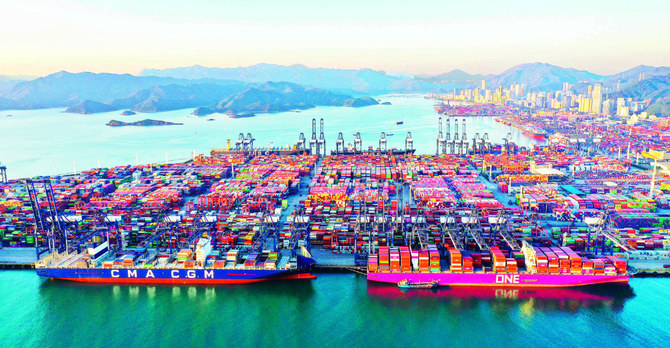
World should not ‘pull back’ from globalization, says Egypt’s former minister of trade and industry 

Governments worldwide should rethink their approach to trade to avoid “pulling back” what has been built over the last few decades, says former Egyptian trade minister Rachid Mohamed Rachid. (AFP)
Short Url
Updated 21 January 2023
Follow

World should not ‘pull back’ from globalization, says Egypt’s former minister of trade and industry 

  • Rachid Mohamed Rachid says he is skeptical about the trade policies pursued by top global economies
  • Direction taken by the Gulf states is “creating a positive vibe,” Alsara Investment Group founder tells Arab News

DAVOS: Rachid Mohamed Rachid, Egypt’s former minister of trade and industry, has warned against the risks of moving away from the global economy, saying that “a lot of what we have enjoyed as consumer societies in the last 10 to 20 years has been due to globalization.”

Speaking to Arab News, the founder of Alsara Investment Group — one of the leading companies operating in the area of consumer goods, luxury, and fashion — said that governments worldwide should rethink their approach to trade to avoid “pulling back” what has been built over the last few decades.

Rachid said: “Globalization, unfortunately, even before the pandemic, has been facing very serious challenges. 

“We never imagined that we would see an American administration coming and imposing sanctions, and tariffs and restrictions on trade, without any institutional logic.”
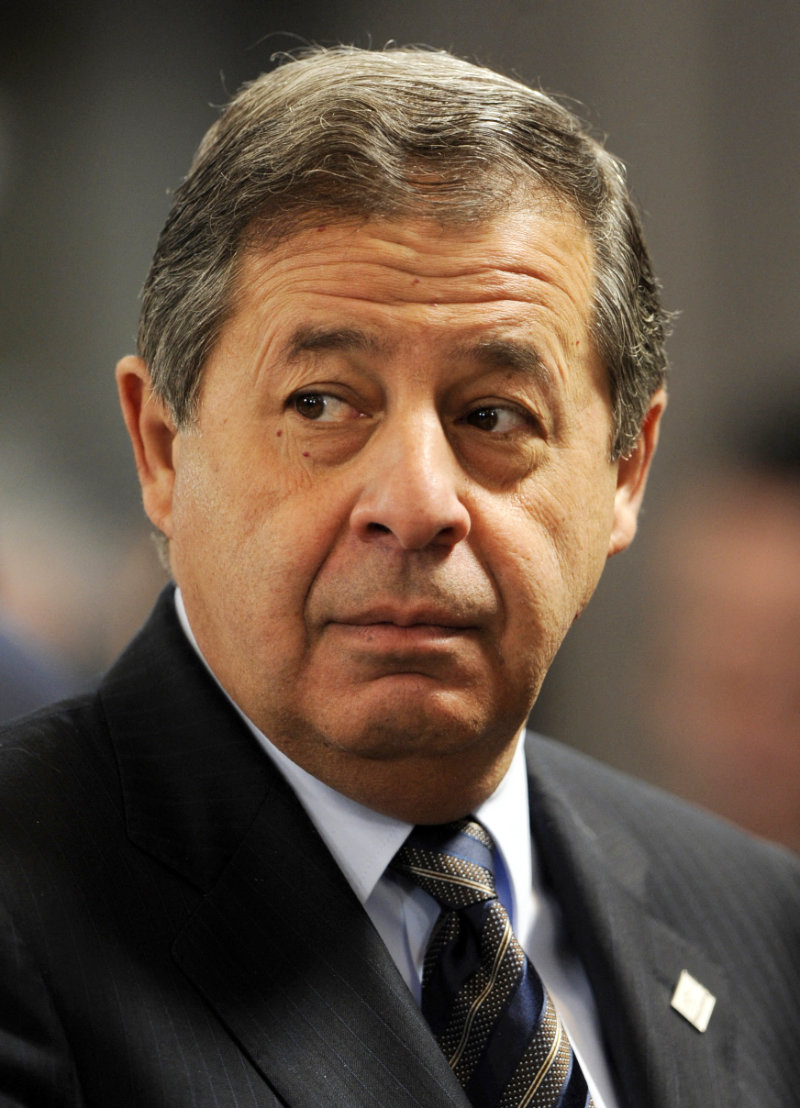


Rachid Mohamed Rachid says he is alarmed at the growing use of trade sanctions as a political weapon. (AFP)

Administrations have promoted policies over the last few years that have drawn governments away from economic integration in favor of more centralized commercial interests, under pressure from increased geopolitical instability and events that have hastened the process.

Rachid highlighted how the COVID-19 pandemic, and in particular the Russian conflict in Ukraine, have accelerated this trend, prompting some of the biggest economies in the world to impose sanctions, “backtracking from globalization” rather than “leading it.”

He said that this approach by global economies could tarnish the reputation of the World Trade Organization.

“Trade sanctions are being used as a weapon in politics,” he said.

“But we know that sanctions are also inventing something called secondary sanctions, which means that countries that have interests with Russia are either forced to cut their relationship or face trade penalties because of it. All these things have really put the WTO in question.”

The businessman also discussed the role of Gulf countries and the direction being pursued by governments in the region.

He said: “I think the direction that is taken today in the Gulf by all the states is a very positive one.

“Everybody is talking about diversification of the economy; everybody is talking about a bigger role for the private sector, less role for the government, opening up for foreign investment, and making countries more hospitable.

“All this in totality is creating a positive vibe.”

Rachid stresses the importance of creating an environment that goes beyond attracting tourists, and is able to lure the human capital from abroad that the region needs to continue as a major player in the world economy, while still offering opportunities to local people.

He said: “The Gulf needs more people… and the number one priority is how to create more opportunities for the local people.

“The question is, how and what could make these places more attractive to foreigners?

“I mean, the government has to really decide first how much it wants in terms of quantities, and what it wants to offer.”

Saudi Arabia ranks 2nd globally in digital government, World Bank 2025 index shows


Updated 18 December 2025
Follow

Saudi Arabia ranks 2nd globally in digital government, World Bank 2025 index shows


WASHINGTON: Saudi Arabia has achieved a historic milestone by securing second place worldwide in the 2025 GovTech Maturity Index released by the World Bank.

The announcement was made on Thursday during a press conference in Washington, DC, which evaluated 197 countries.

The Kingdom excelled across all sub-indicators, earning a 99.64 percent overall score and placing it in the “Very Advanced” category.

It achieved a score of 99.92 percent in the Core Government Systems Index, 99.90 percent in the Public Service Delivery Index, 99.30 percent in the Digital Citizen Engagement Index, and 99.50 percent in the Government Digital Transformation Enablers Index, reflecting some of the highest global scores.

This includes outstanding performance in digital infrastructure, core government systems, digital service delivery, and citizen engagement, among the highest globally.

Ahmed bin Mohammed Al-Suwaiyan, governor of the Digital Government Authority, attributed this achievement to the unwavering support of the Saudi leadership, strong intergovernmental collaboration, and effective public-private partnerships.

He highlighted national efforts over recent years to re-engineer government services and build an advanced digital infrastructure, which enabled Saudi Arabia to reach this global standing.

Al-Suwaiyan emphasized that the Digital Government Authority continues to drive innovation and enhance the quality of digital services, in line with Saudi Vision 2030, supporting the national economy and consolidating the Kingdom’s transformation goals.

The 2025 GTMI data reflects Saudi Arabia’s excellence across key areas, including near-perfect scores in core government systems, public service delivery, digital citizen engagement, and government digital transformation enablers. This balanced performance places the Kingdom firmly in the “Grade A” classification for very advanced countries, demonstrating the maturity of its digital government ecosystem.

Saudi Arabia’s progress in the index has been remarkable: from 49th place in the 2020 edition, to third in 2022, and now second in 2025, confirming its status as a global leader in digital transformation and innovation.

The achievement also reflects the Kingdom’s focus on putting people at the center of digital transformation, enhancing user experience, improving government efficiency, and integrating artificial intelligence and emerging technologies across public services.
