

Lebanon stripped of voting rights at UN over unpaid annual dues

1 / 3
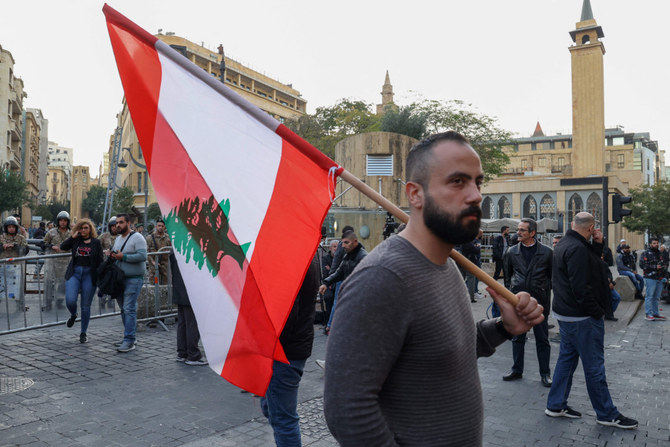
Lebanese protesters gather near a street leading to the parliament building in Beirut on Jan. 20, 2023, in support of independent lawmakers staging a sit-in at until MPs elect a new president. (AFP
2 / 3
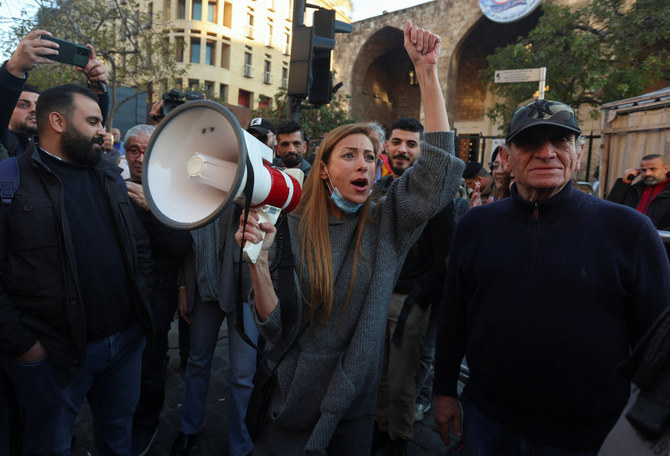
Lebanese lawmaker Cynthia Zarazir stand near demonstrators protesting in support of independent lawmakers who are staging a sit-in at parliament. (Reuters)
3 / 3
Lebanese protesters gather near a street leading to the parliament building in Beirut on Jan. 20, 2023, in support of independent lawmakers staging a sit-in at until MPs elect a new president. (AFP
Short Url
Updated 21 January 2023
Follow

Lebanon stripped of voting rights at UN over unpaid annual dues

  • Beirut owes $1.8m in unpaid dues
  • MPs continue sit-in over presidential deadlock

BEIRUT: Lebanon has been stripped of its voting rights at the UN General Assembly for failing to pay its annual dues.

Secretary-General Antonio Guterres said the government in Beirut must pay arrears of about $1.8 million to regain its status. Other countries that lost the right to vote were Dominica, Equatorial Guinea, Gabon, South Sudan and Venezuela.

Under UN rules, a country can lose its vote if it is in arrears of at least two years’ contributions, unless it shows evidence that it cannot pay for reasons beyond its control. Lebanon has been mired in economic chaos since 2019, when its financial system collapsed after decades of profligate spending, mismanagement and corruption.

The Foreign Ministry said on Friday the debt would be paid “immediately, in a manner that preserves Lebanon’s rights in the UN.”

Meanwhile two independent MPs who spent Thursday night in parliament said on Friday they were refusing to move until the assembly elected a new president. Lebanon has had no head of state for more than two months and the government has been operating in a caretaker capacity since May.

Melhem Khalaf and Najat Saliba were elected last year on the back of protests in late 2019 against Lebanon’s corrupt ruling elite. The squabbling over the presidency is mostly between supporters and opponents of the Iran-backed Hezbollah group.

Saliba said: “Our constitutional right is to remain in the hall until a president is elected, and we … are simply asking MPs to do what they are asked. We are not challenging anyone, nor can we force anyone to do anything. But we are staying here.”

Khalaf told Arab News: “We feel as if democracy is failing in Lebanon, and we have a responsibility today to respect it. Without a president, the work of state institutions will remain suspended. MPs are obligated … to go to parliament and elect a president.”  


Baghdad says it will prosecute Daesh militants being moved from Syria to Iraq

Updated 6 sec ago
Follow

Baghdad says it will prosecute Daesh militants being moved from Syria to Iraq

  • The US military started the transfer process on Friday with the first Daesh prisoners moved from Syria to Iraq

BAGHDAD: Baghdad will prosecute and try militants from the Daesh group who are being transferred from prisons and detention camps in neighboring Syria to Iraq under a US-brokered deal, Iraq said Sunday.
The announcement from Iraq’s highest judicial body came after a meeting of top security and political officials who discussed the ongoing transfer of some 9,000 IS detainees who have been held in Syria since the militant group’s collapse there in 2019.
The need to move them came after Syria’s nascent government forces last month routed Syrian Kurdish-led fighters — once top US allies in the fight against Daesh — from areas of northeastern Syria they had controlled for years and where they had been guarding camps holding Daesh prisoners.
Syrian troops seized the sprawling Al-Hol camp — housing thousands, mostly families of Daesh militants — from the Kurdish-led force, which withdrew as part of a ceasefire. Troops last Monday also took control of a prison in the northeastern town of Shaddadeh, from where some Daesh detainees had escaped during the fighting. Syrian state media later reported that many were recaptured.
Now, the clashes between the Syrian military and the Kurdish-led Syrian Democratic Forces, or SDF, sparked fears of Daesh activating its sleeper cells in those areas and of Daesh detainees escaping. The Syrian government under its initial agreement with the Kurds said it would take responsibility of the Daesh prisoners.
Baghdad has been particularly worried that escaped Daesh detainees would regroup and threaten Iraq’s security and its side of the vast Syria-Iraq border.
Once in Iraq, Daesh prisoners accused of terrorism will be investigated by security forces and tried in domestic courts, Iraq’s Supreme Judicial Council said.
The US military started the transfer process on Friday with the first Daesh prisoners moved from Syria to Iraq. On Sunday, another 125 Daesh prisoners were transferred, according to two Iraqi security officials who spoke to The Associated Press on condition of anonymity in line with regulations.
So far, 275 prisoners have made it to Iraq, a process that officials say has been slow as the US military has been transporting them by air.
Both Damascus and Washington have welcomed Baghdad’s offer to have the prisoners transferred to Iraq.
Iraq’s parliament will meet later on Sunday to discuss the ongoing developments in Syria, where its government forces are pushing to boost their presence along the border.
The fighting between the Syrian government and the SDF has mostly halted with a ceasefire that was recently extended. According to Syria’s Defense Ministry, the truce was extended to support the ongoing transfer operation by US forces.
The Daesh group was defeated in Iraq in 2017, and in Syria two years later, but Daesh sleeper cells still carry out deadly attacks in both countries. As a key US ally in the region, the SDF played a major role in defeating Daesh.
During the battles against Daesh, thousands of extremists and tens of thousands of women and children linked to them were taken and held in prisons and at the Al-Hol camp. The sprawling Al-Hol camp hosts thousands of women and children.
Last year, US troops and their partner SDF fighters detained more than 300 Daesh militants in Syria and killed over 20. An ambush in December by Daesh militants killed two US soldiers and one American civilian interpreter in Syria.