

Saudi Arabia’s debut Islamic Arts Biennale spotlights 18 local artists

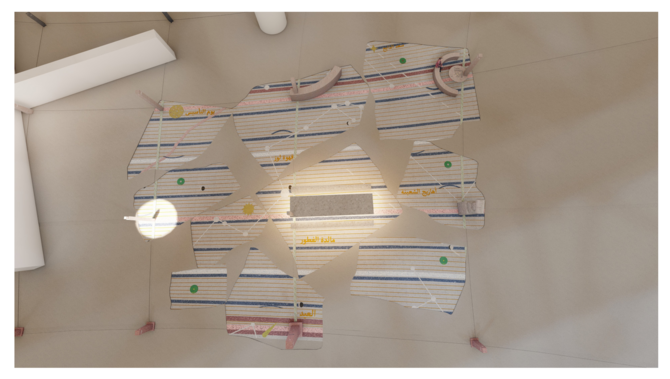
"Sun Path," Rajab to Shawwal 1444, Civil Architecture (Ali Karimi and Hamed Bukhamseen). (Supplied)
Short Url
Updated 20 January 2023
Follow

Saudi Arabia’s debut Islamic Arts Biennale spotlights 18 local artists

  • ‘Awwal Bait’ event showcases 240 artefacts, artwork
  • Beauty, diversity of Muslim experience ‘brought to life’

DUBAI: The Kingdom’s inaugural Islamic Arts Biennale, hosted by the Diriyah Biennale Foundation, announced on Thursday that it would showcase the work of 18 Saudi artists.

The event, set to “Bridge the Past, Present, and Future,” will take place at the iconic Aga Khan award-winning Western Hajj Terminal in Jeddah from Jan. 23 to Apr. 23.  

The participating artists include Abdelrahman El-Shahed, Sarah Al-Abdali, Sarah Brahim, Sultan bin Fahad, Ayman Zedani, Basmah Felemban and Leen Ajlan.


Parts of a Quran manuscript with portions of the text of the Holy Qur’an from chapter 5 Al-Ma’ida to chap. (Supplied)

The biennale will feature over 40 artworks and more than 200 artefacts from Saudi institutions.

Held under the theme “Awwal Bait,” meaning “First House,” referencing the Holy Kaaba in Makkah, the biennale aims to highlight the beauty and diversity of the Muslim experience.  

The event is being curated by a multi-disciplinary panel of experts, including Dr. Saad Al-Rashid, a leading Saudi scholar and archaeologist; Dr. Omniya Abdel Barr, Barakat Trust Fellow at the Victoria and Albert Museum; Dr. Julian Raby, director emeritus of the National Museum of Asian Art, Smithsonian Institution, Washington D.C.; and Artistic Director Sumayya Vally, principal of Counterspace, and honorary professor of practice, UCL.

Aya Al-Bakree, CEO of the Diriyah Biennale Foundation, said in a statement: “The Diriyah Biennale Foundation has placed a special emphasis on nurturing and providing a platform for homegrown talent in its inaugural edition.

“It’s an exciting, first-of-its kind new stage for the local, regional and international art community to get inspired by fresh, thought-provoking perspectives on the diversity of the past, present, and future of the Islamic arts from around the world,” she added.

“Local artists from Saudi Arabia have done an incredible job in bringing the sacred aspects of Islam to life through indigenous and modern techniques and media. We are keen for people to join the dialogue and experience, firsthand, the sense of community that the faith can evoke, through art.”


Elie Saab, Zuhair Murad show new couture collections in Paris

Updated 29 January 2026
Follow

Elie Saab, Zuhair Murad show new couture collections in Paris

  • Saab’s collection uses light as central theme
  • Exploration of structure, movement by Murad

DUBAI: Lebanese designers Elie Saab and Zuhair Murad presented their Spring/Summer 2026 haute couture collections in Paris earlier this week.

Look 1 by Elie Saab. (Supplied)

Saab’s collection referenced light as a central theme, expressed through elongated silhouettes and layered embellishment, according to a statement from the brand.

Look 2 by Elie Saab. (Supplied)

The runway featured gowns built on sheer bases, with metallic embroidery, sequins and crystal beadwork creating layered textures across champagne, gold, bronze and soft ivory tones.

Look 3 by Elie Saab. (Supplied)

Column dresses, deep necklines and floor-length gowns dominated the collection, while draped panels, embroidered capes and sheer overlays added movement.

Look 4 by Elie Saab. (Supplied)

Several looks incorporated fringed detailing and geometric patterns, with crystal embellishments catching the light as models walked.


A post shared by ELIE SAAB (@eliesaabworld)

Accessories were kept minimal, allowing the focus to remain on craftsmanship and surface technique.

Meanwhile, Murad’s collection also placed craftsmanship at the center of the show.

Look 1 by Zuhair Murad. (Supplied)

According to the house, the collection explored structure and movement, using corsetry to define the body and draping to create fluidity.

Look 2 by Zuhair Murad. (Supplied)

The runway featured fitted gowns and sculpted eveningwear built around structured bodices, many finished with dense embroidery, crystals and metallic thread.

Look 3 by Zuhair Murad. (Supplied)

A palette of champagne, pale blue, sage green, ivory and gold ran throughout the show, with strapless silhouettes, off-the-shoulder gowns and column dresses appearing alongside sheer panels, thigh-high slits and flowing trains.

Look 4 by Zuhair Murad. (Supplied)

Shorter dresses with crystal-encrusted bodices were shown alongside floor-length gowns, with sheer layers and extended trains.