

Saudi Arabia’s debut Islamic Arts Biennale spotlights 18 local artists

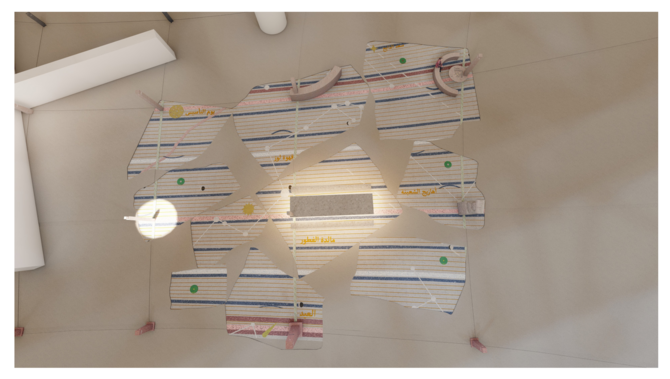
"Sun Path," Rajab to Shawwal 1444, Civil Architecture (Ali Karimi and Hamed Bukhamseen). (Supplied)
Short Url
Updated 20 January 2023
Follow

Saudi Arabia’s debut Islamic Arts Biennale spotlights 18 local artists

  • ‘Awwal Bait’ event showcases 240 artefacts, artwork
  • Beauty, diversity of Muslim experience ‘brought to life’

DUBAI: The Kingdom’s inaugural Islamic Arts Biennale, hosted by the Diriyah Biennale Foundation, announced on Thursday that it would showcase the work of 18 Saudi artists.

The event, set to “Bridge the Past, Present, and Future,” will take place at the iconic Aga Khan award-winning Western Hajj Terminal in Jeddah from Jan. 23 to Apr. 23.  

The participating artists include Abdelrahman El-Shahed, Sarah Al-Abdali, Sarah Brahim, Sultan bin Fahad, Ayman Zedani, Basmah Felemban and Leen Ajlan.


Parts of a Quran manuscript with portions of the text of the Holy Qur’an from chapter 5 Al-Ma’ida to chap. (Supplied)

The biennale will feature over 40 artworks and more than 200 artefacts from Saudi institutions.

Held under the theme “Awwal Bait,” meaning “First House,” referencing the Holy Kaaba in Makkah, the biennale aims to highlight the beauty and diversity of the Muslim experience.  

The event is being curated by a multi-disciplinary panel of experts, including Dr. Saad Al-Rashid, a leading Saudi scholar and archaeologist; Dr. Omniya Abdel Barr, Barakat Trust Fellow at the Victoria and Albert Museum; Dr. Julian Raby, director emeritus of the National Museum of Asian Art, Smithsonian Institution, Washington D.C.; and Artistic Director Sumayya Vally, principal of Counterspace, and honorary professor of practice, UCL.

Aya Al-Bakree, CEO of the Diriyah Biennale Foundation, said in a statement: “The Diriyah Biennale Foundation has placed a special emphasis on nurturing and providing a platform for homegrown talent in its inaugural edition.

“It’s an exciting, first-of-its kind new stage for the local, regional and international art community to get inspired by fresh, thought-provoking perspectives on the diversity of the past, present, and future of the Islamic arts from around the world,” she added.

“Local artists from Saudi Arabia have done an incredible job in bringing the sacred aspects of Islam to life through indigenous and modern techniques and media. We are keen for people to join the dialogue and experience, firsthand, the sense of community that the faith can evoke, through art.”


‘One in a Million’: Syrian refugee tale wows Sundance

Updated 24 January 2026
Follow

‘One in a Million’: Syrian refugee tale wows Sundance

PARK CITY: As a million Syrians fled their country's devastating civil war in 2015, directors Itab Azzam and Jack MacInnes headed to Turkey where they would meet a young girl who encapsulated the contradictions of this enormous migration.

In Ismir, they met Isra'a, a then-11-year-old girl whose family had left Aleppo as bombs rained down on the city, and who would become the subject of their documentary "One In A Million," which premiered at the Sundance Film Festival on Friday.

For the next ten years, they followed her and her family's travels through Europe, towards Germany and a new life, where the opportunities and the challenges would almost tear her family apart.

The film is by directors Itab Azzam and Jack MacInnes. (Supplied)

There was "something about Isra'a that sort of felt to us like it encapsulated everything about what was happening there," MacInnes told an audience at the Sundance Film Festival in Park City, Utah on Friday.

"The obvious vulnerability of her situation, especially as being a child going through this, but that at the same time, she was an agent.

"She wasn't sitting back, waiting for other people to save her. She was trying to fight, make her own way there."

The documentary mixes fly-on-the-wall footage with sit-down interviews that reveal Isra'a's changing relationship with Germany, with her religion, and with her father.

It is this evolution between father and daughter that provides the emotional backbone to the film, and through which tensions play out over their new-found freedoms in Europe -- something her father struggles to adjust to.

Isra'a, who by the end of the film is a married mother living in Germany, said watching her life on film in the Park City theatre was "beautiful."

And having documentarists follow her every step of the way as she grew had its upsides.

"I felt like this was something very special," she told the audience after the screening. "My friends thought I was famous; it made making friends easier and faster."