Health authorities detect poliovirus traces in Pakistan’s Lahore, clear 37 other cities 

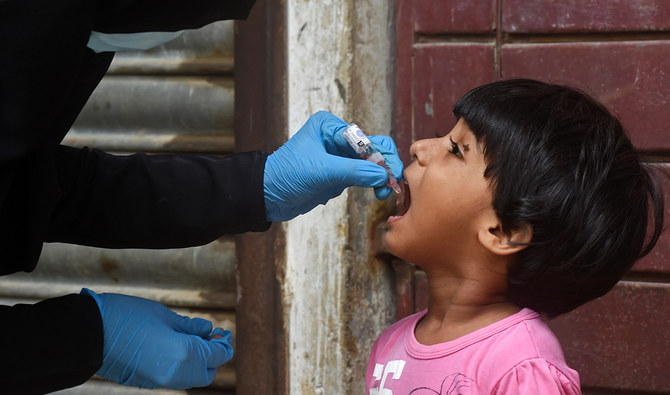
A health worker administers polio vaccine drops to a child during a polio vaccination door-to-door campaign in Pakistan's port city of Karachi on July 20, 2020. (Photo courtesy: AFP/FILE)
Short Url
Updated 20 January 2023
Follow

Health authorities detect poliovirus traces in Pakistan’s Lahore, clear 37 other cities 

  • Pakistan and Afghanistan are the only two countries in the world where polio remains an endemic 
  • A vaccination campaign has been launched in 26 union councils across Lahore after detection of virus 

ISLAMABAD: Pakistani health authorities have found traces of the poliovirus in environmental samples collected from the eastern city of Lahore, local media reported, days after the government launched an anti-polio drive across the South Asian country. 

An environmental sample report by Pakistan’s National Institute of Health (NIH) showed encouraging signs as no virus traces were found in sewage samples collected from 37 cities. 

However, samples from Lahore tested positive and prompted the authorities to launch a vaccination campaign in 26 union councils across the second largest city of Pakistan, Pakistan’s Dawn newspaper reported. 

“The National Institute of Health (NIH) has confirmed the detection of Type-1 Wild Poliovirus (WPV1) in an environmental sample collected from District Lahore (Gulshan Ravi ES site) in January 2023,” the report read. 

“This is the first positive environmental sample from Pakistan this year,” it said, citing the NIH. 

Pakistan and Afghanistan are the only two countries in the world where polio continues to threaten the health and well-being of children. Polio affects the nervous system of children and ultimately leads to paralysis. 

Pakistan last year reported poliovirus in 37 samples detected nationwide. 

On Sunday, the Pakistani government launched its first anti-polio campaign of the year, targeting 44.2 million children under the age of five. 

This included 22.54 million children in Punjab, 10.1 million in Sindh and 7.4 million in Khyber Pakhtunkhwa provinces. 


IMF warns against policy slippage amid weak recovery as it clears $1.2 billion for Pakistan

Updated 11 December 2025
Follow

IMF warns against policy slippage amid weak recovery as it clears $1.2 billion for Pakistan

  • Pakistan rebuilt reserves, cut its deficit and slowed inflation sharply over the past one year
  • Fund says climate shocks, energy debt, stalled reforms threaten stability despite recent gains

ISLAMABAD: Pakistan’s economic recovery remains fragile despite a year of painful stabilization measures that helped pull the country back from the brink of default, the International Monetary Fund (IMF) warned on Thursday, after it approved a fresh $1.2 billion disbursement under its ongoing loan program.

The approval covers the second review of Pakistan’s Extended Fund Facility (EFF) and the first review of its climate-focused Resilience and Sustainability Facility (RSF), bringing total disbursements since last year to about $3.3 billion.

Pakistan entered the IMF program in September 2024 after years of weak revenues, soaring fiscal deficits, import controls, currency depletion and repeated climate shocks left the economy close to external default. A smaller stopgap arrangement earlier that year helped avert immediate default, but the current 37-month program was designed to restore macroeconomic stability through strict monetary tightening, currency adjustments, subsidy rationalization and aggressive revenue measures.

The IMF’s new review shows that Pakistan has delivered significant gains since then. Growth recovered to 3 percent last year after shrinking the year before. Inflation fell from over 23 percent to low single digits before rising again after this year’s floods. The current account posted its first surplus in 14 years, helped by stronger remittances and a sharp reduction in imports. And the government delivered a primary budget surplus of 1.3 percent of GDP, a key program requirement. Foreign exchange reserves, which had dropped dangerously low in 2023, rose from US$9.4 billion to US$14.5 billion by June.

“Pakistan’s reform implementation under the EFF arrangement has helped preserve macroeconomic stability in the face of several recent shocks,” IMF Deputy Managing Director Nigel Clarke said in a statement after the Board meeting.

But he warned that Islamabad must “maintain prudent policies” and accelerate reforms needed for private-sector-led and sustainable growth.

The Fund noted that the 2025 monsoon floods, affecting nearly seven million people, damaging housing, livestock and key crops, and displacing more than four million, have set back the recovery. The IMF now expects GDP growth in FY26 to be slightly lower and forecasts inflation to rise to 8–10 percent in the coming months as food prices adjust.

The review warns Pakistan against relaxing monetary or fiscal discipline prematurely. It urges the State Bank to keep policy “appropriately tight,” allow exchange-rate flexibility and improve communication. Islamabad must also continue raising revenues, broadening the tax base and protecting social spending, the Fund said.

Despite the progress, Pakistan’s structural weaknesses remain severe.

Power-sector circular debt stands at about $5.7 billion, and gas-sector arrears have climbed to $11.3 billion despite tariff adjustments. Reform of state-owned enterprises has slowed, including delays in privatizing loss-making electricity distributors and Pakistan International Airlines. Key governance and anti-corruption reforms have also been pushed back.

The IMF welcomed Pakistan’s expansion of its flagship Benazir Income Support Program, which raises cash transfers for low-income families and expands coverage, saying social protection is essential as climate shocks intensify. But it warned that high public debt, about 72 percent of GDP, thin external buffers and climate exposure leave the country vulnerable if reform momentum weakens.

The Fund said Pakistan’s challenge now is to convert short-term stabilization into sustained recovery after years of economic volatility, with its ability to maintain discipline, rather than the size of external financing alone, determining the durability of its gains.