

Saudi bid for Expo 2030 ‘an investment in the future of our citizens, residents and visitors,’ RCRC chief tells Davos

Head of RCRC speaking with award-winning broadcaster Emma Crosby at a special fireside chat at the CNBC pavilion on the Davos promenade on the sidelines of the World Economic Forum’s Annual Meeting. (Twitter)
Short Url
Updated 20 January 2023
Follow

Saudi bid for Expo 2030 ‘an investment in the future of our citizens, residents and visitors,’ RCRC chief tells Davos

  • The Kingdom has already earned significant support for its bid from more than 60 countries and organizations 
  • More than 30 million people expected in Riyadh and 1 billion eyed for virtual interaction on metaverse

DAVOS: Saudi Arabia’s bid for Expo 2030 was not a one-off investment but rather one “in the future of our citizens, residents, and visitors,” the head of the Royal Commission for Riyadh City, Fahd Al-Rasheed, said.

“We’re thinking about the legacy of the site itself and how it can be used. It cannot be just built and then everybody packs their bags and leaves. It has to be used beyond us.

“So, we’re thinking about the design of the buildings, and we have that in this site masterplan in a way that we can use them for the future of work, the future of education, and reskilling,” he added.

Speaking with award-winning broadcaster Emma Crosby at a special fireside chat at the CNBC pavilion on the Davos promenade on the sidelines of the World Economic Forum’s Annual Meeting, Al-Rasheed noted that the Expo 2030 infrastructure would come naturally given the work already being done regarding Crown Prince Mohammed bin Salman’s Vision 2030.

His vision, however, for the Expo was not solely in the look and feel of the site, but in its legacy.

He said: “Our legacy from Expo 2030 is not going to be a building. It has to be mass engagement, and at a scale never seen before.

“It is literally the largest event in the world, and so what we committed to is the following; not only are we going to get 30, 40 million people to the site, which is fantastic, it’s a record. We’re going to get 1 billion people to interact with it on the metaverse and we are now translating that vision into reality.”


The Saudi Arabia Pavilion stands tall at Dubai Expo 2022, which drew 26 million visitors over six months. (Dubai Expo 2020)

The virtual Expo would cater for those unable to fly to Riyadh, but the RCRC’s chief executive officer pointed out that it would be more than just a virtual tour.

“You’d give 1 billion people the opportunity to actually come and see it, and that would be the first win. The second win is they would actually come in and do something experiential about water use and energy use, learn something and apply it in their home. That will get you mass impact.

“And third, maybe even transact, do a job virtually, or meet somebody or a company, get an investment, et cetera. So again, it has to be useful to everybody for it to be used,” Al-Rasheed added.

He said: “You have to have a great site, great mobility, which we are doing already now. And the metro will connect to the site. The site is just south of the airport. So, it’s basically the gateway into the city of Riyadh. And we are going to have 140,000 rooms and hotel rooms by then anyway. And so, the Expo will come in naturally.”

Saudi Arabia is no stranger to hosting millions of visitors, given that it is home to the Two Holy Mosques which bring in millions of pilgrims every year for Hajj in Makkah.


However, that is not to say that creating such a complex site will come cheap. A whopping $8 billion of investment from the Kingdom will be going into making the plans become a reality.

“It’s a very large investment. We believe that this investment is totally justified. We have a return-on-investment target as well for it. We have a socio-economic target on jobs created both during the Expo and before and after.

“So, the government of Saudi Arabia doesn’t just put money into buildings and infrastructure and white elephants. We actually want a return on investment out of everything that we do,” Al-Rasheed added.

On the Expo’s theme, The Foresight of Tomorrow, he said: “It means that we have to take responsibility for our future, whether we are countries, companies, or individuals.

“We have to project the next two, three decades and look at the opportunities that it’s going to avail, and the challenges, and tackle them. We need to stare them right in the face.”

Within this theme lies three subthemes: A Different Tomorrow, Climate Action, and Prosperity for All.

To paint a picture of the first sub theme, Al-Rasheed gave the example of how robotics could reformat a 200-employee factory into one that only needed three employees.

“The plant is more productive, but what happens to 197 employees that you just basically moved out of a job? You have to think about reskilling. So, by confronting the problem, I immediately thought about what I need to do in order to manage from a socio-economic perspective.
“You have the same thing on the second subtheme, which is climate action. What do we need to do? Not just as countries meeting and suits, et cetera, talking about what the future would look like, but what do I as an individual contribute? How do I use water differently, energy differently? What is my role?”

And on the third subtheme, he added: “How can we provide opportunity for everyone? They may not take it, but we have to provide it.”

The capital has already begun working on climate action and sustainability, with more than $70 billion invested in such projects.

Al-Rasheed said: “We said we cannot announce a strategy of hypergrowth without having a sustainability commitment. So, last year we actually announced the real sustainability strategy.

“We love our environment, we love our city, and we have a commitment to the world. So, we will change all our systems, we will change all our plans. We will make 30 percent of our cars, electric vehicles by 2030 and 50 percent renewable energy sources by 2030.”

The fireside chat was attended by numerous WEF delegates, business executives, journalists, and investors.

Saudi Arabia submitted its bid for the World Expo 2030 in October last year, in a letter sent by Crown Prince Mohammed bin Salman to the Bureau International des Expositions, the international organizing body for the global event since 1931. 

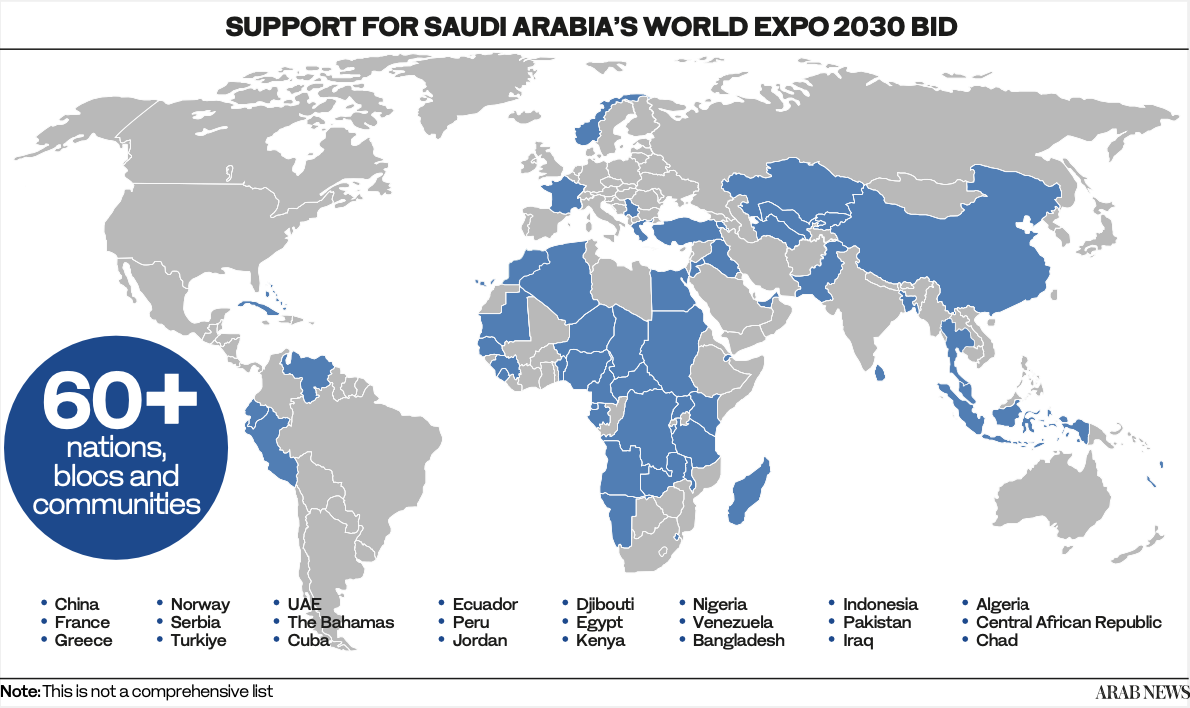
The Kingdom has already earned significant support for its bid from more than 60 countries and organizations around the world, including China, France, Turkiye, Greece, Armenia, Cuba, dozens of other African nations, and the Organization of Islamic Cooperation. 

The Kingdom 's capital is competing against Busan in South Korea, Rome in Italy, and Odesa in Ukraine for Expo 2030, with a ballot to be held by the BIE in November 2023, on the principle of one country, one vote.

Surviving the sands: The battle to save Arabian wolves

Updated 13 December 2025
Follow

Surviving the sands: The battle to save Arabian wolves

  • Exploring the wolf’s role in Arabia’s heritage and ecosystem

RIYADH: Wolves are often portrayed in Western stories and films as dangerous, unpredictable predators. In contrast, Arabic perspectives offer a more nuanced view. 

In Saudi Arabia, wolves are admired for their resilience, intelligence, and role in the natural environment. The Arabian wolf, or Canis lupus arabs, is one of the Peninsula’s iconic native predators. 

For centuries, it shaped both ecological and cultural landscapes across Saudi Arabia. However, its population declined in recent decades. Today, conservation efforts led by the National Center for Wildlife aim to protect and restore this species.

Saudi regulations now make it illegal to display, sell, or transport wolves without authorization. NCW’s initiatives include studying wolf genetics, developing breeding programs to restore wild populations, raising public awareness, and imposing fines of up to SR80,000 ($22,000) for unlicensed hunters.

The Arabian wolf, or Canis lupus arabs, is one of the Arabian Peninsula’s iconic native predators. (SPA)

The Arabian wolf is a symbol of the desert and an important component of the Kingdom’s biodiversity. Historically, it inhabited deserts, mountains, and valleys across Saudi Arabia, Yemen, and Oman. Unlike wolves from colder regions, it evolved to survive extreme heat, scarce water, and fluctuating prey populations.

“Saudi Arabia’s vast and diverse ecosystems have enabled many wildlife species to thrive, including the Arabian wolf,” NCW notes. The wolf historically helped control populations of rodents, small mammals, and weak or diseased animals, maintaining a balanced ecosystem.

However, the shift from nomadic life to urban settlements and agriculture, alongside expanding human activity, put increasing pressure on the species. 

Habitat loss, conflicts with herders, and hunting practices significantly reduced their natural range. NCW records show numerous cases of injured wolves rescued and rehabilitated, highlighting the challenges they face today.

DID YOU KNOW?

• In Saudi Arabia, hunting wolves without a proper license can result in fines of up to SR80,000.

• Mexican wolves, locally known as ‘El Lobo,’ are critically endangered, despite ongoing reintroduction efforts.

• While recent figures for Saudi Arabia’s wolf population are not available, a 2004 report estimated their numbers at 500-600.

Culturally, the Arabian wolf is admired and feared in equal measure. In Bedouin tradition, it symbolizes independence and intelligence, appearing in poetry and oral stories.

“Two cultures in the world share a similar view of the wolf: Native American and Arab cultures,” said Obaid Alouni, a Saudi environmentalist. “They admired wolves and respected wolves. For example, when they see a wolf and someone has a gun, they don’t kill it even though they could,” he added.

Alouni explained that despite being predators, wolves coexisted with humans in the Arabian Peninsula: “There was a kind of coexistence in the Arabian Peninsula.” Yet livestock owners often feared wolves for preying on sheep and goats, creating a tense relationship between humans and wolves.

This dual perception shaped the wolf’s role in cultural metaphors: it was seen as a mirror of the desert itself — tough, resilient, and adaptable. “Arabs have always sought positive qualities in wolves. For example, one of their characteristics is that wolves understand their pack and sacrifice themselves for them. They do not betray their pack and fight for it, in addition to their loyalty to it,” Alouni explained.

Protecting wolves is crucial for maintaining healthy ecosystems. Their presence influences herbivore behavior, supporting a balanced environment. (SPA)

Physically, the Arabian wolf is one of the smallest gray wolf subspecies, adapted to desert life. It weighs 18-25 kilograms and measures 100-110 cm in length. Its large ears reduce heat, a light sandy-gray coat reflects sunlight and camouflages it in the desert, and its diet includes small mammals, birds, and occasionally livestock.

Sadly, the Arabian wolf is classified as endangered due to habitat loss, human conflict, and historical hunting. Alouni noted that hybridization has further reduced the population of purebred Arabian wolves: “Unfortunately, a species is now being circulated that is not the true size of the Arabian wolf. The National Center for Wildlife is currently conducting extensive research to learn more about the Arabian wolf and its true size. The species currently prevalent is shorter in stature.”

Other wolf subspecies include the Gray Wolf, found in North America, Europe, and Asia. It weighs 30–80 kilograms, measures up to 180 cm in length, and is known for its complex social packs. 

Opinion

This section contains relevant reference points, placed in (Opinion field)

The Arctic Wolf, native to Arctic Canada and Greenland, has a thick white coat, short snout and ears, and survives extreme cold, preying on musk oxen, Arctic hares, and caribou. 

The Indian Wolf, scientifically known as Canis lupus pallipes, inhabits South and West Asia, weighs 20-30 kilograms, and forms small, stealthy packs. 

Finally, the Ethiopian wolf is fox-like, inhabits highlands above 3,000 meters, weighs 13–18 kilograms, and has a reddish coat with white markings. It is one of the world’s rarest wolves, with fewer than 500 individuals in the wild.

Protecting wolves is crucial for maintaining healthy ecosystems. As apex predators, they regulate prey populations, prevent overgrazing, maintain plant diversity, and reduce disease spread by feeding on sick or weak animals. Their presence influences herbivore behavior, supporting a balanced environment.

The Arabian wolf is more than a desert predator. It is a cultural symbol, a survivor of harsh landscapes, and a vital component of Saudi Arabia’s ecological identity. The work of the NCW is essential: protecting the Arabian wolf means conserving biodiversity, preserving heritage, and sustaining ecological systems across the Arabian Peninsula.