Saudi Arabia, MENA growth outlook bright despite challenges, ministers say

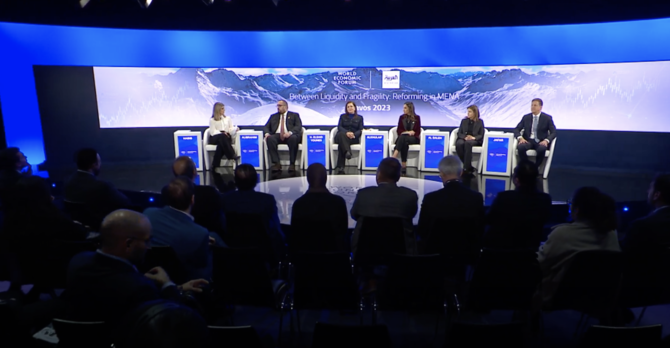
The future looks bright for Saudi Arabia and other Middle East and North African economies, but governments in the region must be wary of geopolitical instability and inflation to sustain growth, ministers told WEF. (Screenshot/WEF)
Short Url
Updated 19 January 2023
Follow

Saudi Arabia, MENA growth outlook bright despite challenges, ministers say

  • Nations must be wary of geopolitical upheaval, inflation, Davos panel agrees
  • Kingdom’s Vision 2030 agenda already paying dividends, economy minister says

DAVOS: The future looks bright for Saudi Arabia and other Middle East and North African economies, but governments in the region must be wary of geopolitical instability and inflation to sustain growth, ministers told the World Economic Forum on Thursday.

Saudi Arabia’s Minister of Economy and Planning Faisal Alibrahim took part in a panel discussion on how the MENA region can build an inclusive and sustainable economic future for all of its nations.

He said the Kingdom’s economy was beginning to see results from its Vision 2030 agenda, which led to its economy being one of the fastest growing in the world in 2022.

“Our non-oil activities, the private sector essentially, has grown at a very high rate up until the end of Q3. On a cumulative basis it reached 5.9 percent and before that in Q2 it was even higher. That is one of the highest, if not the highest, rates in 11 years,” he said.

“We will continue our plans to diversify the economy. We were very fortunate that we have seen results of Vision 2030 materialize over the last few years, especially in 2022, and Saudi becoming the global growth story.”

That private sector growth, coupled with an increase in foreign direct investment in new and revived sectors like tourism, culture, sport and entertainment, and mining, were set to deliver long-term prosperity to Saudi Arabia, Alibrahim said.

“We have a very strong fiscal position, a very strong and resilient financial system and a monetary system as well, so we continuously assess if this will impact the private sector, which has been growing consistently and we’ve seen even foreign direct investment grow at 250 percent,” he said.

“The private sector in terms of exports has grown around 20 percent and manufacturing has grown more than 20 percent in the last year.”

Alibrahim said the government’s efforts to make the Kingdom an attractive proposition for foreign direct investment would lead to a “co-creation of value” with its partners.

“We started at 0.7 percent (FDI) and we’re still moving forward. We want to move faster but with the introduction of the National Investment Strategy and with the many trillions that are targeted to be attracted, we’re moving forward,” he said.

“We are trying to build the right business environment in terms of transparency, policy predictability an institutional environment that never existed this well before to attract this FDI.”

Egypt’s Minister of Planning and Economic Development Hala El-Said and Bahrain’s Minister of Sustainable Development Noor Ali Al-Khulaif echoed Alibrahim’s optimism for the region’s economies as they diversify and attract investment, with both highlighting the progress made in their own countries.

But the panelists warned against the threat to growth from looming crises, with geopolitical upheaval and inflation being the most concerning. They also highlighted the need for keeping channels of communication and cooperation open between nations in the region.

“Inflation is one of the things that is a worry not only for Egypt but for all countries … because it is an extra cost on prices to any citizen,” El-Said said.

Al-Khulaif said: “Certainly, the geopolitical situation (is concerning) … but touching on the theme of WEF this year, communication, I’ve seen it a lot this week … this understanding that my own stability and prosperity, really depends on the stability and prosperity of the countries around me.”

“I think there is a huge amount of willingness to communicate and work together toward growth,” she said.


G7 countries to release oil reserves as IEA agrees to largest ever market intervention

Updated 11 March 2026
Follow

G7 countries to release oil reserves as IEA agrees to largest ever market intervention

  • IEA recommends release of 400 million barrels

RIYADH: Germany, Japan and Austria will release part of their oil reserves after the International Energy Agency recommended the release of 400 million barrels of oil ‌from stockpiles, the largest ‌such move in IEA ​history.

In a statement, IEA Executive Director Fatih Birol said the flow of oil, gas and other commodities through the Strait of Hormuz have all but stopped, leading global energy supply to fall by around 20 percent.

Ahead of the confirmation of the move — a larger intervention than the 182.7 million barrels that were released in 2022 by in response to Russia’s invasion of Ukraine — several countries began setting out plans to bring their reserves into play as countries grapple with ​soaring crude prices amid ​the US-Israeli war with Iran. 

Birol said: “I can now announce that IEA countries have decided to launch the largest ever release of emergency oil stocks in our agency's history. 

“IEA countries will be making 400 million barrels of oil available to the market to offset the supply lost through the effective closure of the strait.

“This is a major action aiming to alleviate the immediate impacts of the disruption in markets.”

Germany’s Economy ⁠Minister ​Katherina Reiche ⁠confirmed on Wednesday her government plans to limit petrol price increases at filling stations to once a day and to introduce more stringent antitrust regulation of the sector.

She did not ⁠give an exact timing for ‌those measures, but added that ‌the US and ​Japan would be the ‌largest contributors to the release of the ‌oil reserves.

The US has not confirmed it would do so, but its Interior Secretary Doug Burgum told Fox News on Wednesday that “these are the kinds of moments that these reserves are used for.”

The announcements did not stop oil prices rising, with Brent crude up 3.26 percent to $90.66 a barrel at 4:29 p.m Saudi time, and West Texas Intermediate up 3.12 percent to $86.05. Both were some way below the $119 a barrel seen earlier in the week.

“The situation regarding oil supplies is tense, as the Strait of Hormuz is currently virtually impassable,” Germany’s Reiche said.

“We will comply with this request and ‌contribute our share, because Germany stands behind the IEA’s most important principle: mutual ⁠solidarity,” Reiche ⁠said about the IEA’s request.

According to a statement by Reiche’s ministry, Germany will contribute 2.64 million tonnes of oil. This corresponds to 19.51 million barrels.

Reiche stressed there was no supply shortage in the country, which has a legally mandated reserve of oil and oil products intended to cover 90 days’ demand.

South Korea will release 22.46 million ​barrels of oil, which represents 5.6 percent of the total IEA ask, the ⁠country's industry ministry said.

“The government will consult with the IEA ⁠secretariat on details, such ‌as ‌the ​timing ‌and amount, from ‌the perspective of national interests in accordance with domestic conditions,” ‌the ministry said in a statement.

The ⁠ministry ⁠said it would continue to coordinate closely with major countries in responding to high oil prices to minimise any domestic ​impact.

Austrian Economy Minister Wolfgang Hattmannsdorfer said his country was releasing part of the emergency oil reserve and extending the national strategic gas reserve, adding: “One thing is clear: in a crisis, there must be no crisis winners at the expense of commuters and businesses.”

Acting ahead of the IEA move, G7 ​member Japan announced plans to release 15 days' worth of ‌private-sector oil reserves and one month's worth of state oil reserves.

“Rather than wait for formal IEA approval ‌of a coordinated international reserve release, Japan will act first to ease global energy market supply and demand, releasing reserves as early as the 16th of this month,” Prime Minister Sanae Takaichi said in a broadcast statement.

Following a meeting with the IEA on Wednesday, G7 energy ministers said: “In principle, we support the implementation of proactive measures to address the situation, including the use of strategic reserves.”

All IEA member countries are required to keep 90 days’ worth of their nation’s oil use in reserve in case of global disruption.