

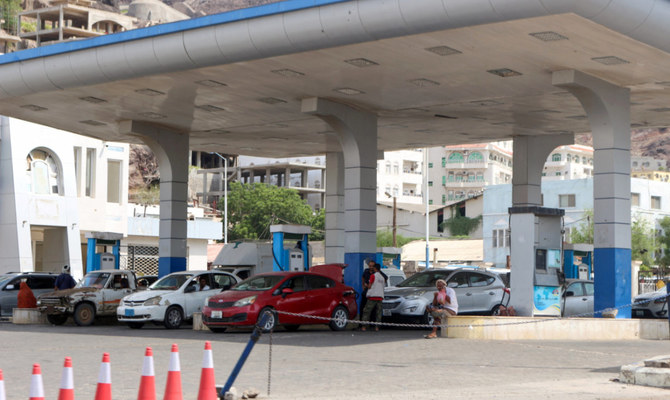

AL-MUKALLA: Yemen’s parliament has publicly condemned the government’s plan to hike fuel and utility prices, among other revenue-generating methods, the latest in a string of outraged responses to the policies.
The Leadership Authority of the parliament stated that the government’s decision to increase fuel prices, electricity and water bills did not take into account the worsening economic situation and the miserable living conditions of the population.
It demanded that the government rescind the price increases and seek other means of generating revenues without harming the populace.
“The decisions did not consider the living situations of citizens or the alternatives needed for military and civilian state personnel and low-income groups,” the lawmakers said in a statement.
The government’s Supreme Economic Council, led by Prime Minister Maeen Abdul Malik Saeed, has approved a 50 percent increase in customs on non-essential goods, a 100 percent increase in fuel prices, a 50 percent increase in cooking gas prices and a gradual increase in electricity and water rates in government-controlled areas.
The council said that the steps were intended to stabilize the Yemeni riyal, stimulate the economy and alleviate poverty.
The recent steps have outraged top officials, including MPs, activists, and the general public, who have accused the government of aggravating what was already a humanitarian catastrophe.
Deputy Speaker of Parliament Mohsen BaSorah told Arab News on Sunday that the Yemeni government should battle corruption, limit the spending of ministers and enhance wages and pensions before considering implementing the most recent economic measures.
“The government has the right to issue decisions to increase revenues, but these decisions should be balanced and not harmful to the people,” BaSorah said.
He also said that the government should expand oil exploration, collect state revenues from provinces, shut down unauthorized exchange firms blamed for currency devaluation and pay ministry and civilian public employees on a regular basis.
“The government must eliminate corruption’s sources, minimize its own expenditures and raise wages, salaries and pensions that have remained unchanged since July 2005,” BaSorah said.
Yemenis say that the minimum monthly pension amount has been reduced from $100 in 2005 to $25 now.
University professors also say that their monthly salaries were worth $1000 a decade ago, compared to $250 today.
“The salaries of citizens and military personnel are not regularly paid, while those of government employees are paid monthly and in two currencies,” BaSorah said.
Yemeni government ministers have not replied to Arab News’ requests for comment in response to lawmakers’ criticism.
Houthi strikes on oil facilities in Hadramout and Shabwa have halted oil exports — Yemen’s principal source of revenue — and the government warned last month that it may not be able to pay public workers in regions under its control.
Previous increases in gasoline prices, meanwhile, have driven up the costs of basic necessities and transportation and caused violent demonstrations throughout areas under government control.
The government’s economic measures have prompted Yemeni journalists, such as Fatehi bin Lazreq, to resort to the courts in an effort to get the government to alter its stance.
Bin Lazerq, editor of the news site Aden Al-Ghad, told Arab News on Sunday that he had filed a complaint against the Yemeni government in an Aden court, claiming that Yemenis would not endure any further economic difficulties.
“Yemen is in a very terrible economic state. Raising the customs dollar rate from YER 500 ($2) to YER 750 will exacerbate the problem,” Bin Lazreq said.
The editor recommended that the government seek other sources of funding from the Coalition to Restore Legitimacy in Yemen or the International Monetary Fund, as well as lower its expenditures and diplomatic missions.
“We filed a lawsuit against the prime minister and the Economic Council headed by Hossam Al-Sharjabi for issuing a decision that breaches the law on raising the prices of fuel, gas, electricity and customs,” Bin Lazerq said, shortly after returning from the specialized administrative court in Aden.


