

Yemeni rights groups urging Houthis to release online influencers

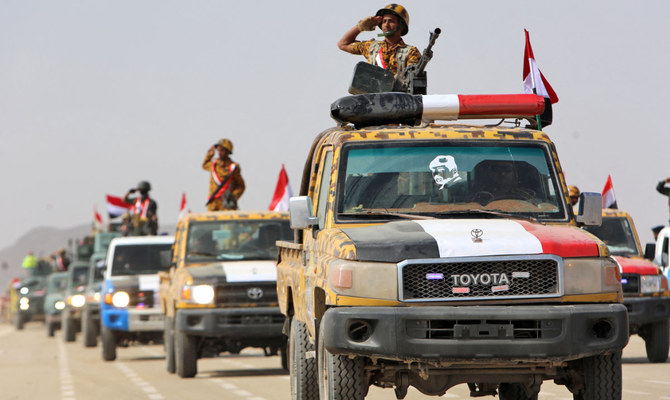
Fighters loyal to Yemen's internationally recognized government take part in a military parade in the northeastern province of Marib. (AFP/File)
Short Url
Updated 08 January 2023
Follow

Yemeni rights groups urging Houthis to release online influencers

  • Crackdown on dissidents follows mounting public anger against militia, activists say

AL-MUKALLA: More than 100 Yemeni human rights and civil society organizations have urged the international community to pressure the Houthi militia into freeing thousands of detained Yemenis, including several high-profile YouTubers.

The Yemeni organizations, including the Yemeni Network for Rights and Freedoms, Rasd Coalition and others, launched a petition urging the Houthis to release four social media influencers held captive for exposing the corruption of the militia’s leaders and condemning the movement’s repressive crackdown on dissidents.

“Civil society organizations in Yemen are closely monitoring the Houthi militia’s frantic and hysterical campaigns against journalists and social media influencers who have merely voiced their opposition to the machine of corruption and looting that has devoured everything, and left the populace suffering from the scourge of poverty and hunger,” the groups said in a joint statement.

They urged the UN and foreign mediators to act by ordering the Houthis to release critics and cease persecuting prominent dissidents.

Since late December, the Houthis have abducted and interrogated four prominent Yemeni social media influencers in Sanaa for criticizing the movement after it failed to pay public workers, ignored growing famine and neglected to provide basic services to Yemenis.

The Houthis first kidnapped Ahmed Hajar from a Sanaa street after he was featured in a widely circulated YouTube video. In the clip, Hajar strongly criticizes the militia for levying heavy taxation, failing to relieve poverty, ignoring deteriorating services and promoting endemic corruption.

The militia later abducted Mustafa Al-Mumari, Hamoud Al-Mesbahi and Ahmed Elaw. The three voiced support for Hajar and repeated the same charges against the militia.

The four YouTubers had long been seen as Houthi loyalists who used their social media clout to back the group’s military operations throughout the country, while also criticizing the Arab coalition and Yemen’s internationally recognized government.

Yemeni activists argue that the most recent round of crackdowns against critics, including previous loyalists, demonstrates that the militia will not tolerate criticism from its own supporters. It also shows that the Houthis are concerned about an escalation of public resentment that developed during the UN-brokered ceasefire, they added.

Zafaran Zaid, a Yemeni human rights activist and lawyer who was sentenced to death in absentia by a Houthi-run court, told Arab News that the abducted influencers obtained important documents that exposed Houthi officials looting public funds and pillaging state and private lands by force, as well as other forms of corruption. The documents also revealed growing rivalries between different wings of the militia.

“The activists went out to expose numerous truths and disprove the falsehoods and claims of the Houthi militia, who had monopolized essential utilities like water and gas, and commodities and services in the black markets,” Zaid said.

“As a result, the Houthis arrested the influencers and made up charges of them being mercenaries and supporters of the militia’s opponents.”

Similarly, the Mothers of Abductees Association, an umbrella organization representing thousands of women relatives of civilian war prisoners, accused the Houthis of torturing three Yemeni teachers from the province of Mahwet in order to coerce the trio into confessing to spying for the Yemeni government and Arab coalition.

The association said that Abdulaziz Ahmed Al-Aqeeli, 47, Sagheer Ahmed Fare’e, 45, and Esmail Mohammed Al-Melhani, 28, who were detained by the Houthis during separate periods in 2015, were so severely tortured by the Houthis that they were left unable to walk.

“We hold the Houthi armed group fully liable for the repercussions of unjustly accusing our kidnapped sons of crimes, coercing them to confess under duress and condemning them to death,” the association said in a statement.


Syria’s Kurdish fighters agree to leave Aleppo after deadly clashes

Updated 3 sec ago
Follow

Syria’s Kurdish fighters agree to leave Aleppo after deadly clashes

  • Syria’s official SANA news agency reported that “buses carrying the last batch of members of the SDF organization have left the Sheikh Maqsud neighborhood in Aleppo, heading toward northeastern Syria”

ALEPPO: Syria’s Kurdish fighters said Sunday that they agreed under a ceasefire to withdraw from Aleppo after days of fighting government forces in the city.
Hours earlier, Syria’s military said it had finished operations in the Kurdish-held Sheikh Maqsud neighborhood with state television reporting that Kurdish fighters who surrendered were being bused to the north.
The military had already announced its seizure of Aleppo’s other Kurdish-held neighborhood, Ashrafiyeh.
Kurdish forces had controlled pockets of Syria’s second city Aleppo and operate a de facto autonomous administration across swathes of the north and northeast, much of it captured during the 14-year civil war.
The latest clashes erupted after negotiations to integrate the Kurds into the country’s new government stalled.
“We reached an understanding that led to a ceasefire and secured the evacuation of the martyrs, the wounded, the trapped civilians and the fighters from Ashrafiyeh and Sheikh Maqsud neighborhoods to northern and eastern Syria,” the Kurdish-led Syrian Democratic Forces (SDF) wrote in a statement.
Syria’s official SANA news agency reported that “buses carrying the last batch of members of the SDF organization have left the Sheikh Maqsud neighborhood in Aleppo, heading toward northeastern Syria.”
The SDF initially denied its fighters were leaving, describing the bus transfers as forced displacement of civilians.
An AFP correspondent saw at least five buses on Saturday carrying men out of Sheikh Maqsud, but could not independently verify their identities.
According to the SDF statement, the ceasefire was reached “through the mediation of international parties to stop the attacks and violations against our people in Aleppo.”
The United States and European Union both called for the Syrian government and Kurdish authorities to return to political dialogue.
The fighting, some of the most intense since the ousting of long-time ruler Bashar Assad in December 2024, has killed at least 21 civilians, according to figures from both sides, while Aleppo’s governor said 155,000 people fled their homes.
Both sides blamed the other for starting the clashes on Tuesday.

Children ‘still inside’

On the outskirts of Sheikh Maqsud, families who had been trapped by the fighting were leaving, accompanied by Syrian security forces.
An AFP correspondent saw men carrying children on their backs board buses headed to shelters.
Dozens of young men in civilian clothing were separated from the crowd, with security forces making them sit on the ground before transporting them to an unknown destination, according to the correspondent.
A Syrian security official told AFP on condition of anonymity that the young men were “fighters” being “transferred to Syrian detention centers.”
At the entrance to the district, 60-year-old Imad Al-Ahmad was heading in the opposite direction, trying to seek permission to return home.
“I left four days ago...I took refuge at my sister’s house,” he told AFP. “I don’t know if we’ll be able to return today.”
Nahed Mohammad Qassab, a 40-year-old widow also waiting to return, said she left before the fighting to attend a funeral.
“My three children are still inside, at my neighbor’s house. I want to get them out,” she said.
A flight suspension at Aleppo airport was extended until further notice.

‘Return to dialogue’

US envoy Tom Barrack met Syrian President Ahmed Al-Sharaa on Saturday, and afterwards called for a “return to dialogue” with the Kurds in accordance with the integration framework agreed in March.
The deal was meant to be implemented last year, but differences, including Kurdish demands for decentralized rule, stymied progress as Damascus repeatedly rejected the idea.
The fighting in Aleppo raised fears of a regional escalation, with neighboring Turkiye, a close ally of Syria’s new Islamist authorities, saying it was ready to intervene. Israel has sided with the Kurdish forces.
The clashes have also tested the Syrian authorities’ ability to reunify the country after the brutal civil war and commitment to protecting minorities, after sectarian bloodshed rocked the country’s Alawite and Druze communities last year.