POKHARA, Nepal: A plane making a 27-minute flight to a Nepal tourist town crashed into a gorge Sunday while attempting to land at a newly opened airport, killing at least 68 of the 72 people. At least one witness reported hearing cries for help from the fiery wreck. It’s the country’s deadliest airplane accident in three decades.
Hours after dark, scores of onlookers crowded around the crash site near the airport in the resort town of Pokhara as rescue workers combed the wreckage on the edge of the cliff and in the ravine below. Officials suspended the search for the four missing people overnight and planned to resume looking Monday.
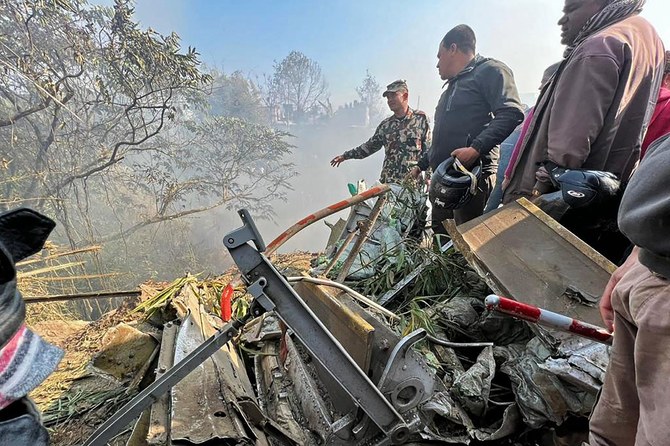
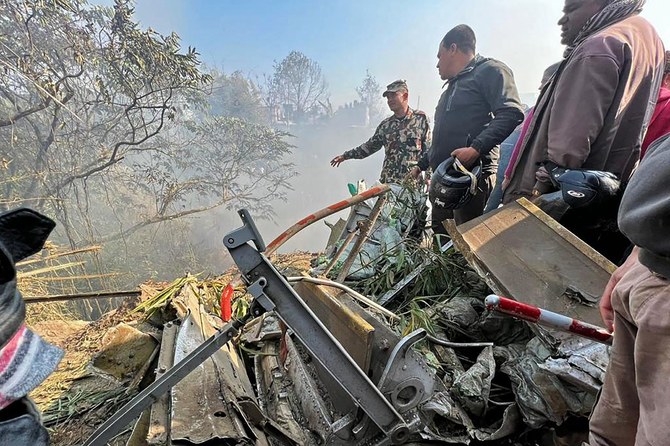
Local resident Bishnu Tiwari, who rushed to the crash site near the Seti River to help search for bodies, said the rescue efforts were hampered by thick smoke and a raging fire.
“The flames were so hot that we couldn’t go near the wreckage. I heard a man crying for help, but because of the flames and smoke we couldn’t help him,” Tiwari said.
It was not immediately clear what caused the accident, Nepal’s Civil Aviation Authority said.
A witness said he saw the aircraft spinning violently in the air after it began landing, watching from the terrace of his house. Finally, Gaurav Gurung said, the plane fell nose-first toward its left and crashed into the gorge.
The aviation authority said the aircraft last made contact with the airport from near Seti Gorge at 10:50 a.m. before crashing.
The twin-engine ATR 72 aircraft, operated by Nepal’s Yeti Airlines, was flying from the capital, Katmandu, to Pokhara, located 200 kilometers (125 miles) west. It was carrying 68 passengers including 15 foreign nationals, as well as four crew members, Nepal’s Civil Aviation Authority said in a statement. The foreigners included five Indians, four Russians, two South Koreans, and one each from Ireland, Australia, Argentina and France.
Images and videos shared on Twitter showed plumes of smoke billowing from the crash site, about 1.6 kilometers (nearly a mile) away from Pokhara International Airport. The aircraft’s fuselage was split into multiple parts that were scattered down the gorge.
Firefighters carried bodies, some burned beyond recognition, to hospitals where grief-stricken relatives had assembled. At Katmandu airport, family members appeared distraught as they were escorted in and at times exchanged heated words with officials as they waited for information.
Tek Bahadur K. C., a senior administrative officer in the Kaski district, said he expected rescue workers to find more bodies at the bottom of the gorge.
Images and videos shared on Twitter showed plumes of smoke billowing from the crash site as rescue workers, Nepali soldiers, and crowds of people gathered around the wreckage of the aircraft to find survivors. The aircraft’s fuselage was split into multiple parts that were scattered down the gorge.
Prime Minister Pushpa Kamal Dahal, who rushed to Tribhuvan International Airport in Katmandu after the crash, set up a panel to investigate the accident.
”The incident was tragic. The full force of the Nepali army, police has been deployed for rescue,” he said.
South Korea’s Foreign Ministry said in a statement that it’s still trying to confirm the fate of two South Korean passengers and has sent staff to the scene. The Russian Ambassador to Nepal, Alexei Novikov, confirmed the death of four Russian citizens who were on board the plane.
Pokhara is the gateway to the Annapurna Circuit, a popular hiking trail in the Himalayas. The city’s new international airport began operations only two weeks ago.
The type of plane involved, the ATR 72, has been used by airlines around the world for short regional flights. Introduced in the late 1980s by a French and Italian partnership, the aircraft model has been involved in several deadly accidents over the years.
In Taiwan two earlier accidents involving ATR 72-500 and ATR 72-600 aircrafts happened just months apart.
In July 2014, a TransAsia ATR 72-500 flight crashed while trying to land on the scenic Penghu archipelago between Taiwan and China, killing 48 people onboard. An ATR 72-600 operated by the same Taiwanese airline crashed shortly after takeoff in Taipei in February 2015 after one of its engines failed and the second was shut down, apparently by mistake.
The 2015 crash, captured in dramatic footage that showed the plane striking a taxi as it hurtled out of control, killed 43, and prompted authorities to ground all Taiwanese-registered ATR 72s for some time. TransAsia ceased all flights in 2016 and later went out of business.
ATR identified the plane involved in Sunday’s crash as an ATR 72-500 in a tweet. According to plane tracking data from flightradar24.com, the aircraft was 15 years old and “equipped with an old transponder with unreliable data.” It was previously flown by India’s Kingfisher Airlines and Thailand’s Nok Air before Yeti took it over in 2019, according to records on Airfleets.net.
Yeti Airlines has a fleet of six ATR72-500 planes, company spokesperson Sudarshan Bartaula said.
Nepal, home to eight of the world’s 14 highest mountains, including Mount Everest, has a history of air crashes. According to the Flight Safety Foundation’s Aviation Safety database, there have been 42 fatal plane crashes in Nepal since 1946.
Sunday’s crash is Nepal’s deadliest since 1992, when all 167 people aboard a Pakistan International Airlines plane were killed when it plowed into a hill as it tried to land in Katmandu.
The European Union has banned airlines from Nepal from flying into the 27-nation bloc since 2013, citing weak safety standards. In 2017, the International Civil Aviation Organization cited improvements in Nepal’s aviation sector, but the EU continues to demand administrative reforms.


![]()
68 dead, 4 missing after Nepal’s worst air crash in 30 years
Short Url
https://arab.news/j3bu8
68 dead, 4 missing after Nepal’s worst air crash in 30 years
- A witness said he saw the aircraft spinning violently in the air after it began landing, watching from the terrace of his house
- The twin-engine ATR 72 aircraft, operated by Nepal’s Yeti Airlines, was flying from the capital, Katmandu, to Pokhara


Latest updates


Recommended


© 2026 SAUDI RESEARCH & PUBLISHING COMPANY, All Rights Reserved And subject to Terms of Use Agreement.