



COLOMBO/DUBAI: When Ibn Battuta arrived in northern Sri Lanka, the ruler of the Jaffna Kingdom greeted him with pearls more beautiful than any he had ever seen in his life.
The famed Moroccan explorer’s ship arrived in Puttalam in September 1344, and he spent a few days on the island, entertaining the king who was interested in his voyages, and visiting Adam’s Peak, a mountain venerated by Muslim pilgrims as the site of the footprint of the first man and prophet.
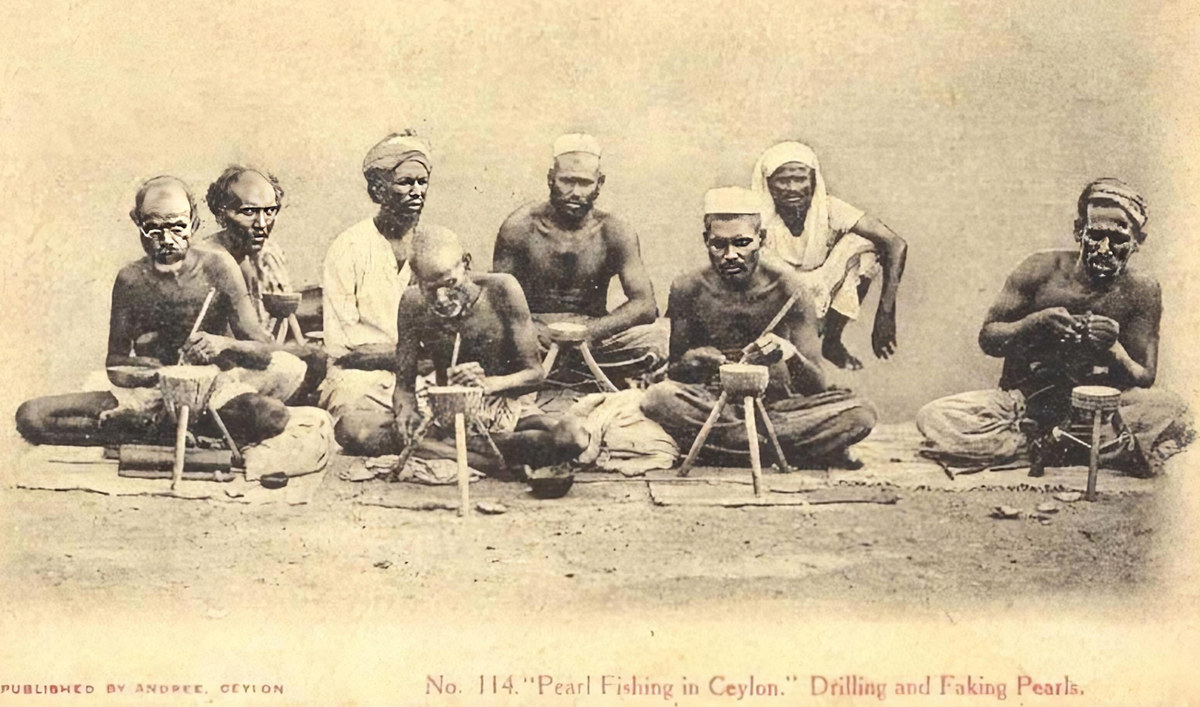
Ibn Battuta recorded the journey in his “Travels,” and gave a detailed description of it, focusing much of his attention on pearl reefs and pearl hunting — one of the main revenue earners for the Jaffna king’s coffers.
He wrote in his memoir that the gems he was gifted were “wonderful pearls, the biggest and most beautiful pearls in the world!”
But he was not the island’s first Arab visitor.
Those who arrived in Sri Lanka centuries before Ibn Battuta were the ones that developed pearl fishing, and who lifted the gemstone, formed by mollusks, into becoming the island’s most valuable aquatic resource.
The archival illustration from a German publication dated 1909 shows Sri Lankan fishermen processing pearl mollusks. (AN Photo)
Abdul Raheem Jesmil, development officer at Sri Lanka’s Department of Archeology, whose research focuses on the history of Sri Lankan Muslims, estimates that the first Arab visitors to the island arrived in pre-Islamic times, around the 3rd century B.C.
At that time, the trade with the island was entirely in the hands of Arabs who came mainly from the Arabian Peninsula and parts of Mesopotamia.
“They came in search of spices such as cardamom, cinnamon, cloves, and white pepper,” Jesmil said.
“When they stayed here, they found that some parts of the island’s ocean were full of pearls ... They diverted their businesses to pearl diving.”
Pearl diving has been practiced for thousands of years and in many communities of the Arabian Gulf was the main source of wealth in ancient times. Men from these regions would spend months on expeditions at sea during the pearling season, while families awaited them on the shore and performed rituals for their safety.
When Arab traders reached Sri Lanka, they immediately understood the wealth of its pearl beds and explored the island’s northwestern coast.
Pearls were initially found mostly in oysters in the Gulf of Mannar, off the towns of Mannar, Chilaw and Kalpitiya.
They were highly valued among the aristocracy of ancient Rome, where chroniclers in the 2nd century A.D. recorded how they were brought by ships that chartered the Indian Ocean or by caravans.
As the industry grew in importance and expanded over centuries, divers also began to explore the areas south of the pearl-rich gulf.
“They found new places from Beruwala to Hambantota, which run from the western coast to the southern,” Jesmil told Arab News, adding that the industry was so lucrative that many of the Arab pearl traders settled down in Sri Lanka and married local women, mostly from the Tamil communities that were involved in their business.
While little is known about any remaining artifacts documenting the presence of pre-Islamic merchants from the Middle East, after the advent of Islam such evidence is abundant, especially as the Arab influence also entered the sphere of culture and religion.
“The first mosque in Sri Lanka was built by these Arabs ... Al-Abrar Mosque stands a monument of Arabian culture,” Jesmil said, referring to a mosque in Beruwala that was built in 920 A.D. It is the oldest remaining —and widely considered to be the first —mosque in Sri Lanka.
Later manuscripts by Europeans indicate that until the 19th century the gathering of pearl shells from the sea, processing of them, and trading were dominated by Arabs and Tamils, who were considered the best divers.
For one century, pearl fisheries were under the control of the Portuguese who entered a pact with coastal communities in Mannar. During that time, the industry reportedly employed some 50,000 people. When the Dutch expelled the Portuguese in the mid-17th century, they expanded it to 200,000 employees.
It was under another colonial power, Britain, which took over a century later, that pearl fishing began to struggle. The waters which used to be one of the most abundant sources of natural pearls in the world for more than two millennia, started to lose their oyster colonies.
After the British made a series of unsuccessful experiments in reviving the industry, in the 1920s it received a final blow with the introduction of the cultured pearl by the Japanese.
Some pearl hunting continued after Sri Lanka gained independence, but today it is nearly extinct.
While Sri Lanka is still a well-known jewelry producer, the gemstones that once gained its fame are no longer in the spotlight.
Rizan Nazeer, chief executive of the annual FACETS Sri Lanka International Gem and Jewelry Trade Show in Colombo, said that the pearls used by local artisans are hardly ever native ones.
“Pearl fishing is a dying industry in Sri Lanka, the gemstones have been superseded,” he said.
“We get pearls from Japan and Australia.”


