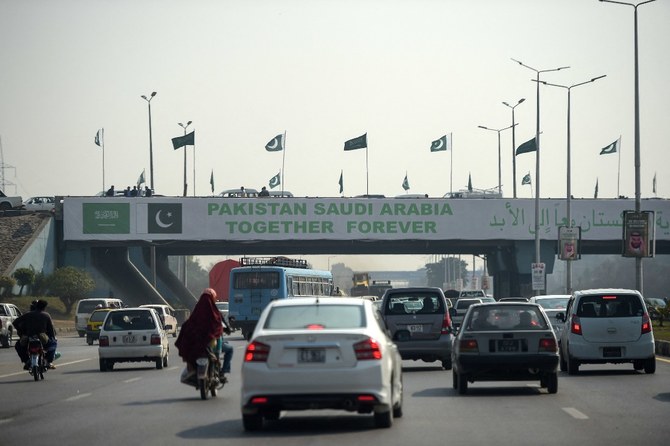
ISLAMABAD: The possibility of expanding Saudi investment will be a welcome relief to Pakistan, experts and business leaders told Arab News, as Riyadh plans to consider a major funding boost in the South Asian nation’s troubled economy.
As Pakistan’s foreign exchange reserves remain under pressure due to upcoming debt repayments, Crown Prince Mohammed bin Salman earlier this week directed authorities and the Saudi Fund for Development to see if the Kingdom’s investment could be lifted to $10 billion and deposits in the Pakistani central bank raised to $5 billion.
It is not the first time in the recent past that Pakistan has looked to Saudi Arabia to deal with the challenges posed by low reserves and maturing debts. In 2021, the SFD deposited $3 billion in the State Bank of Pakistan, and while other countries demanded their deposits back after maturity, the Saudi funds remained in the system in 2022 when Islamabad requested a repayment extension.
Immediately after the crown prince’s decision was announced, Prime Minister Shehbaz Sharif said on Wednesday that Pakistan was “immensely grateful,” echoing the sentiment of the country’s business community.
“The entire Pakistani nation is extremely grateful for the directives. In the current time of political and economic uncertainty, this news comes as a breath of fresh air for all of us,” Sardar Yasir Ilyas Khan, former chairman of the Islamabad Chamber of Commerce and Industry, told Arab News.
“There is a lot of potential, and Saudi Arabia’s expertise in this segment with regard to their public investment fund and holding the largest sovereign wealth fund in the world gives them a huge advantage.”
Pakistan was cash-strapped after a deadlock with the International Monetary Fund over tax targets delayed the disbursal of another tranche of its bailout program. The situation worsened when the worst floods in decades hit the country in July-October and cut its economic growth by half.
Khaqan Najeeb, former adviser at the Ministry of Finance, said that Pakistan is going through a severe dollar liquidity crunch, and an injection of funds into the central bank’s reserves could help ease the problem.
Foreign investment also was desperately needed.
“Discussions must commence with the Saudis, as they have said that they could study up to $10 billion of investment in Pakistan,” Najeeb said.
“Pakistan is a country starved for the FDI (foreign direct investment). Our FDI over the last couple of years has come down to under a $2 billion mark, which for a country like Pakistan is not enough. In the last couple of months of this financial year of 2023, our FDI has halved compared with the same period last year.”
But the Pakistani government needs to do its homework to make investments from the Kingdom sustainable and also attract private sector stakeholders.
With the Kingdom showing interest in Pakistan’s refining and industry, economist Ali Salman highlighted the need for policy incentives to mobilize projects with Saudi businesses.
“We hope that the government of Pakistan will come up with a favorable oil refinery policy which will then attract investment from Saudis,” he said.
Businesses are hopeful that with Saudi support the country’s financial situation will soon get back on track.
“I am expecting that in near future, within three to four months, the situation will start to normalize,” Khurshid Burlas, chairman of the regional coordination committee at the Rawalpindi Chamber of Commerce and Industry, told Arab News.
“We are expecting (that) due to all this support, Pakistan will come out of this economic crisis.”


![]()

$10bn Saudi investment hope brings ‘fresh air’ to Pakistan’s troubled economy
Short Url
https://arab.news/5qfyf
$10bn Saudi investment hope brings ‘fresh air’ to Pakistan’s troubled economy
- Crown prince directed authorities this week to see if Saudi investment could be raised to $10 billion
- Saudi Fund for Development will review increasing deposits in Pakistan’s central bank to $5 billion


Latest updates


© 2026 SAUDI RESEARCH & PUBLISHING COMPANY, All Rights Reserved And subject to Terms of Use Agreement.