


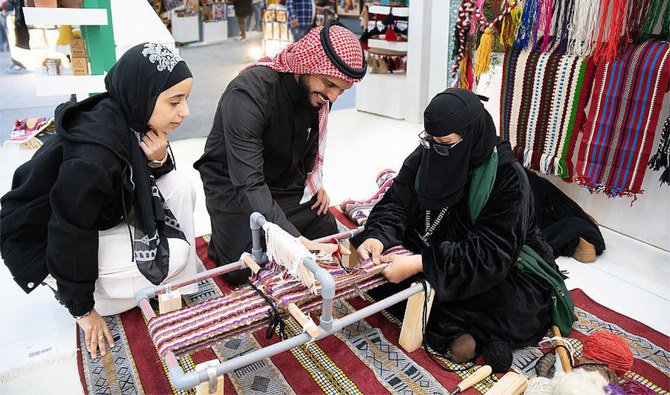
CAIRO: The art of Al-Sadu weaving attracted large crowds to the Saudi Arabia pavilion at the Bayt Al-Arab exhibition in Cairo that concluded on Wednesday.
Badriya Al-Mutairi, a participant weaving Al-Sadu at the Saudi pavilion, said that she learned the art aged five from her mother and grandmother.
“Only women practice this Bedouin craft and the first thing I learned was cleaning wool, washing it with water and hanging it to air-dry,” she said.
Al-Mutairi added: “The first stage begins with shearing goat hair, sheep wool, or camel hair, then digging up the wool by hand to clean it, wash it and hang it to dry.
“We then spin the wool and turn it into threads that are wrapped in the form of a ball called a ‘duja,’ after which the weaving process begins in which Al-Sadu threads are connected to each other.”
Today, the traditional art can be seen on modern products such as mobile phone covers, bracelets and bags.
The art of Al-Sadu has been registered in UNESCO’s list of intangible cultural heritage. Al-Mutairi is proud that the Kingdom’s government has made tremendous efforts in preserving, sustaining and promoting Saudi culture locally and globally.
Al-Mutairi, who has accredited training certificates from the Technical and Vocational Training Corporation and the Royal Institute for Traditional Arts, has trained hundreds of young women in Al-Sadu weaving in order to preserve the art.
She also praised the efforts of the Social Development Bank in helping train young women from around the Kingdom in learning the art of Al-Sadu and showcasing the technique in international exhibitions.
Thirteen countries took part in Bayt Al-Arab, with about 150 family businesses exhibiting — 70 from Egypt and 80 from other Arab countries.


