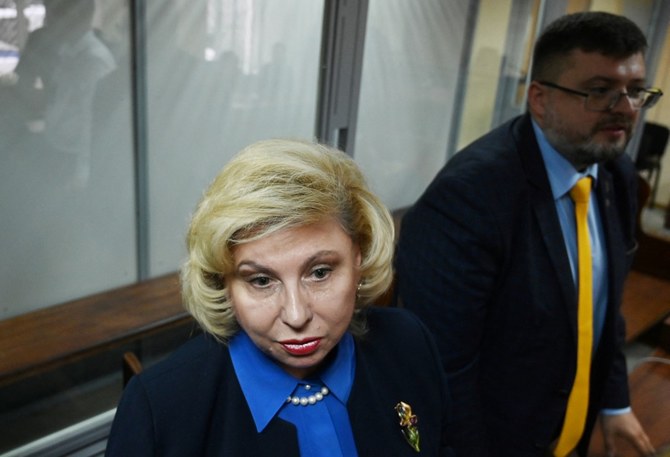
Ankara: Russia and Ukraine have not reached a new prisoner exchange agreement during talks in Turkiye, Moscow’s envoy told AFP on Thursday, saying her earlier remarks about a swap were misinterpreted.
Russian Human Rights Commissioner Tatyana Moskalkova held rare talks in Ankara on Wednesday with her Ukrainian counterpart Dmytro Lubinets.
Turkish state media later quoted her as telling reporters that they had agreed to exchange “more than 40 prisoners” from each side.
But Moskalkova told AFP that those comments referred to the number of people the sides had already exchanged in the past.
“Someone misunderstood something,” Moskalkova said on the sidelines of an international conference in the Turkish capital.
“We were talking about the results of our past work. These exchanges already happened.”
Moskalkova added that she and Lubinets had exchanged lists of wounded soldiers in preparation for a possible future swap.
“Such exchanges happen all the time. These agreements are reached by the military, and we work jointly with them.”
The warring sides have held few direct contacts since Russia invaded its neighbor 11 months ago.
But Turkish President Recep Tayyip Erdogan has tried to use his good relations with both Moscow and Kyiv to arrange peace talks.
Erdogan said on Wednesday that he backed the idea of setting up a permanent “humanitarian corridor” in war zone.
Moskalkova called it a “very important proposal” that still needed to be agreed with Russian President Vladimir Putin.
“The return of the wounded is a constant subject of our discussions, and Mr.Erdogan proposed a new way of solving this issue,” she said.
“This will probably still need to be discussed with Russian President Putin, and with the state agencies involved in this line of work.”

No new Russia-Ukraine prisoner swap deal in Turkiye talks: Moscow
https://arab.news/5p2sp
No new Russia-Ukraine prisoner swap deal in Turkiye talks: Moscow
- Turkish state media quoted her telling reporters that they had agreed to exchange “more than 40 prisoners” from each side
A month on, flood-struck Aceh still reels from worst disaster since 2004 tsunami
- Aceh accounts for almost half of death toll in Sumatra floods that struck in November
- Over 450,000 remain displaced as of Friday, as governor extended state of emergency
JAKARTA: Four weeks since floodwaters and torrents of mud swept across Aceh province, villages are still overwhelmed with debris while communities remain inundated, forced to rely on each other to speed up recovery efforts.
The deadly floods and landslides, triggered by extreme weather linked to Cyclone Senyar, hit the provinces of North Sumatra, West Sumatra and Aceh in late November.
Aceh, the westernmost province of Indonesia, was the worst-hit. Accounting for almost half of the 1,137 death toll, a month later more than 450,000 people are still unable to return to their homes, as many struggle to access clean water, food, electricity and medical supplies.
“We saw how people resorted to using polluted river water for their needs,” Ira Hadiati, Aceh coordinator for the Medical Emergency Rescue Committee, or MER-C, told Arab News on Friday.
Many evacuation shelters were also lacking toilets and washing facilities, while household waste was “piling up on people’s lawns,” she added.
In many regions, people’s basic needs “were still unmet,” said Annisa Zulkarnain, a volunteer with Aceh-based youth empowerment organization Svara.
“Residents end up helping each other and that’s still nowhere near enough, and even with volunteers there are still some limitations,” she told Arab News.
Volunteers and aid workers in Aceh have grown frustrated with the central government’s response, which many have criticized as slow and ineffective.
And Jakarta continues to ignore persistent calls to declare the Sumatra floods a national disaster, which would unlock emergency funds and help streamline relief efforts.
“It seems like there’s a gap between the people and the government, where the government is saying that funds and resources have been mobilized … but the fact on the ground shows that even to fix the bridges, it’s been ordinary people working together,” Zulkarnain said.
After spending the past two weeks visiting some of the worst-affected areas, she said that the government “really need to speed up” their recovery efforts.
Aceh Gov. Muzakir Manaf extended the province’s state of emergency for another two weeks starting Friday, while several district governments have declared themselves incapable of managing the disasters.
Entire villages were wiped out by the disastrous floods, which have also damaged more than 115,000 houses across Aceh, along with 141 health facilities, 49 bridges, and over 1,300 schools.
The widespread damage to roads and infrastructure continue to isolate many communities, with residents traveling for hours on foot or with motorbikes in search of basic supplies.
“Even today, some areas are still inundated by thick mud and there are remote locations still cut off because the bridges collapsed. For access, off-road vehicles are still required or we would use small wooden boats to cross rivers,” Al Fadhil, director of Geutanyoe Foundation, told Arab News.
“From our perspective, disaster management this time around is much worse compared to how it was when the 2004 tsunami happened.”
When the Indian Ocean earthquake and tsunami struck in 2004, Aceh was the hardest-hit of all, with the disasters killing almost 170,000 people in the province.
But MER-C’s Hadiati said that the impact of the November floods and landslides is “more extensive and far worse than the tsunami,” as 18 Acehnese cities and regencies have been affected — about twice more than in the 2004 disaster.
As Friday marks 21 years since the cataclysmic tsunami, Fadhil said the current disaster management was “disorganized,” and lacked leadership and coordination from the central government, factors that played a crucial role after 2004.
“The provincial and district governments in Aceh, they’ve now done all they could with what they have,” he said.
“But their efforts stand against the fact that there’s no entry of foreign aid, no outside support, and a central government insisting they are capable.”


