

Saudi mining sector needs small, nimble firms to grow metals industry: Ajlan Bros official 

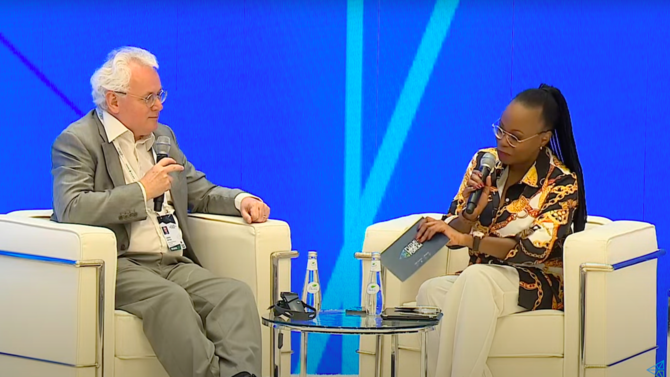
Lamon Rutten, CEO of KSA Mining & Metals Exchange (Screenshot)
Short Url
Updated 12 January 2023
Follow

Saudi mining sector needs small, nimble firms to grow metals industry: Ajlan Bros official 

RIYADH: Saudi Arabia’s mining sector needs to create small and flexible upstream and downstream firms to boost innovation in the metals industry, according to the CEO of the mining exchange business within Ajlan Bros.

In an interview during the second day of the Future Minerals Forum in Riyadh, Lamon Rutten said in order to meet the sector’s rising demand, the Kingdom should consider letting some of their staff go to create their own services companies since smaller, more nimble companies are more cost effective.

“Small companies are often way better suited for jobs that require a more nimble approach, lower overheads, and different types of risk appetite,” the CEO of KSA Mining & Metals Exchange explained.

These smaller companies are usually set up by people who worked for the big international companies, so they developed the skills and often have decades of experience. They are also aware of the appropriate level of quality that they are expected to provide, Rutten elaborated.

“Over the past ten years junior miners accounted for 25 percent of exploration expenditure in Australia and they accounted for 75 percent of discoveries,” he disclosed.

What these smaller companies lack, however, is proper capital. This is why making room for raising public funds for these smaller companies is crucial, the CEO stressed.

Currently, the Saudi Stock Exchange, also known as Tadawul, has two platforms: the main market for big companies – referred to as TASI - and another parallel market for smaller companies – referred to as Nomu.

“So what you need is an exchange that allows these smaller companies to list the same way as smaller mining companies can now list in the main market in South Africa, Canada, and Australia but impossible to list on TASI,” Rutten highlighted.

Nevertheless, in order for this to happen, companies, investors, and financial intermediaries need to undergo a educational process that better equips them for listing on the main market.

“For investors, it requires, if you want, a more long-term view on investments, portfolio thinking – it's again a big educational process. For the regulators who are supposed to determine what instruments can be offered to investors, it requires also a completely different way of thinking,” Rutten concluded.

The second edition of the Future Minerals Forum began on Jan. 10 with a ministerial roundtable, followed by two days of meetings and addresses involving more than 200 speakers from around the world.

Topics under discussion include sustainability, the future of mining, and energy transition, as well as the contribution of minerals to the development of societies, digital transformation, and integrated value chains.

The forum comes as Saudi Arabia is deemed to be on track to become a “global leader” in the mining industry thanks to the Kingdom’s “welcoming investment climate” according to a report from The Payne Institute for Public Policy at the Colorado School for Mines in the US, issued in December.

Currently, the Kingdom is processing 145 exploration license applications sent in by foreign companies, according to the analysis.

According to geological surveys dating back 80 years, the Kingdom is thought to have an estimated reserve of untapped mining potential valued at $1.3 trillion.

However, with the prices of valuable minerals rising, especially gold, copper and zinc, the true value of the Kingdom’s current mineral wealth could be double that figure, CEO of the Saudi Geological Survey Abdullah Al-Shamrani said in September 2022.


‘The future is renewables,’ Indian energy minister tells World Economic Forum

Updated 22 January 2026
Follow

‘The future is renewables,’ Indian energy minister tells World Economic Forum

  • ‘In India, I can very confidently say, affordability (of renewables) is better than fossil fuel energy,’ says Pralhad Venkatesh Joshi during panel discussion
  • Renewables are an increasingly important part of the energy mix and the technology is evolving rapidly, another expert says at session titled ‘Unstoppable March of Renewables?’

BEIRUT: “The future is renewables,” India’s minister of new and renewable energy told the World Economic Forum in Davos on Wednesday.
“In India, I can very confidently say, affordability (of renewables) is better than fossil fuel energy,” Pralhad Venkatesh Joshi said during a panel discussion titled “Unstoppable March of Renewables?”
The cost of solar power has has fallen steeply in recent years compared with fossil fuels, Joshi said, adding: “The unstoppable march of renewables is perfectly right, and the future is renewables.”
Indian authorities have launched a major initiative to install rooftop solar panels on 10 million homes, he said. As a result, people are not only saving money on their electricity bills, “they are also selling (electricity) and earning money.”
He said that this represents a “success story” in India in terms of affordability and “that is what we planned.”
He acknowledged that more work needs to be done to improve reliability and consistency of supplies, and plans were being made to address this, including improved storage.
The other panelists in the discussion, which was moderated by Godfrey Mutizwa, the chief editor of CNBC Africa, included Marco Arcelli, CEO of ACWA Power; Catherine MacGregor, CEO of electricity company ENGIE Group; and Pan Jian, co-chair of lithium-ion battery manufacturer Contemporary Amperex Technology.
Asked by the moderator whether she believes “renewables are unstoppable,” MacGregor said: “Yes. I think some of the numbers that we are now facing are just proof points in terms of their magnitude.
“In 2024, I think it was 600 gigawatts that were installed across the globe … in Europe, close to 50 percent of the energy was produced from renewables in 2024. That has tripled since 2004.”
Renewables are an increasingly important and prominent part of the energy mix, she added, and the technology is evolving rapidly.
“It’s not small projects; it’s the magnitude of projects that strikes me the most, the scale-up that we are able to deliver,” MacGregor said.
“We are just starting construction in the UAE, for example. In terms of solar size it’s 1.5 gigawatts, just pure solar technology. So when I see in the Middle East a round-the-clock project with just solar and battery, it’s coming within reach.
“The technology advance, the cost, the competitiveness, the size, the R&D, the technology behind it and the pace is very impressive, which makes me, indeed, really say (renewables) is real. It plays a key role in, obviously, the energy demand that we see growing in most of the countries.
“You know, we talk a lot about energy transition, but for a lot of regions now it is more about energy additions. And renewables are indeed the fastest to come to market, and also in terms of scale are really impressive.”
Mutizwa asked Pan: “Are we there yet, in terms of beginning to declare mission accomplished? Are renewables here to stay?”
“I think we are on the road but (its is) very promising,” Pan replied. There is “great potential for future growth,” he added, and “the technology is ready, despite the fact that there are still a lot of challenges to overcome … it is all engineering questions. And from our perspective, we have been putting in a lot of resources and we are confident all these engineering challenges will be tackled along the way.”
Responding to the same question, Arcelli said: “Yes, I think we are beyond there on power, but on other sectors we are way behind … I would argue today that the technology you install by default is renewables.
“Is it a universal truth nowadays that renewables are the cheapest?” asked Mutizwa.
“It’s the cheapest everywhere,” Arcelli said.