

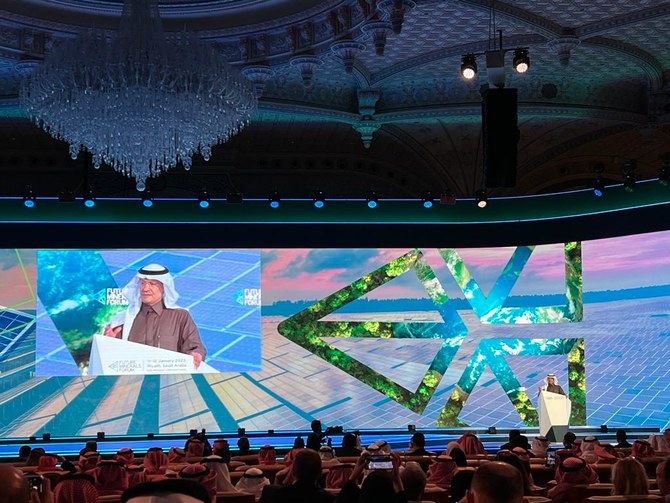
Saudi energy minister reveals minerals discovery boom in key Future Minerals Forum address

Prince Abdulaziz bin Salman addressing the Future Minerals Forum (Screenshot)
Short Url
Updated 11 January 2023
Follow

Saudi energy minister reveals minerals discovery boom in key Future Minerals Forum address

RIYADH: Uranium and titanium have been discovered in “significant quantities” in Saudi Arabia, according to the Kingdom’s energy minister as he set out the government’s plans to be a global leader in the mining sector.

Speaking at the Future Minerals Forum in Riyadh, Prince Abdulaziz bin Salman talked up the expansions of Saudi Arabia’s mission in developing renewable energy, as well as the Kingdom’s ambition to become a global hub for green metal industries which will lead to more investment in the sector.

He also stated that the Kingdom has an abundance of metals and minerals now greatly in demand in the world and is developing the structure and partnerships that can exploit them to the best advantage.

“Recent explorations of activities showed a diverse portfolio of uranium in different geological locations within the Kingdom such as Jabal Saeed, Madinah, Jabal Qariah in the north,” said the minister, adding: “Along with uranium, rare minerals such as titanium have been identified in significant quantities in the Kingdom, unlocking even greater investment opportunities.”

During a fireside chat, Prince Abdulaziz discussed his aim of utilizing the second edition of the FMF as a “stage for us as Saudi Arabia to reconfigure the perception of Saudi Arabia.”

He went on: “Saudi Arabia is of course a leading global oil industry and we are well on the way to becoming a global leader in all forms of clean energy encompassing hydrocarbons, renewable and clean hydrogen to complement our artificial skills in oil and gas.”

The minister said the government has set “ambitious targets for its energy mix”, and this will require “a large scale of deployment of solar, wind and battery storage projects across the Kingdom”.

“Manufacturing these components will also create a demand surge for minerals like copper, aluminum, zinc, nickel, lithium, and silicon,” he added.

However, extracting these minerals must fit in with the Kingdom’s sustainability and economic diversification plans.

“Saudi Arabia is committed to the development and securing of the key metals and minerals needed for localization of the supply chain and to pursue the goal of cleaner energy,” said the minister..

Prince Abdulaziz concluded his speech by highlighting the efforts of the Saudi people in the Kingdom to the many local and international guests of the forum.

“I ask you not to believe me or any speaker that may come before me or after me. I would ask you to float around, go to the alleys and go to the streets, walk into the office buildings and see the real energy of Saudi Arabia – it is the youth of Saudi Arabia, it is the women and men that are making these things a reality,” he said.

The minister also discussed that all new gas power plants in Saudi Arabia on Jan. 20 in Taiba and Qassim will be carbon capture enabled.

“Clean hydrogen is a focus of our investment with the largest clean hydrogen hub in the world planned in the Kingdom, this ambitious program will make the Kingdom a clean energy industry destination with reduced footprint,” he said.


Saudi Cabinet approves regulatory frameworks for 4 SEZs 

Updated 58 min 41 sec ago
Follow

Saudi Cabinet approves regulatory frameworks for 4 SEZs 

RIYADH: Saudi Arabia has formalized the regulatory frameworks for four Special Economic Zones located in Jazan, Cloud Computing Zone, King Abdullah Economic City, and Ras Al-Khair.

These zones are designed to stimulate investment by offering tailored incentives and governance, enhancing the Kingdom’s competitive edge in sectors such as advanced manufacturing, maritime logistics, cloud technology, and energy-related industries, the Saudi Press Agency reported.  

The SEZ initiative is part of Saudi Arabia’s broader economic transformation plan under Vision 2030, which aims to diversify the economy beyond oil revenues and develop new engines of growth through foreign direct investment and infrastructure development.  

Saudi Minister of Investment Khalid Al-Falih expressed his appreciation for the Cabinet’s approval of the SEZ regulations, stating in a tweet: “I extend my sincere thanks and gratitude to the leadership, may God support it, for its continued support of efforts to enhance the business environment, attract investments, and diversify and raise the competitiveness of the national economy, through the essential step embodied in the Cabinet’s approval of the regulatory frameworks for the Special Economic Zones.”  

The session, presided over by King Salman bin Abdulaziz Al Saud, included the approval of a wide range of cooperation agreements and memoranda of understanding.   

These included an MoU on energy cooperation with Pakistan, healthcare collaboration with Iraq, and a digital communication pact with Palestine.   

Additional approvals involved cooperation with the Hungarian judiciary, as well as agreements with UNESCO and the World Economic Forum.  

Notably, the Cabinet approved the establishment of a commercial and economic office for the Hong Kong Special Administrative Region in Riyadh, underlining growing bilateral trade and investment ties between Saudi Arabia and Asian financial hubs.  

On infrastructure, the Council noted the launch of phase three of the major road development program in Riyadh, which aims to enhance connectivity and transform the city into a regional center for sustainable transport and logistics services.  

Other approvals included Saudi Arabia’s accession to the Beijing 2010 Convention on the suppression of unlawful acts relating to international civil aviation, and revisions to the governance of the General Authority for Defense Development.  

The Cabinet also endorsed the closure of the national and regional tourism development councils and approved the final accounts of several government agencies.  

It directed further review on annual performance reports submitted by regulatory bodies and strategic institutes, including those focusing on food security, export development, and communications.  

Several high-level appointments and promotions in the foreign ministry and other government bodies were confirmed during the session, reflecting the Kingdom’s ongoing administrative reforms and leadership renewal across key sectors.