


CHICAGO: Prominent European politicians on Tuesday urged their governments to more forcefully condemn the violent response by the regime in Iran to the ongoing protests in the country and the suppression of protesters’ rights.
During a conference at the Press Club Brussels, organized by the International Committee in Search of Justice, several former members of the European parliament called for the closure of Iranian embassies and the expulsion of diplomats, and for all European countries to “end their hypocrisy” by also closing their own embassies in Iran.
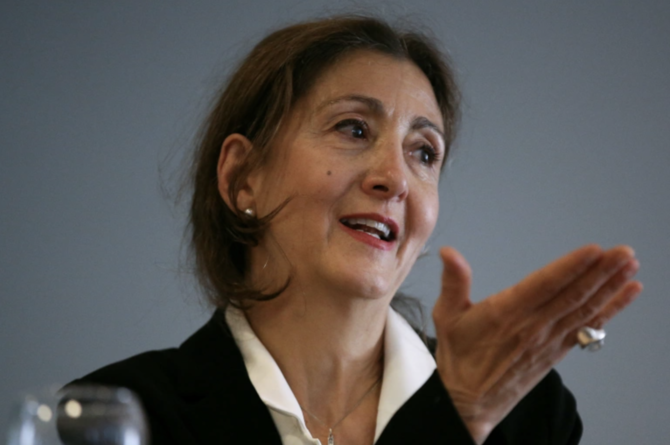
The speakers at the event included: Alejo Vidal Quadras, president of the ISJ and a former first vice-president of the European Parliament; Struan Stevenson, chair of the ISJ Committee on the Protection of Political Freedoms in Iran and a former member of the European Parliament (1999-2014); and Ingrid Betancourt, a Colombian presidential candidate who was held hostage by guerrillas in her home country for more than six years.
Betancourt, who also holds French citizenship, said European governments should immediately recall their ambassadors from Iran, adding that embassies “have to be shut” and the world needs to show “courage.”
She praised the protesters in Iran for the continuing demonstrations, which began on Sept. 16 last year and have primarily been led by women. They began shortly after the death in police custody of 22-year-old Mahsa Amini, who had been arrested for not correctly covering her hair in accordance with the regime’s strict dress codes.
The response from authorities in Tehran has been a brutal attempt to suppress the unrest. The speakers said that estimates suggest more than 500 civilians have been executed so far, many of them hanged in public from cranes.
“This is the first revolution conducted by women … and while women are fighting for their rights, men are being attacked and persecuted by the regime, too — everyone,” said Betancourt.
“These women, at this moment, are putting their lives at stake and they are doing this for all of us, all of the women in the world … if we don’t get this right, we won’t be able to get any other issues right in the world. … This is about mankind, humankind.”
Betancourt accused the Iranian regime of targeting its critics with terrorist attacks in an attempt to silence their support for the protesters.
“If they have … to kill their youth, imagine what they are doing to their country,” she said, before criticizing other nations for failing to act.
“We are not doing anything. I am offended by the lack of action our governments are having with what is going on in Iran,” Betancourt added.
Late last year, Belgian Prime Minister Alexander De Croo was criticized by ISJ members for signing a prisoner-swap treaty with the Iranian regime. Their protest, signed by 21 former European ministers and dignitaries, urged Belgian authorities not to include convicted terrorists in the treaty, in particular terrorist mastermind Assadollah Assadi, who was sentenced in 2021 to 20 years in prison in Belgium for his role in a plot to bomb a gathering of Iranian opposition group the National Council of Resistance of Iran.
Quadras said many European countries have not been forceful enough in their condemnation of the Iranian regime’s violence against civilian protesters and called for the establishment of an alternative government in the country that would respect human and civil rights.
“It’s not a question of replacing one dictatorship for another dictatorship,” he said. “The alternative must ensure the change from dictatorship to democracy.”
Democracy was undermined in 1953, Quadras said, when the UK and the US orchestrated a coup that toppled the democratically elected Iranian government. That, he said, led to the rise of tyranny in Iran, first from the former Shah of Iran and later by the ayatollahs.
Stevenson said more than 500 people have been executed as a result of the current protests, including five professors. Despite this, he said, the regime has “failed” to end the protests. He added that it has also stepped up its campaign of misinformation, falsely labeling opposition group the People’s Mojahedin Organization of Iran, also known as MEK, as “Islamist” and “Marxist.”
The MEK is an Iranian political-militant organization that advocates the overthrow of the Islamic Republic and installing Rajavi as the country’s new, democratic leader.
“The West has fallen for it,” Stevenson said. “But in the past 40 years, the MEK has been the first and only resistance to the tyrannical regime” in Iran and has exposed its brutality.
As if to prove his point, during a question-and-answer session after the conference, the first question was from an audience member who accused MEK leader Rajavi of being an Islamist. All of the speakers denounced the claim as “false propaganda” typical of the misinformation promoted by the Iranian regime to counter the negative media coverage of its own brutality. Stevenson once again said governments should close Iranian embassies on their soil and expel the diplomats and staff.
“There must be no impunity for the people responsible for these atrocities,” he said. “They must be held to account for these crimes.
“If we remain silent it will lead to more executions. But words alone won’t stop these executions — withdraw our ambassadors from Iran, close their embassies and expel all their regime aides out of our territories and out of Europe. And then we can look at restoring democracy.”
The conference was streamed live on Twitter. The speakers’ presentations are included in a newly published 78-page ISJ report titled “Iran’s Democratic Revolution,” which examines the current uprising from a number of political, human rights, strategic and international angles.


