

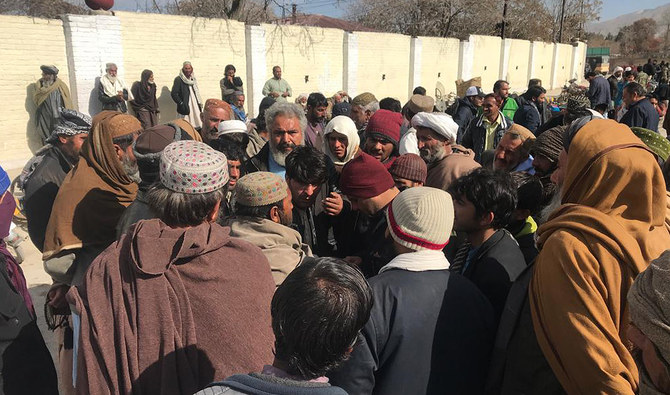

QUETTA: Residents in the southwestern Pakistani city of Quetta on Monday blocked a key highway as they protested a delay in the provision of subsidized flour, amid a wheat crisis in the impoverished Balochistan province.
Balochistan has demanded immediate assistance from the federal government, Punjab and Sindh provinces to overcome the crisis as the southwestern province has run out of wheat stock for its more than 12 million people.
Quetta residents gathered near the city’s railway station where the provincial food department has been providing subsidized flour for the last two months, but most of them returned home empty handed on Monday as the government didn’t have enough stock to continue provision of subsidized flour.
Having waited for hours, angry residents blocked the nearby Zarghoon Road over non-provision of subsidized flour. The protesters dispersed after a couple of hours, following talks with police officials.
“I reached here at dawn along with my grandson to get a single sack of subsidized flour,” Kulsoom Bibi, 64, told Arab News.
“But waiting for hours in bitter cold, I am returning home without the flour because the government is not sending the subsidized flour stock.”
Abdul Khaliq, who works as a daily wager in Quetta, said he had been searching for subsidized flour for the last four days, but could not find it.
“We can’t purchase flour from the market,” he told Arab News. “There is not even 1 kilogram of flour in my house and my four children are in hunger.”
Last summer’s unprecedented rains and floods damaged large tracts of agricultural land in Naseerabad division and elsewhere in Balochistan, leaving the impoverished province dependent on the Punjab and Sindh provinces to fulfill its demand for wheat.
During the crisis, flour prices have gone up by 100 percent as a 20kg flour bag is being sold for Rs2,850 ($12.69) and the price of a 50kg flour bag has jumped to Rs7,050 ($31.40) in the market.
Jabir Baloch, an additional director at the Baochistan Food Department, also blamed flour mills for the shortage and said the administration had sealed seven mills in Quetta for hoarding the stock.
“The federal government has dispatched 200,000 flour bags for Balochistan, which will be distributed among the poor masses at various points established by the food department,” he told Arab News.
But Badaruddin Kakar, president of the Balochistan Flour Mills Association, said the province needed more than 1 million wheat bags and the 200,000 flour sacks pledged by the federal government were not enough to cover the demand.
“We need 1.2 million wheat bags to meet the regular food demand of the people of Balochistan, but unfortunately Sindh and Punjab provinces were not willing to help us in this wheat crisis despite many requests,” Kakar told Arab News.
“After the 18th amendment of the constitution, all provinces are allowed to utilize their subsidized wheat stock for their own people. However, Sindh and Punjab should assist Balochistan in this crisis.”


