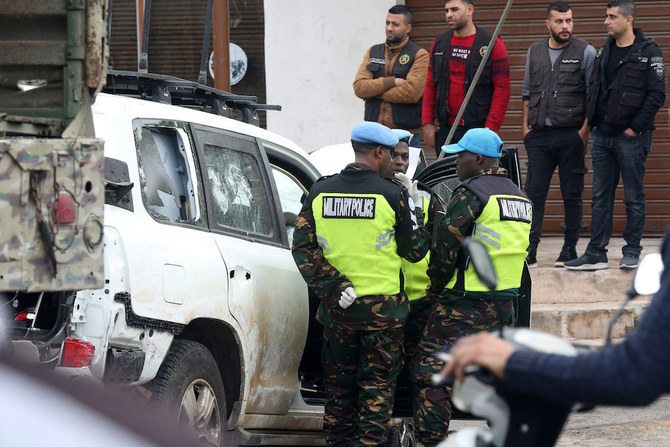
7 charged over UNIFIL convoy attack in Lebanon

Members of the UN peacekeepers forces gather near a bullet-riddled car at the site where a UN peacekeeping force UNIFIL convoy came under small arms fire, in the village of al-Aqbiya in south Lebanon (AFP)
Short Url
Updated 05 January 2023
Follow

7 charged over UNIFIL convoy attack in Lebanon

  • Judge said the incident, which took place in the town of Al-Aqabiya, happened in the spur of the moment and was not planned in advance

BEIRUT: A Lebanese military tribunal on Thursday charged seven people over the December attack on a UN peacekeeping convoy, which left one Irish soldier dead and three others wounded.

Lebanese military court judge Fadi Akiki laid the charges, which carry sentences of up to 20 years’ imprisonment with hard labor. Though the charges were based on an intent to murder, the attack was not deemed premeditated.

Akiki said that the incident, which took place in the southern town of Al-Aqabiya, happened in the spur of the moment and was not planned in advance.

One of those charged, Mohammed Ayad, is in custody after being handed over to the security services by Hezbollah. Four fugitives, against whom search and investigation warrants were issued, as well as two other unidentified fugitives, were also charged.

During the initial interrogation, Ayad told investigators that he shot at the UNIFIL vehicle with a machine gun.

Seven bullets struck the vehicle, two of which passed through a headrest, instantly killing the driver, 23-year-old Pvt. Sean Rooney.

Hezbollah, which was quick to deny any responsibility for the incident, handed over Ayad two weeks after the attack.

An investigation found that the incident began when a group of about 50 people attacked the vehicle with sticks and other objects.

When Ayad later opened fire, killing Rooney, the vehicle crashed into an electricity pole, causing a severe head injury to another passenger.

A judicial source told Arab News: “The vehicle was separated from a convoy that was headed to Beirut from southern Lebanon at night. The lost vehicle was confronted in two different locations in Al-Aqabiya before the attack.”

Akiki referred his decision to first military investigative judge Fadi Sawan, who will interrogate Ayad based on further testimonies and the findings of a UNIFIL investigation.

The charges brought against the fugitives included attempted murder, sabotaging a military vehicle and threatening by shooting in the air.


Lebanon’s government approves a deal to transfer Syrian prisoners back to Syria

Updated 30 January 2026
Follow

Lebanon’s government approves a deal to transfer Syrian prisoners back to Syria

  • Lebanon and Syria have a complicated history with grievances on both sides
  • A key obstacle to warming relations has been the fate of about 2,000 Syrians in Lebanese prisons

BEIRUT: Lebanon’s Cabinet on Friday approved an agreement to transfer Syrian prisoners serving their sentences in Lebanon back to their home country.
The issue of prisoners has been a sore point as the neighboring countries seek to recalibrate their relations following the ouster of former Syrian President Bashar Assad in a lightning offensive by Islamist-led insurgents in December 2024. Former insurgent leader Ahmad Al-Sharaa is now Syria’s interim president.
Lebanon and Syria have a complicated history with grievances on both sides. Many Lebanese resent the decades-long occupation of their country by Syrian forces that ended in 2005. Many Syrians resent the role played by the Lebanese militant group Hezbollah when it entered Syria’s civil war in defense of Assad’s government.
A key obstacle to warming relations has been the fate of about 2,000 Syrians in Lebanese prisons, including some 800 held over attacks and shootings, many without trial. Damascus had asked Beirut to hand them over to continue their prison terms in Syria, but Lebanese judicial officials said Beirut would not release any attackers and that each must be studied and resolved separately.
The deal approved Friday appeared to resolve that tension. Lebanese Information Minister Paul Morcos said other issues remain to be resolved between the two countries, including the fate of Lebanese believed to have been disappeared into Syrian prisons during Assad’s rule and the demarcation of the border between the two countries.
Lebanon’s Deputy Prime Minister Tarek Mitri told reporters after the Cabinet meeting that about 300 prisoners would be transferred as a result of the agreement.
Protesters gathered in a square below the government palace in downtown Beirut ahead of the Cabinet vote to call for amnesty for Lebanese prisoners, including some who joined militant groups fighting against Assad in Syria. Some of the protesters called for the release of Sunni cleric Ahmad Al-Assir, imprisoned for his role in 2013 clashes that killed 18 Lebanese army soldiers.
“The state found solutions for the Syrian youth who are heroes and belong to the Syrian revolution who have been imprisoned for 12 years,” said protester Khaled Al- Bobbo. “But in the same files there are also Lebanese detainees. ... We demand that just as they found solutions for the Syrians, they must also find solutions for the people of this country.”