

Iran’s Guards arrest seven people linked to UK over protests

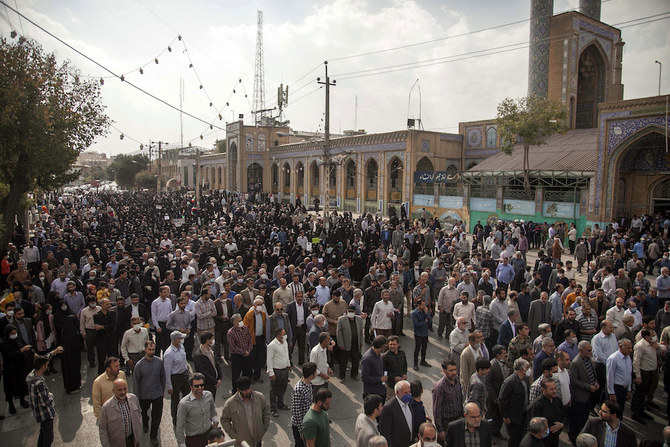
Iranians rally in the western city of Kermanshah. (File/AFP)
Short Url
Updated 27 December 2022
Follow

Iran’s Guards arrest seven people linked to UK over protests

  • British foreign ministry said it was seeking further information from Iranian authorities on the reports
  • Supporters of Belgian aid worker held in Iran staged Christmas Day protest in Brussels

DUBAI/BRUSSELS: Iran’s Revolutionary Guards arrested seven people with links to Britain on Sunday, including some who held dual nationality, over anti-government protests that have rocked the country, according to a statement published by state media.
“Seven main leaders of the recent protests related to the UK were detained by intelligence services of the IRGC (Revolutionary Guards) including dual nationals who were trying to leave the country,” the statement read.
The British foreign ministry said it was seeking further information from Iranian authorities on reports that British-Iranian dual nationals had been arrested in Iran.
The reported arrests follow unrest triggered by the Sept. 16 death in detention of Mahsa Amini, a 22-year-old Kurdish Iranian who was arrested for wearing “inappropriate attire” under Iran’s strict Islamic dress code for women.
The protests, in which demonstrators from all walks of life have called for the fall of Iran’s ruling theocracy, has posed one of the biggest challenges to the republic since the 1979 revolution.
The government has blamed the unrest on demonstrators bent on destruction of public property and says they are trained and armed by enemies including the United States and Israel. 

BRUSSELS

Meanwhile, supporters of a Belgian aid worker being held in Iran staged a Christmas Day protest in Brussels to demand his immediate release, with a spokesman questioning why a prisoner swap treaty was stalled.
Around 50 people took part in the demonstration under constant rain in the center of the Belgian capital, brandishing pictures of the aid worker, Olivier Vandecasteele.
A spokesman for the campaign to free Vandecasteele, Olivier Van Steirtegem, said the gathering took place because “it’s the first year that Olivier is marking Christmas as a hostage in Iran.”
He said the situation was “unthinkable for his family,” who did not even know where Vandecasteele was being detained.
Vandecasteele, 41, was seized in February and has since been held in conditions that Belgium’s government has described as “inhumane.”
Last week, Iran imposed a 28-year jail term on him, stirring an already bitter debate over a stymied prisoner exchange treaty.
The Belgian government subsequently urged all Belgians in Iran, including dual nationals, to leave the country over the risk that they could be arbitrarily arrested and imprisoned.
Belgium insists Vandecasteele is innocent and was being held as a hostage as Tehran attempts to force Brussels to release an Iranian agent convicted of terrorism.
Under a treaty Belgium and Iran signed earlier this year, Vandecasteele would have been eligible to be swapped for the Iranian Assadollah Assadi.
Assadi, an Iranian diplomat who was stationed in Austria, was arrested in 2018 after German, French and Belgian law enforcement foiled a plot to set off a bomb at a rally outside Paris by an Iranian exiled opposition group.
After three years in detention, he was sentenced last year in Belgium to 20 years in prison for terrorism.
But in early December, Belgium’s constitutional court suspended the implementation of the prisoner swap treaty pending a final ruling on its legality within the next three months.
Van Steirtegem said the Belgian government believed the stalled treaty was “the only path” to getting Vandecasteele freed.
“The question is whether we can accept leaving a Belgian man to potentially die in Iranian jail. All that because we don’t want to transfer a prisoner from here who has already served five years in prison.”
(With Reuters and AFP)


US condemns RSF drone attack on World Food Programme convoy in Sudan’s North Kordofan

Updated 42 min 27 sec ago
Follow

US condemns RSF drone attack on World Food Programme convoy in Sudan’s North Kordofan

  • Denise Brown, the UN Humanitarian Coordinator for Sudan, also expresses concern over the drone attack

WASHINGTON: The US has condemned a drone attack by Rapid Support Forces on an aid convoy in Sudan’s North Kordofan state that killed one person and injured three others.

“The United States condemns the recent drone attack on a World Food Program convoy in North Kordofan transporting food to famine-stricken people which killed one and wounded many others,” US Senior Adviser for Arab and African Affairs Massad Boulos wrote on X.

“Destroying food intended for people in need and killing humanitarian workers is sickening,” the US envoy wrote.

“The Trump Administration has zero tolerance for this destruction of life and of U.S.-funded assistance; we demand accountability and extend our condolences to all those affected by these inexcusable events and terrible war,” he added.

The Sudan Doctors Network said the convoy was struck by RSF drones in the Allah Karim area as it headed toward displaced people in El-Obeid, the state capital, Anadolu Agency reported.

The network described the attack as a “clear violation of international humanitarian law,” warning that it undermines efforts to deliver life-saving aid to civilians amid worsening humanitarian conditions across the country.

There was no immediate comment from the rebel group.


Denise Brown, the UN Humanitarian Coordinator for Sudan, in a statement also expressed concern over the drone attack which hit the aid trucks in North Kordofan.

“I am deeply concerned by a drone attack earlier today on trucks contracted by the World Food Programme (WFP) in North Kordofan, the aftermath of which I came across a few hours later, as I left the state capital, El Obeid.”

“The trucks were en route from Kosti to deliver life-saving food assistance to displaced families near El Obeid when they were struck, tragically killing at least one individual and injuring many more. The trucks caught fire, destroying food commodities intended for life-saving humanitarian response.”

Brown added that “Humanitarian personnel, assets and supplies must be protected at all times. Attacks on aid operations undermine efforts to reach people facing hunger and displacement.”

“Safe and unimpeded humanitarian access remains critical to ensure assistance reaches the most vulnerable people across Sudan.”

Since April 2023, the conflict between Sudan’s army and the paramilitary forces has killed tens of thousands, displaced 11 million and which the UN has described as one of the world’s worst humanitarian crises.

An alert issued by the Integrated Food Security Phase Classification (IPC), confirmed famine conditions in El-Fasher and Kadugli, the capital of South Kordofan, about 800 kilometers to the east.

The IPC said that 20 more areas in Sudan’s Darfur and neighboring Kordofan were at risk of famine.

Of Sudan’s 18 states, the RSF controls all five states in the western Darfur region, except for parts of North Darfur that remain under army control. The army holds most areas of the remaining 13 states across the south, north, east and center of the country, including the capital, Khartoum.

The conflict between the army and the RSF, which erupted in April 2023, has killed thousands of people and displaced millions.