

Parvez Elahi calls decision to dissolve Punjab assembly ‘final’ after being reinstated as chief minister

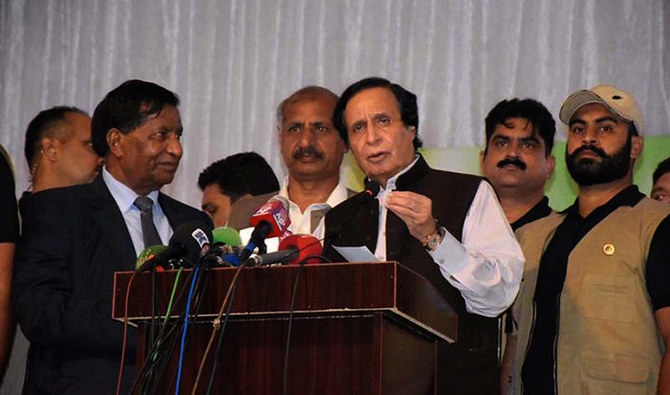
In this picture taken on September 24, 2022, Punjab Cheif Minister Chaudhry Parvez Elahi gestures during an inauguration ceremony of Grand Asian University of Sialkot in Sialkot city. (Photo courtesy: Associated Press of Pakistan/File)
Short Url
Updated 24 December 2022
Follow

Parvez Elahi calls decision to dissolve Punjab assembly ‘final’ after being reinstated as chief minister

  • Elahi took his case to the Lahore High Court after the Punjab governor removed him and dissolved his cabinet
  • His counsel told the court the provincial legislature would continue to function until the next hearing in January

ISLAMABAD: The political drama in Pakistan’s most populous Punjab province continued on Friday after Chaudhry Parvez Elahi said the decision to dissolve the provincial assembly was “final,” shortly after assuring a local court which reinstated him as chief minister that the legislature would continue to perform it functions until the next hearing.
Elahi filed a petition in the Lahore High Court (LHC) earlier in the day after Punjab Governor Muhammad Balighur Rehman issued a notification to remove him from the office and dissolved his cabinet.
His counsel, Barrister Ali Zafar, submitted an affidavit in the court, saying Elahi would not dissolve the provincial assembly until the court convened again and took up the matter on January 11.
The chief minister was subsequently restored by the five-member bench hearing the case that also issued notices to other parties to appear before it during the next hearing.
Shortly after his reinstatement, Elahi said in a Twitter post that the decision to dissolve the assembly was “final” and was in line with former prime minister Imran Khan’s instructions who has been calling for fresh elections in the country.
“The decision to dissolve the assemblies is final,” he said. “Imran Khan’s decision will be fully implemented.”
Elahi maintained the federal government was trying to “run away from elections,” adding that its leaders would be brought before the nation and “the final decision will be made by people.”

Ex-PM Khan, who was ousted from power in April and whose Pakistan Tehreek-e-Insaf (PTI) party rules Punjab and Khyber Pakhtunkhwa, recently announced to dissolve the two provincial assemblies to force the federal government to call early elections in the country.
Elahi, a key Khan ally in Punjab, told the media he would comply with Khan’s request, though he was removed by the governor, appointed by the administration in Islamabad, who claimed that he no longer commanded the majority in the provincial legislature.
As the chief minister took his case to the court, Pakistan Muslim League-Nawaz (PML-N) and Pakistan Peoples Party (PPP), the two main factions that submitted a no-trust resolution against Elahi, withdrew the motion.
The no-confidence resolution was no longer required as Elahi had already been de-notified and was no longer the chief minister, PML-N leader and federal minister Khawaja Saad Rafique said on Twitter.


Pakistan mulls space-based monitoring to support port expansion, maritime safety

Updated 10 sec ago
Follow

Pakistan mulls space-based monitoring to support port expansion, maritime safety

  • Minister says satellite technology could aid port planning and environmental protection
  • Islamabad seeks to modernize ports as it eyes transshipment role, Central Asian trade

KARACHI: Pakistan is considering the use of space-based monitoring systems to support port expansion, maritime safety and environmental protection, the country’s maritime affairs minister said on Wednesday, as he visited the headquarters of the national space agency.

The visit comes as Islamabad seeks to position itself as a transshipment hub by upgrading cargo handling, streamlining import and export processes and offering its southern ports on the Arabian Sea to landlocked Central Asian states as trade gateways.

“Advanced space-based monitoring systems can play a vital role in safeguarding seas, improving maritime management and strengthening responses to environmental threats,” Maritime Affairs Minister Muhammad Junaid Anwar Chaudhry said, according to a statement released after his visit.

Chaudhry was briefed on satellite-based assessments identifying potential sites for new ports, as well as tools for maritime traffic monitoring and disaster response.

Pakistan has been working to expand and modernize its port infrastructure to improve efficiency and attract regional cargo flows, particularly as it seeks to enhance connectivity through its coastline along the Arabian Sea.

During the visit, officials from the Pakistan Space and Upper Atmosphere Research Commission (SUPARCO) outlined the use of high-resolution satellite imagery, artificial intelligence and digital modelling to monitor ports, track cargo dwell time, detect oil spills and support search-and-rescue operations at sea.

“We can benefit from continuous monitoring of coastal ecosystems to assess water quality, sediment dispersion and overall environmental health,” Chaudhry said, adding that data-driven approaches were essential for informed policymaking in the maritime sector.

He also highlighted the growing risks posed by climate change, including rising sea levels, coastal erosion and extreme weather events, and said stronger cooperation between maritime authorities and scientific institutions was needed to protect coastal communities and infrastructure.

SUPARCO officials said the agency was ready to develop artificial intelligence-based solutions for ports and maritime operations, including systems to address customs-related inefficiencies and improve emergency response times.
The minister said the ministry and SUPARCO would move toward formalizing cooperation through a structured framework to support joint initiatives.