

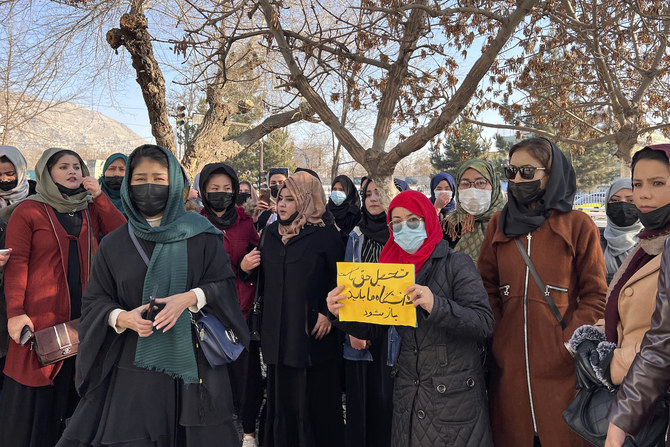

KABUL: Students and lecturers from Kabul University protested in the Afghan capital on Thursday against a ban on women attending college classes — the latest severe blow to their rights under the Taliban administration.
The Ministry of Higher Education announced on Tuesday evening that women’s higher education “would be postponed until further notice” with immediate effect.
The students who showed up for class and exams after the announcement were turned away by members of the security forces who blocked the gates of campuses across the country.
The move drew condemnation from the UN, international organizations, foreign governments, including EU members, the US, Saudi Arabia, Qatar and Pakistan, who urged the Taliban to revisit the decision.
A day later, dozens of protesting female and male students and lecturers gathered in front of the Kabul University gate. The men were soon removed from the site by security officers, but women remained chanting “Education for all,” and carrying banners stating “All or no one,” “Freedom and equality,” “Education is our right,” and “Education, work, freedom.”
Protesting men were soon removed from the site by security officers, but women remained chanting “Education for all,” and carrying banners stating “All or no one,” “Freedom and equality,” “Education is our right,” and “Education, work, freedom.”
Since the Taliban assumed power, they have introduced a series of restrictions on women, including a dress code and limits on their choice of profession. In March, girls were barred from secondary school, ostensibly until a plan for their education was approved, while classes for women at university and college continued. This latest ban comes as another devastating blow for women and girls.
For many women, university education was a ray of hope — that it would still be possible to escape the increasingly suffocating limitations imposed on them. This was until Wednesday, when they arrived at their campuses and saw members of the security forces everywhere.
“We saw the Taliban standing at every gate and at every corner of the university and they were preventing the girls from entering,” Karishma Nazari, a second-year economics student at a private university in Kabul, told Arab News.
“We were told that we don’t have the right to work, go out and study. We were again told to return home.”
Nazari’s senior, Hussna Sarwari, was going to take her final-year exam when the ban came into force.
“We had high hopes. When schools were closed for girls, our only hope was the universities, we thought that by graduating from university, we will reach our expectations and will be freed from these limitations. We worked hard day and night to fulfill this. This right was also taken away from us,” she said.
“Every day there is a new order, every day there is a new ban. Tomorrow, they will issue such an order that girls would not even have the right to breathe ... We have no more hope left.”
In a display of solidarity, male students at several campuses across the country walked out of their classes on Wednesday, while at least 16 male professors at top universities publicly announced their resignations.
“Preventing girls from studying and progressing is one of the most illogical decisions announced by the Taliban. With this decision, they have angered all the people of Afghanistan,” Farimah Nikkhwa, Kabul-based women’s rights activist, told Arab News.
For her and other female activists like Mahjuba Habibi, there are now hopes that international pressure on the Taliban would see change occur, especially since the administration is seeking global recognition.
“It is more than one year since the Taliban have controlled the government in Afghanistan and with all their power tried to sideline women from Afghan society,” Habibi said.
“Women and girls in Afghan society have been deprived of their basic rights of going to schools and universities. We are urging the international community to not allow the group to make the future generation face (this) darkness.”


