Russia: US Patriot missiles will not help end Ukraine conflict

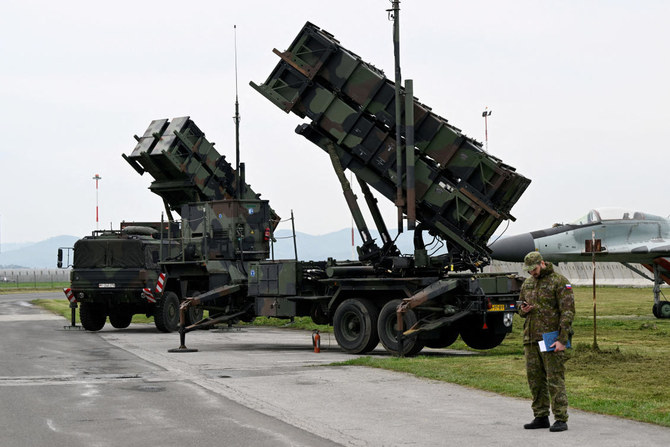
The US announced another $1.85 billion in military aid for Ukraine, including the Patriot air defense system to help it ward off barrages of Russian missiles. (Reuters)
Short Url
Updated 22 December 2022
Follow

Russia: US Patriot missiles will not help end Ukraine conflict

  • Kremlin spokesman: US fighting a proxy war with Russia ‘to the last Ukrainian’
  • Some Republicans urge an end to aid and an audit to trace how allocated money was spent

WASHINGTON/KYIV: Russia said on Thursday that supplies of US Patriot missile systems to Ukraine, announced during Ukrainian President Volodymyr Zelensky’s visit to Washington, would not help settle the conflict or prevent Russia from achieving its goals.
In a call with reporters, Kremlin spokesman Dmitry Peskov said that there had been no signs of readiness for peace talks during Zelensky’s visit, proving that the United States was fighting a proxy war with Russia “to the last Ukrainian.”
Zelensky told the US Congress on Wednesday that aid to his country was an investment in democracy as he invoked battles against the Nazis in World War Two to press for more assistance in the war against Russia.
Zelensky’s comments came as Republicans — some of whom have voiced increasing skepticism about sending so much aid to Ukraine — are set to take control of the US House of Representatives from Democrats on Jan. 3.
The United States announced another $1.85 billion in military aid for Ukraine, including the Patriot air defense system to help it ward off barrages of Russian missiles.
Zelensky said the Patriot system was an important step in creating an air shield.
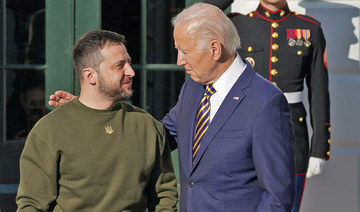
“This is the only way that we can deprive the terrorist state of its main instrument of terror — the possibility to hit our cities, our energy,” Zelensky told a White House news conference, standing next to President Joe Biden.
“We would like to get more Patriots ... we are in war,” Zelensky told reporters at the White House.
Some Republicans have urged an end to aid and an audit to trace how allocated money has been spent.
Russia says it launched its “special military operation” in Ukraine on Feb. 24 to rid it of nationalists and protect Russian-speaking communities. Ukraine and the West describe Russia’s actions as an unprovoked war of aggression that has killed.
Congress is on the verge of approving an additional $44.9 billion in emergency military and economic assistance, on top of some $50 billion already sent to Ukraine this year as Europe’s biggest land conflict since World War Two drags on.
White House National Security Council spokesman John Kirby said Washington was seeing no sign that Russian President Vladimir Putin was willing to engage in peacemaking.
Zelensky’s aide, Mykhailo Podolyak, said the United States had “finally pinpointed the baseline” in the conflict.
“1. Russia must lose. 2. No ‘territory in exchange for pseudo/world’ compromises. 3. Ukraine will receive all necessary military aid. As much as possible. 4. No one cares about Russia’s ‘talk to us’ hysteria...,” he wrote on Twitter.
Ukraine has come under repeated Russian strikes targeting its energy infrastructure in recent weeks, leaving millions without power or running water in the dead of winter.
Zelensky congratulated electrical workers for working round the clock, trying to keep the lights on as they marked Power Engineers’ Day on Thursday, a day after the Winter Solstice, the shortest day of the year.
“Even if the enemy can temporarily leave us without light, it will still never succeed in leaving us without the desire to make things right, to mend and restore to normal,” he said on Telegram. .”..Together we will overcome any darkness.”
TASS news agency earlier cited Russia’s US ambassador as saying that Zelensky’s visit to the United States confirmed that Washington’s statements about not wanting a conflict with Russia were empty words.
America’s provocative actions were leading to an escalation, the consequences of which were impossible to imagine, TASS cited Anatoly Antonov as saying.
Moscow said last week that Patriot systems, if delivered to Ukraine, would be a legitimate target for Russian strikes.


San Francisco parents scramble as teachers strike leaves 50,000 students out of school

Updated 3 sec ago
Follow

San Francisco parents scramble as teachers strike leaves 50,000 students out of school

  • On Tuesday, the San Francisco Unified School District’s 120 schools remained closed for a second day
  • About 6,000 teachers are striking over wages, health benefits, and resources for special needs students
SAN FRANCISCO: Connor Haught has been juggling virtual work meetings and arts and crafts projects for his two daughters as his family tries to navigate a teachers strike in San Francisco with no end date in sight.
Haught’s job in the construction industry allows him to work from home but, like many parents in the city, he and his wife were scrambling to plan activities for their children amid the uncertainty of a strike that has left nearly 50,000 students out of the classroom.
“The big concern for parents is really the timeline of it all and trying to prepare for how long this could go on,” Haught said.
The San Francisco Unified School District’s 120 schools were set to remain closed for a third day Wednesday, after about 6,000 public schoolteachers went on strike over higher wages, health benefits, and more resources for students with special needs.
Some parents are taking advantage of after-school programs offering full-day programming during the strike, while others are relying on relatives and each other for help with child care.
Haught said he and his wife, who works evenings at a restaurant, planned to have their 8- and 9-year-old daughters at home the first week of the strike. They hope to organize play dates and local excursions with other families. They have not yet figured out what they will do if the strike goes on a second week.
“We didn’t try to jump on all the camps and things right away because they can be pricey, and we may be a little more fortunate with our schedule than some of the other people that are being impacted,” Haught said.
The United Educators of San Francisco and the district have been negotiating for nearly a year, with teachers demanding fully funded family health care, salary raises and the filling of vacant positions impacting special education and services.
Teachers on the picket lines said they know the strike is hard on students but that they walked out to offer children stability in the future.
“This is for the betterment of our students. We believe our students deserve to learn safely in schools and that means having fully staffed schools. That means retaining teachers by offering them competitive wage packages and health care and it means to fully fund all of the programs we know the student need the most,” said Lily Perales, a history teacher at Mission High School.
Superintendent Maria Su said Tuesday there was some progress in the negotiations Monday, including support for homeless families, AI training for teachers and establishing best practices for the use of AI tools.
But the two sides have yet to agree on a wage increase and family health benefits. The union initially asked for a 9 percent raise over two years, which they said could help offset the cost of living in San Francisco, one of the most expensive cities in the country. The district, which faces a $100 million deficit and is under state oversight because of a long-standing financial crisis, rejected the idea. Officials countered with a 6 percent wage increase paid over three years.
On Tuesday, Sonia Sanabria took her 5-year-old daughter and 11-year-old nephew to a church in the Mission District neighborhood that offered free lunch to children out of school.
Sanabria, who works as a cook at a restaurant, said she stayed home from work to take care of the children.
“If the strike continues, I’ll have to ask my job for a leave of absence, but it will affect me because if I don’t work, I don’t earn,” Sanabria said.
She said her elderly mother helps with school drop off and pick up but leaving the children with her all day is not an option. Sanabria said she has given them reading and writing assignments and worked with them on math problems. Sanabria said she is making plans for the children day-by-day and expressed support for the striking teachers.
“They are asking for better wages and better health insurance, and I think they deserve that because they teach our children, they take care of them and are helping them to have a better future,” she said, adding, “I just hope they reach agreement soon.”