

Zelensky blames Iran for aiding Russia in ‘genocidal policy’ against Ukraine

U.S. President Joe Biden welcomes Ukraine's President Volodymyr Zelenskiy to the White House in Washington, U.S., on December 21, 2022. (REUTERS)
Short Url
Updated 22 December 2022
Follow

Zelensky blames Iran for aiding Russia in ‘genocidal policy’ against Ukraine

  • “That is how one terrorist has found the other,” Zelensky told the Congress, referring to Iran and Russia
  • The US will supply Ukraine with the powerful Patriot missile defense system as part of a $1.85 billion military aid package

RIYADH/JEDDAH: Ukrainian President Volodymyr Zelensky blamed “terrorist” Iran for assisting Russian attacks against his country’s critical infrastructure and urged US leaders to act, or risk emboldening Tehran against American allies.

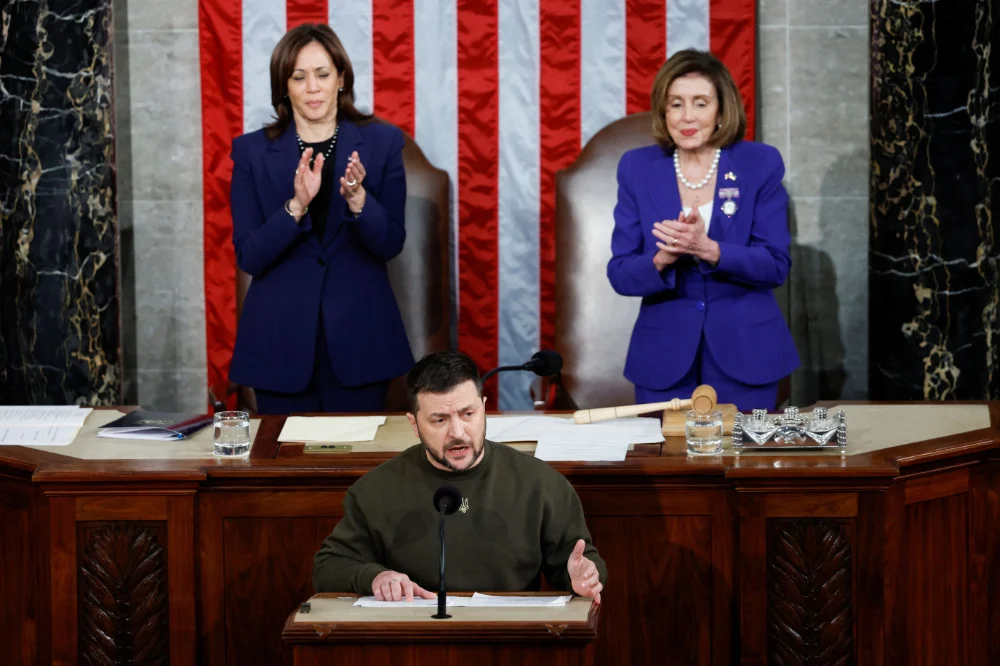
“Russia found an ally in this genocidal policy — Iran,” Zelensky told a packed joint-session of the US Congress on Wednesday. “Iranian deadly drones sent to Russia in the hundreds became a threat to our critical infrastructure. That is how one terrorist has found the other.”

Western officials have said that Iran had supplied Russia with drones used to target Ukrainian energy infrastructure. The attacks have left millions of Ukrainians without heat or running water.

“It is just a matter of time before they strike against one of your allies,” said the Ukrainian president, telling lawmakers to take action to prevent that scenario from happening.

Iran-backed entities have for years attacked the US and its allies, including Saudi Arabia and the UAE, in actions that have drawn international rebuke.
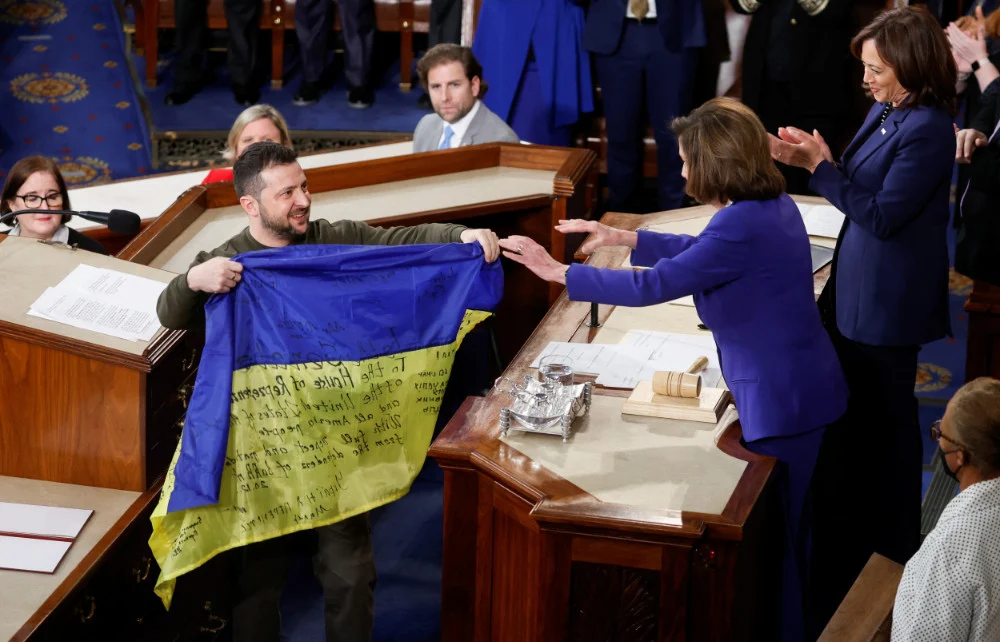


Ukraine's President Volodymyr Zelenskiy presents a Ukrainian flag given to him by defenders of Bakhmut to U.S. House Speaker Nancy Pelosi (D-CA) during a joint meeting of U.S. Congress in the House Chamber of the U.S. Capitol in Washington, U.S., December 21, 2022. (REUTERS)

Yemen’s Houthi militia, who are supported by Tehran, have launched missiles into the Kingdom that have killed civilians and damaged infrastructure, including oil refineries and civilian airports.

The US will supply Ukraine with the powerful Patriot missile defense system as part of a $1.85 billion military assistance package in the war with Russia.

The aid includes a $1 billion drawdown to provide Ukraine with “expanded air defense and precision-strike capabilities” and an additional $850 million in security assistance, Secretary of State Antony Blinken said on Wednesday.

The package came as Zelensky arrived in Washington to meet President Joe Biden and seek “weapons, weapons and more weapons” in his first overseas trip since Russia invaded in February.

FASTFACT

Russian President Vladimir says there are no financial limits on what the government would provide for the army, but military chiefs have to learn from and fix the problems they had experienced in Ukraine.

Zelensky said the visit was intended to strengthen Ukraine’s “resilience and defense capabilities” amid repeated Russian missile and drone attacks on the country’s energy and water supplies.

Biden said on Wednesday at a White House news conference with Zelensky that Russian President Vladimir Putin has no intention of ending “this cruel war.”

He said US shares the same vision of a “free, independent, prosperous and secure Ukraine.”

Biden said that when Zelensky is ready to negotiate a settlement with Moscow, he will “be able to succeed as well because he would have won on the battlefield.”

Zelensky said that a “just peace” with Russia means no compromises on Ukraine’s sovereignty and territorial integrity.
Zelensky’s political adviser, Mykhailo Podolyak, said the visit “puts an end to the attempts by the Russian side ... to prove an allegedly growing cooling in our relations. Weapons, weapons and more weapons — it is important to personally explain why we need certain types of weapons. In particular, armored vehicles, the latest missile defense systems and long-range missiles.”

White House spokesman John Kirby said: “Clearly we’re going to make sure that President Zelensky, when he leaves this country, knows that he’s leaving with the full support of the US.”

Meanwhile, Russian President Vladimir Putin was defiant on Wednesday at an end-of-year meeting of defense chiefs, at which he said Russian forces were fighting like heroes in Ukraine, would be equipped with modern weapons, and would achieve all Moscow’s goals.

Russia has suffered a string of battlefield defeats since the summer amid widespread reports of disorganization, poor training and shoddy equipment.

Putin said there were no financial limits on what the government would provide for the army, but military chiefs had to learn from and fix the problems they had experienced in Ukraine.

He backed a plan by his defense minister to boost the size of the armed forces by more than 30 percent to 1.5 million combat troops. A call-up of 300,000 reservists in September was plagued with problems, with many men physically unfit or too old and lacking basic equipment.

Putin said he considered Ukrainians to be a “brotherly” people, and blamed the war on “third countries seeking the disintegration of the Russian world.” The West has rejected this as nonsense, and says the Russian invasion of Ukraine is an imperial-style land grab.

— With input from Reuters


As India claims fourth-largest economy spot, what it means on the ground

People gather to shop for clothes at a weekend market in Bengaluru, India, on Dec. 28, 2025. (AFP)
Updated 10 sec ago
Follow

As India claims fourth-largest economy spot, what it means on the ground

  • Indian government review says economy grew to $4.19 billion, overtaking Japan
  • Claim still needs IMF review as only organized sector counted, economist says

NEW DELHI: When Ramesh Chandra Biswal left his job as a space scientist in the US, he returned to eastern India and ran an agriculture startup on a promise of his country’s rapid economic growth.

Nine years on, as India positions itself as the world’s fourth largest economy, he is still waiting for the promise to come true.

India’s economy was the sixth largest in the world, valued at about $2.6 trillion in 2017, when Biswal launched his Villamart project in his home village in Odisha.

According to calculations in the Indian government’s end-of-year economic review, it has now grown to $4.19 trillion, overtaking Japan’s economy in terms of nominal Gross Domestic Product.

The review also projects that India will overtake Germany to become the world’s third-largest economy within the next three years, trailing only the US and China in economic weight.

But on the ground, Biswal was not sure what the projections meant because they had no impact on his life or business.

“The hype around India becoming the fourth largest economy is not grounded. People cannot relate to that,” he said.

“The number of people here in India is much more than Japan ... We have to improve the per capita income instead of telling the story of being the fourth largest economy.”

Over the years that he has been running his company, Biswal has not noticed much change, but hoped that the news of the country’s growth would at least create a positive hype and motivate everyone.

“People are trying. As an entrepreneur, we are also trying, struggling every day, trying to do something new,” he said.

“I’m getting some respect in society. That way, it is giving me the driving force.”

But not everyone was immediately optimistic. For Sarvesh Sau, a fruit seller in Delhi, it has been increasingly difficult to keep his family afloat.

“Rich people are getting rich, those who have resources ... but a low-income group person like me finds it difficult to manage a decent living despite putting in more than 12 hours of work every day.

“We are a big nation, and we will look big compared to others. Are we able to match Japan?”

The world’s most populous nation, India has about 1.46 billion people and a GDP per capita estimated by the World Bank to be about $2,700. It is about 12 times lower than Japan’s.

Yogendra Kumar, a plumber in Noida, said his income has been rising, but it is consistently outpaced by the cost of living, leaving him feeling poorer over time.

“I have heard that India has become the fourth largest economy, but I don’t know how to react to that. It does not make any difference to our lives. It sounds good that India is growing, but the matter of fact is that for people like me the struggle for survival is more acute now than before,” he said.

“Today I earn more but the inflation takes away all the money, and it makes it difficult to have a comfortable life,” he told Arab News. “Mustard oil was 50 rupees 10 years ago. It is now 200 rupees. A cooking gas cylinder used to cost 500 rupees — now it costs more than double. Everything is so expensive.”

While India’s claim of being the fourth-largest economy is still awaiting review by the International Monetary Fund, Prof. Arun Kumar, a development economist, does not expect it to be confirmed.

“Our GDP data, as the IMF has said, is suspect because it doesn’t include the informal sector ... According to my estimate, we are still the seventh largest economy, just ahead of Italy,” he told Arab News, also estimating India’s actual growth to be much lower than the government’s projection.

“Even though official data shows a 7 percent to 8 percent rate of growth, people realize that it’s not growing so well,” Prof. Kumar said.

“The rate of growth is only of the organized sector, not of the unorganized sector ... The unorganized sector is declining and that is where 94 percent of the employment is.”