UK home secretary’s ‘crazy rhetoric’ fueling surge in racism, ex-government adviser warns

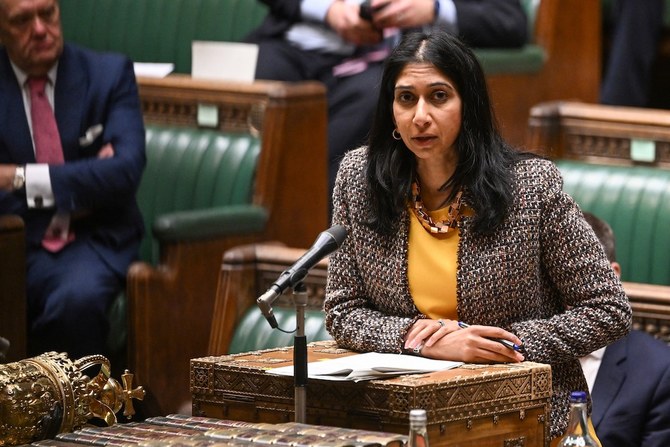
Braverman has promoted a strong stance on migration, including saying it was her “dream” to be able to deport migrants to Rwanda using a controversial asylum agreement.(AFP)
Short Url
Updated 19 December 2022
Follow

UK home secretary’s ‘crazy rhetoric’ fueling surge in racism, ex-government adviser warns

  • Nimco Ali: ‘I don’t want open borders … but you can be strict and still be human and have compassion’
  • Somali-born Ali, who moved to Britain as a child refugee, served under former PM Boris Johnson

LONDON: UK Home Secretary Suella Braverman’s comments on migration are driving a surge in racism in the country, the former government adviser on tackling violence against women has said, the Sunday Times reported.

Somali-born Nimco Ali, who resigned from her post, warned that Prime Minister Rishi Sunak will lose the next general election “with Suella as his home secretary.”

Ali, 39, moved to the UK as a child refugee. She served as an adviser under the Boris Johnson government but resigned this month after citing complaints about Braverman, who was made home secretary in October.

Braverman has promoted a strong stance on migration, including saying it was her “dream” to be able to deport migrants to Rwanda using a controversial asylum agreement.

Ali said: “When you start to normalize these things it’s really hard to put it back in its box. When you have your home secretary speaking the way she is speaking and being cheered, that is problematic, especially when you’re the first man of color to be prime minister.

“There’s nothing wrong with saying we need stronger borders. For me, I don’t want open borders, that’s not how you run a country, but you can be strict and still be human and have compassion.”

Ali said Braverman’s “crazy rhetoric” had led to her decision to resign, adding: “I don’t know why your ambition is to put people on a flight to Rwanda and get rid of human rights. You are a woman of color.

“I can understand when white able-bodied men say it, but you? Even talking about it now makes me anxious.”

Ali said she had recently suffered two separate incidents of racial abuse in London. “I thought, what is actually going on? Why are people thinking it’s OK to be so openly racist?” she added, describing Braverman’s comments as “legitimizing” racism.

A home secretary source told the Sunday Times: “It’s the home secretary’s duty to be honest with the British people about the scale of the crisis we’re facing on the south coast with the small boats crisis. She makes no apologies for that.”


26 Doctors without Borders workers remain unaccounted for in South Sudan a month after attacks

Updated 4 sec ago
Follow

26 Doctors without Borders workers remain unaccounted for in South Sudan a month after attacks

  • A hospital in the town of Lankien was bombed by government forces, MSF said
  • “We have lost contact with them amid ongoing insecurity”

NAIROBI: More than two dozen Doctors Without Borders workers remain unaccounted for a month after attacks in South Sudan, the medical charity said.
Two facilities belonging to the group, known by French acronym MSF, were attacked on Feb. 3 in Jonglei State, northeast of the capital, Juba, where violence has displaced an estimated 280,000 people since December.
A hospital in the town of Lankien was bombed by government forces, MSF said, while another medical facility in the town of Pieri was raided by “unknown assailants.” Both were located in opposition-held areas.
Staff working at the two facilities fled alongside much of the local population into deeply rural areas where armed clashes and aerial bombardments were ongoing.
MSF said in a statement on Monday that “26 of 291 of our colleagues working in Lankien and Pieri remain unaccounted for.
“We have lost contact with them amid ongoing insecurity,” it said.
The lack of communication with its staff could be linked to the limited network connectivity in much of the state. Staff members who had been contacted described “destruction, violence and extreme hardships.”
Fighting escalated sharply in December, when opposition forces captured a string of government outposts in north central Jonglei. In January, the government responded with a counteroffensive that recaptured most of the area it had lost.
Displaced people in Akobo, an opposition-held town near the Ethiopian border, described horrific violence by government fighters. Many described not being able to find food or water as they walked for days to reach safety.
The attacks on MSF facilities in Lankien and Pieri are part of an uptick in violence on humanitarian staff, supplies and infrastructure, aid groups say. MSF facilities have been attacked 10 times in the last 12 months.
“This violence has taken an unbearable toll not only on health care services, but on the very people who kept them running,” said Yashovardhan, MSF head of mission in South Sudan, who only uses one name.
“Medical workers must never be targets,” he said. “We are deeply concerned about what has happened to our colleagues and the communities we serve.”