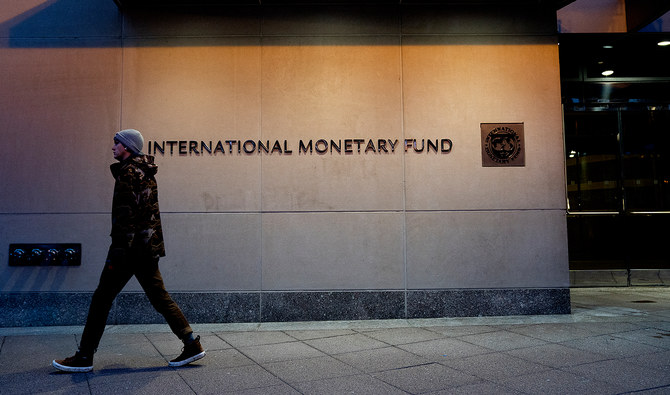
KARACHI: Esther Pérez Ruiz, the International Monetary Fund (IMF) representative for Pakistan, on Wednesday termed the ongoing discussions with the Pakistani government on the ninth review of the $7 billion loan program “productive,” which would release around $1 billion to the cash-strapped South Asian nation.
Pakistan’s central bank reserves have depleted to $6.7 billion — barely enough for a month’s imports — as the country continues to grapple with a widening current account deficit, balance-of-payment crisis and currency depreciation.
The IMF review for the release of its next tranche of funding has been pending since September, leaving the South Asian nation desperately looking for external financing.
Pakistan’s finance minister Ishaq Dar said on Monday that Islamabad had already met all requirements for a review by the global lender.
“Discussions to date in the context of the 9th review have been productive, and have enabled a revision to the macroeconomic outlook post floods as well as an in-depth evaluation of fiscal, monetary, exchange rate, and energy policies adopted since the completion of the combined seventh and eight reviews,” Ruiz said in a statement to Arab News.
“The IMF looks forward to continue the dialogue over policies that adequately address the humanitarian and rehabilitation needs from the floods, while also preserving fiscal and external sustainability given available financing.”
The IMF approved seventh and eighth reviews together in August of Pakistan’s bailout program agreed in 2019, allowing the release of more than $1.1 billion.
Pakistan secured a $6 billion bailout program in 2019 that was topped up with a further $1 billion earlier this year.
Islamabad has also been approaching its allies, including Saudi Arabia, to seek financial support.

IMF says discussions with Pakistan ‘productive’ on ninth review of $7 billion program
https://arab.news/rfmkz
IMF says discussions with Pakistan ‘productive’ on ninth review of $7 billion program
- The IMF review is pending since September and has left Pakistan in dire need of external financing
- Islamabad has also been trying to approach allies, including Saudi Arabia, to seek financial support
Pakistan terms climate change, demographic pressures as ‘pressing existential risks’
- Pakistan has suffered frequent climate change-induced disasters, including floods this year that killed over 1,000
- Pakistan finmin highlights stabilization measures at Doha Forum, discusses economic cooperation with Qatar
ISLAMABAD: Pakistan’s Finance Minister Muhammad Aurangzeb on Saturday described climate change and demographic pressures as “pressing existential risks” facing the country, calling for urgent climate financing.
The finance minister was speaking as a member of a high-level panel at the 23rd edition of the Doha Forum, which is being held from Dec. 6–7 in the Qatari capital. Aurangzeb was invited as a speaker on the discussion titled: ‘Global Trade Tensions: Economic Impact and Policy Responses in MENA.’
“He reaffirmed that while Pakistan remained vigilant in the face of geopolitical uncertainty, the more pressing existential risks were climate change and demographic pressures,” the Finance Division said.
Pakistan has suffered repeated climate disasters in recent years, most notably the 2022 super-floods that submerged one-third of the country, displaced millions and caused an estimated $30 billion in losses.
This year’s floods killed over 1,000 people and caused at least $2.9 billion in damages to agriculture and infrastructure. Scientists say Pakistan remains among the world’s most climate-vulnerable nations despite contributing less than 1 percent of global greenhouse-gas emissions.
Aurangzeb has previously said climate change and Pakistan’s fast-rising population are the only two factors that can hinder the South Asian country’s efforts to become a $3 trillion economy in the future.
The finance minister noted that this year’s floods in Pakistan had shaved at least 0.5 percent off GDP growth, calling for urgent climate financing and investment in resilient infrastructure.
When asked about Pakistan’s fiscal resilience and capability to absorb external shocks, Aurangzeb said Islamabad had rebuilt fiscal buffers. He pointed out that both the primary fiscal balance and current account had returned to surplus, supported significantly by strong remittance inflows of $18–20 billion annually from the Middle East and North Africa (MENA) and Gulf Cooperation Council (GCC) regions.
Separately, Aurangzeb met his Qatari counterpart Ali Bin Ahmed Al Kuwari to discuss bilateral cooperation.
“Both sides reaffirmed their commitment to strengthening economic ties, particularly by maximizing opportunities created through the newly concluded GCC–Pakistan Free Trade Agreement, expanding trade flows, and deepening energy cooperation, including long-term LNG collaboration,” the finance ministry said.
The two also discussed collaboration on digital infrastructure, skills development and regulatory reform. They agreed to establish structured mechanisms to continue joint work in trade diversification, technology, climate resilience, and investment facilitation, the finance ministry said.


