

For Karachi’s tiny Silawat community, winters are a festival of sweet ‘churma’

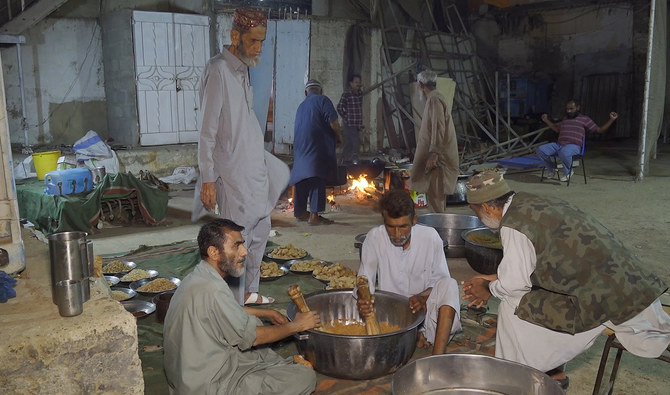
This picture, taken on December 11, 2022, shows an Imtiaz Ali Silawat (second left) with his team preparing churma desert in Karachi's Ranchore Line neighborhood. (AN Photo)
Short Url
Updated 13 December 2022
Follow

For Karachi’s tiny Silawat community, winters are a festival of sweet ‘churma’

  • Churma, made of flour, nuts, sugar and desi ghee, requires several chefs to labor a whole day and night
  • The Silawat Muslim community hails from Rajasthan in India, is traditionally associated with stonemasonry

KARACHI: With the onset of every winter season, a small, close-knit community of stonemasons in the southern Pakistani city of Karachi comes together to share a special, centuries-old Rajasthani dessert called ‘churma.’ The delicacy is prepared under the supervision of Imtiaz Ali Silawat, 71, at a community hall in Ranchore Line neighborhood in the city’s downtown area.

To cook churma, doughs of flour are fried, mashed and parched in oil, before being equally distributed into several pots. It is followed by the addition of cashew nuts, pistachio, almonds, cardamom and edible gum to the mixture.

To give the delicacy a sweet taste, sugar syrup and jaggery syrup is added to it, followed by the addition of desi ghee at the end to give it a rich, exotic taste.

“This is our unique taste, these are called Halwajat and this is eaten in the winter season,” Silawat, who supervises the entire process, told Arab News over the weekend.

“Anyone who eats it is stunned as to what are they eating,” the 71-year-old said with a sense of pride.
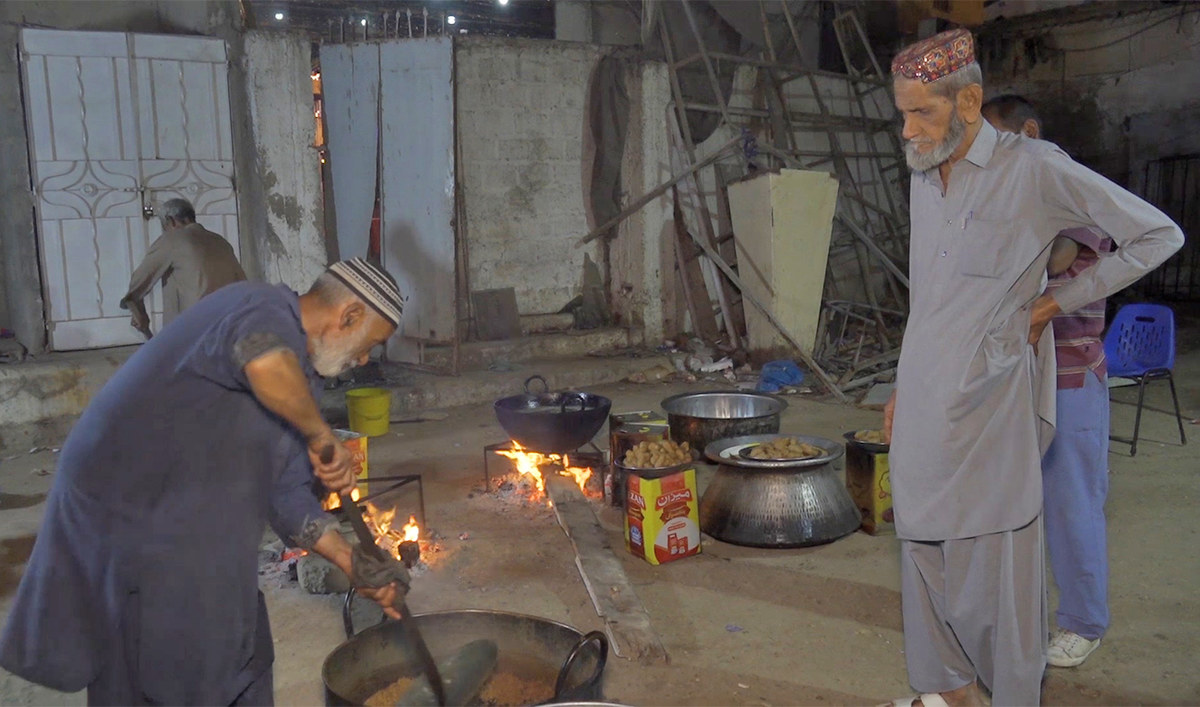


Imtiaz Ali Silawat (right), 71, oversees the making of the Rajasthani dessert called ‘churma’ in Karachi, Pakistan, on December 11, 2022. (AN Photo)

Looking for work, the Silawat community migrated from the northern Indian state of Rajasthan to Karachi some 200 years ago.

A number of Victorian era heritage buildings in the southern Pakistani metropolis reflect the craftsmanship of the community. A few of these buildings are Frere Hall, Sindh High Court, Merewether Clock Tower, Empress Market, Karachi Port Trust, Radio Pakistan, Dayaram Jethamal (DJ) College, Narayan Jagannath Vaidya (NJV) School and the Karachi Metropolitan Corporation.

The close-knit community of roughly 30,000 no longer constructs buildings, but it does pride itself with speaking the Marwari language and cooking traditional cuisines.

“[Making the Rajasthani churma] is our centuries-old tradition. Our ancestors would prepare it. After their generation passed away, [the recipe] has been in my hands for the last 45 years and I have been preparing it,” Silawat told Arab News as he instructed a team of chefs preparing churma.

“I have trained other workers [chefs] so if I am no more, it will continue for the coming generations.”

While the recipe has been passed on from generation to generation, Silawat has added his own touch to the delicacy by adding more dry fruits to the mixture.

“Not that many [dry] fruits were there [in the original recipe], but we have added them. Now, we add [dry] fruits like cashew nuts, according to the weather.”

Wali Muhammad, a 65-year-old Silawat community chef, said preparing churma required precision as a minor mistake could spoil its taste.

“[All ingredients] have to be added, if you will not [add] them, it will not create the [same] taste,” he told Arab News.

“If you would remove it [from the stove] half-cooked, it would not create that taste. We have to see it when it’s prepared and when [one] has to put in anything, otherwise, it will lose the taste.”

Once prepared with a labor of whole day and night, churma is sold to people who book it in advance at a nominal price of Rs620 ($2.75) per kilogram.

Silawat says he could earn money from the high-quality dessert by selling it at a higher price, but making churma is not a business for him, but it is his passion to pass on the recipe to others.

He said some members of the Silawat community also gift the delicacy to people of other communities: “If we want, we can sell it for Rs2,000 [per kilogram], but this is our ‘saughaat’ (gift).”


Opposition demands Imran Khan hospital transfer as government assures specialized examination

Updated 14 February 2026
Follow

Opposition demands Imran Khan hospital transfer as government assures specialized examination

  • Khan’s family says he spoke to his sons for 20 minutes, calls for urgent treatment under personal doctors
  • Former health minister warns ex-PM’s vision loss could be ‘irreversible’ without immediate intervention

ISLAMABAD: Pakistan’s opposition protest entered its second day on Saturday as its leaders demanded that jailed former prime minister Imran Khan be shifted to a private hospital for urgent eye treatment, amid the government’s assurance that his examination would be conducted at a specialized medical institution.

A group of leaders belonging to Tehreek-e-Tahafuz-e-Ayeen-e-Pakistan — or the Movement to Protect the Constitution of Pakistan — gathered outside Parliament House a day after its members started a sit-in, as police maintained a heavy security presence around the building and nearby roads.

Salman Akram Raja, the secretary general of Khan’s Pakistan Tehreek-e-Insaf (PTI) party, called for the former premier’s early transfer for treatment at Islamabad’s Shifa International Hospital.

“We have been told that there is consent to take him to Shifa International,” he said in a video message. “If that is the case, there should be no delay. We are also being told that one member of Khan’s family will be allowed to accompany him.”

Raja said Khan’s treatment should come first, followed by his release.

“Restoration of the Constitution and rule of law in this country has now become inevitable,” he added.

Separately, Mustafa Nawaz Khokhar, another politician, told a news conference at the National Press Club that the opposition’s only demand was that Khan be granted full access to the required medical facilities.

“He has already lost vision in one eye,” he told the media.

“His treatment should take place in the presence of his family,” he continued. “Until this demand is met, we will not step back.”

Dr. Zafar Mirza, a former health minister under Khan’s administration who accompanied Khokhar, said Khan was suffering from central retinal vein occlusion, a serious eye condition that can lead to permanent vision loss if not treated promptly.

“If intervention is not carried out even now, it is possible that he may never be able to see from one eye again,” he said, warning that the extent of the damage remained unclear and could be irreversible.

Earlier in the day, Khan’s legal team filed a petition in the Islamabad High Court seeking suspension of his 17-year prison term in a graft case and his release on medical grounds, citing what they described as his deteriorating health.

Khan’s sister, Aleema Khan, said in a post on X that the former premier had spoken to his sons for about 20 minutes following a direction from the chief justice of Pakistan and that the family was now awaiting urgent treatment at Shifa International Hospital under the supervision of his personal doctors.

“We cannot and will not tolerate any further delay,” she said.

Information Minister Attaullah Tarar said in a social media post that Khan’s further examination and treatment would be conducted at a “specialized medical institution” and that a detailed report would be submitted to the Supreme Court.

“Conjecture, speculation and efforts to turn this into political rhetoric and mileage for vested interests may please be avoided,” he added.

The opposition protest followed a report submitted to the Supreme Court this month by amicus curiae Barrister Salman Safdar, who visited Khan at Rawalpindi’s Adiala jail and recommended that the seriousness of his ocular condition be independently assessed without delay.

Medical documents cited in the filing mentioned drastically reduced vision in Khan’s right eye, which led prison authorities to take him to a government hospital where he underwent an intravitreal injection.

Khan’s party said his family and legal team were not informed about the development, which was first mentioned in a local media report.

The PTI has blamed the government for negligence leading to damage to Khan’s vision, though the allegation has been denied by federal ministers who say that the case is being monitored by the country’s top court while promising “best possible treatment.”

Support for Khan also came from former Pakistani cricketers who played under his captaincy during Pakistan’s 1992 World Cup victory.

Ramiz Raja said on X that seeing Khan “suffer and lose sight in one eye is an emotional meltdown,” while Wasim Akram wished him “strength, a speedy recovery, and a full return to good health.”

Waqar Younis urged that politics be put aside and called for Khan’s timely treatment.

Khan, 73, has been in custody since August 2023 in connection with multiple cases that he and his party say are politically motivated, an allegation the government denies.