

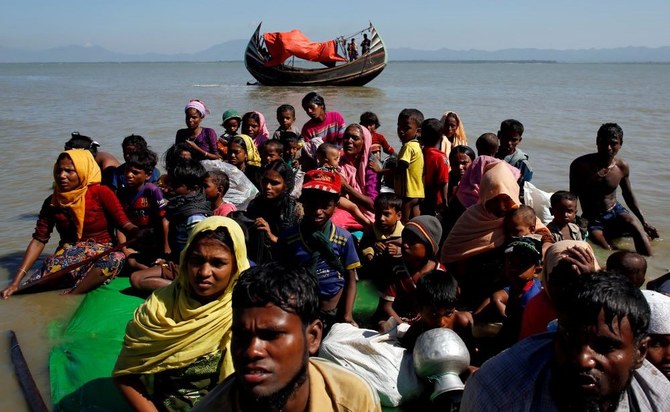
Calls mount on Malaysia to rescue 160 Rohingya refugees stranded at sea

The UN Refugee Agency is seeing an increase in the number of Rohingya making risky journeys from Bangladesh, via the Andaman Sea, as they attempt to relocate to other countries. (Reuters)
Short Url
Updated 11 December 2022
Follow

Calls mount on Malaysia to rescue 160 Rohingya refugees stranded at sea

  • Vessel adrift after engines broke down last week
  • 8 dead, others with no food and water, says activist

KUALA LUMPUR: Calls are mounting on Malaysia’s government to allow the safe disembarkation of Rohingya stranded on a boat within its waters, amid concerns that a number of them have already died from starvation and dehydration.

The boat carrying 160 people, including 120 women and children, sailed from Cox’s Bazar in southeastern Bangladesh on Nov. 25.

The coastal region has since 2017 become the world’s largest refugee settlement, as Bangladesh accepted nearly 1 million members of the Muslim Rohingya minority fleeing a widespread and systematic assault by security forces in neighboring Myanmar.

The conditions inside the squalid, overcrowded camps in Cox’s Bazar are desperate and the UN Refugee Agency has been reporting an increase in the number of Rohingya making risky journeys by the Andaman Sea to relocate to another host country.

The boat stranded in Malaysian waters has been adrift since its engines broke down on Dec. 1.

Mohammed Rezuwan Khan, a Rohingya activist in Cox’s Bazar whose sister and niece are onboard the boat, told Arab News on Sunday that they had nothing to eat or drink for the past few days.

“The rate of deaths in the boat is going to increase very quickly if there is no rescue by today or tomorrow,” he said. “It’s reached more than eight deaths already.” 

Arab News could not independently verify the numbers, but Doctors Without Borders issued a statement on Saturday saying that “some people onboard have reportedly died due to lack of food or water.” It called on the Malaysian government to “urgently allow the safe disembarkation of refugees suffering the effects of a regional humanitarian crisis and fleeing to seek safety.”

Similar calls on Malaysia and other governments in the region were made over the weekend by the Asia Pacific Refugee Rights Network and Amnesty International.

The Malaysian government has not yet responded to the appeals. The Malaysian Ministry of Home Affairs and the Royal Malaysian Navy were unavailable for comment despite repeated attempts by Arab News.

The number of people attempting to cross the Andaman Sea from Bangladesh and Myanmar has increased sixfold since 2020, according to a UNHCR alert from early December.

This year alone, at least 119 people have been reported dead or missing on those journeys. Most of those risking their lives were Rohingya refugees.

“Tragedy and suffering in the camp forced them to choose to risk their lives, even die under the water. It’s like suicide,” Khan said.

“The international community must come forward and find a solution for the Rohingya refugees living in the world’s largest refugee camp. It’s getting too late.”


India, Arab League target $500bn in trade by 2030

Updated 01 February 2026
Follow

India, Arab League target $500bn in trade by 2030

  • It was the first such gathering of India–Arab FMs since the forum’s inauguration in 2016
  • India and Arab states agree to link their startup ecosystems, cooperate in the space sector

NEW DELHI: India and the Arab League have committed to doubling bilateral trade to $500 billion by 2030, as their top diplomats met in New Delhi for the India–Arab Foreign Ministers’ Meeting. 

The foreign ministers’ forum is the highest mechanism guiding India’s partnership with the Arab world. It was established in March 2002, with an agreement to institutionalize dialogue between India and the League of Arab States, a regional bloc of 22 Arab countries from the Middle East and North Africa.

The New Delhi meeting on Saturday was the first gathering in a decade, following the inaugural forum in Bahrain in 2016.

India’s Foreign Minister S. Jaishankar said in his opening remarks that the forum was taking place amid a transformation in the global order.

“Nowhere is this more apparent than in West Asia or the Middle East, where the landscape itself has undergone a dramatic change in the last year,” he said. “This obviously impacts all of us, and India as a proximate region. To a considerable degree, its implications are relevant for India’s relationship with Arab nations as well.”

Jaishankar and his UAE counterpart co-chaired the talks, which aimed at producing a cooperation agenda for 2026-28.

“It currently covers energy, environment, agriculture, tourism, human resource development, culture and education, amongst others,” Jaishankar said.

“India looks forward to more contemporary dimensions of cooperation being included, such as digital, space, start-ups, innovation, etc.”

According to the “executive program” released by India’s Ministry of External Affairs, the roadmap agreed by India and the League outlined their planned collaboration, which included the target “to double trade between India and LAS to US$500 billion by 2030, from the current trade of US$240 billion.”

Under the roadmap, they also agreed to link their startup ecosystems by facilitating market access, joint projects, and investment opportunities — especially health tech, fintech, agritech, and green technologies — and strengthen cooperation in space with the establishment of an India–Arab Space Cooperation Working Group, of which the first meeting is scheduled for next year.

Over the past few years, there has been a growing momentum in Indo-Arab relations focused on economic, business, trade and investment ties between the regions that have some of the world’s youngest demographics, resulting in a “commonality of circumstances, visions and goals,” according to Muddassir Quamar, associate professor at the School of International Studies, Jawaharlal Nehru University.

“The focus of the summit meeting was on capitalizing on the economic opportunities … including in the field of energy security, sustainability, renewables, food and water security, environmental security, trade, investments, entrepreneurship, start-ups, technological innovations, educational cooperation, cultural cooperation, youth engagement, etc.,” Quamar told Arab News.

“A number of critical decisions have been taken for furthering future cooperation in this regard. In terms of opportunities, there is immense potential.”