On remote Bangladeshi island, Rohingya refugee children find healing in art

1 / 3
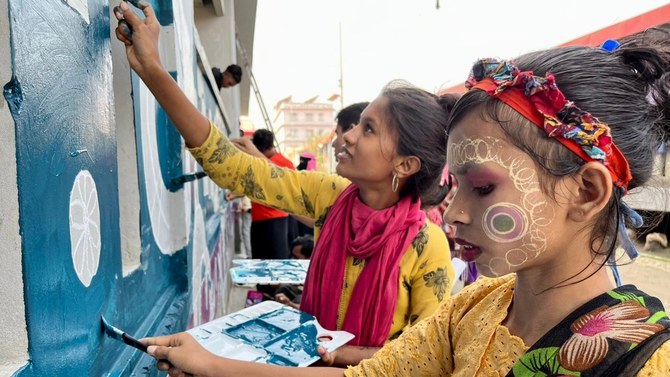
Rohingya refugee children paint a mural in Bhasan Char island, Bangladesh, Nov. 8, 2022. (UNHCR)
2 / 3
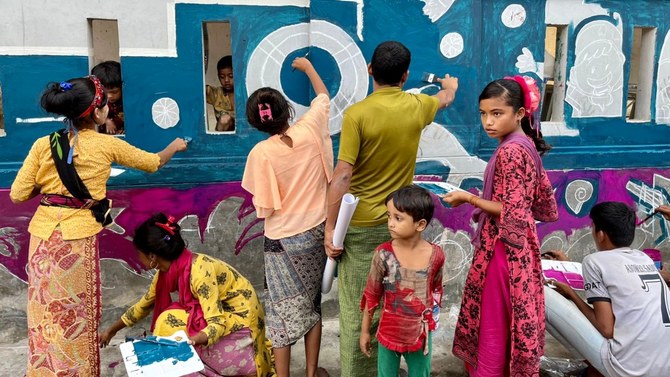
Rohingya refugee children paint a mural in Bhasan Char island, Bangladesh, Nov. 8, 2022. (UNHCR)
3 / 3
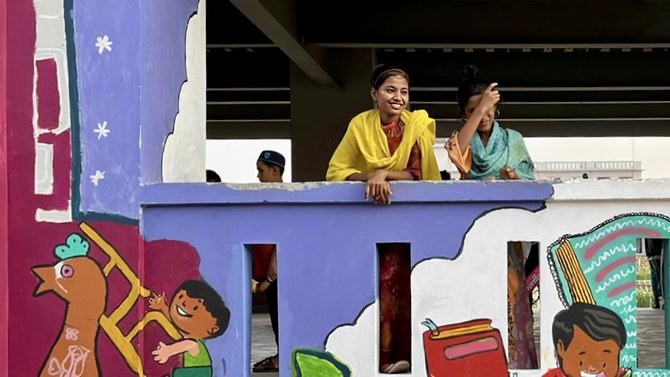
Rohingya refugee children paint a mural in Bhasan Char island, Bangladesh, Nov. 8, 2022. (UNHCR)
Short Url
Updated 01 December 2022
Follow

On remote Bangladeshi island, Rohingya refugee children find healing in art

  • Bangladeshi cartoonist Syed Rashad Imam Tanmoy engaged refugees in drawing mural
  • He asked kids in Bhasan Char to picture their lives, fears, dreams

DHAKA: When Sona Maher’s family escaped a military crackdown in Myanmar, they arrived in Bangladesh with nothing but the clothes they were wearing, and the images of blood and destruction she is still trying to forget.

The 14-year-old is one of more than 1 million Muslim Rohingya who in 2017 fled persecution, rape, and death at the hands of the Myanmar army.

Most of them found safety in neighboring Bangladesh, of which a southeastern part has since become the world’s largest refugee settlement.

Initially settled in the squalid camps of Cox’s Bazar, Meher’s family last year joined a group of nearly 30,000 Rohingya who Bangladeshi authorities have relocated to Bhasan Char, a remote island in the Bay of Bengal.

Before and when the relocation started, the UN Refugee Agency (UNHCR) and rights groups criticized the project on the grounds of safety and Bhasan Char’s livability, as it is prone to severe weather and flooding. But it is also where Maher and other children found solace — in art.

“I witnessed the atrocities by the Myanmar military in my neighborhood in Rakhine. Houses were burnt down, people were killed brutally all around me,” she told Arab News.

“I remember those horrific days and sometimes try to show those incidents in my drawings. I forget the pain when I see the colors of my drawings. It inspires me to hope for a new life, new dreams. I want to get rid of those horrible memories. Life is better now.”

Maher took part in an art project run by Bangladeshi cartoonist Syed Rashad Imam Tanmoy and the UNHCR, and art education NGO Artolution, who asked Rohingya children to picture their lives, fears, and dreams in a huge wall painting.

It took eight days, 50 participants, and long hours of consultation to complete the 50-meter-long mural last month.

“It was not just another pretty picture on the wall. We wanted to offer mental healing through art therapy with the engagement of the community,” Tanmoy told Arab News.

“Initially we experienced some reluctance … At this point, we started the paintings with brushes and colors. A few Rohingyas came forward to watch the process.”

Soon, they too began to paint.

A dominant motif appearing in their drawings was a boat.

“Most of the Rohingyas came up with the idea of drawing boats,” Tanmoy said. “They hold their dreams of returning to their homeland, and of a journey toward a better future.”

For those who participated in the project, such as 17-year-old Anowar Sadek, expressing themselves through art came with some sense of solace.

“Whenever I hold the painting materials, it helps me forget the agonies I witnessed earlier in Rakhine,” he said. “The paintings give me much comfort and pleasure.”

But both the children and art educators know that the comfort will be only temporary as long as they remain without a place that they can call home. And isolation in Bhasan Char also adds to their distress.

“My heart filled with joy when I painted the wall with colors … I want to continue painting throughout my life,” Roksana Akter, a 12-year-old who joined the mural project, said.

“But I have many friends and relatives in Cox’s Bazar. I didn’t see them for a long time. It’s the saddest part of my life at this moment.”


South African diamond mining company says 5 trapped miners presumed dead and files for liquidation

Updated 4 sec ago
Follow

South African diamond mining company says 5 trapped miners presumed dead and files for liquidation

  • The incident occurred in the early hours of Feb. 17 at the Ekapa Mine in Kimberley
  • “This marks the end of 158 years of continuous diamond mining in Kimberley,” CEO Jahn Hohne said

JOHANNESBURG: Five miners who were trapped last week after a mudslide flooded a shaft remain unaccounted for and are “now presumed deceased,” the owners of the diamond mining company in South Africa said Wednesday, announcing that it had filed for liquidation and shut the mine.
The incident occurred in the early hours of Feb. 17 at the Ekapa Mine in Kimberley, the capital of Northern Cape province, when a sudden surge of water, mud and rock in minutes inundated an underground section of the mine, blocking access to its lowest mining level, around 800 meters (half a mile) underground.
The mine owners, Ekapa Resources and Ekapa Minerals, said despite rescue efforts that included drilling and assessments by specialist teams conditions were confirmed to be unsurvivable as tunnels were filled with mud and water with no signs of life. A search operation is ongoing.
At the same time, the owners announced the immediate closure of the mine where the incident occurred and petitioned the courts to be placed in liquidation.
The decision came after an internal evaluation found that, given the protracted worldwide diamond market downturn, exacerbated by the recent tragedy, the company is unable to continue meeting its financial responsibilities, it said.
“This marks the end of 158 years of continuous diamond mining in Kimberley,” CEO Jahn Hohne said in a statement. “A legacy the company acknowledges with humility and respect.”
The National Union of Mineworkers of South Africa (Numsa), considered the largest single trade union in South Africa, told the state broadcaster it was “shocked” by the move, which puts the jobs of about 1,200 workers at risk. The union said it would be meeting with its legal teams to discuss a course of action to possibly block the liquidation.
“The situation is very devastating,” Numsa Kimberley organizer Lerato Mohatlane told the SABC. “If the mine is indeed liquidated, it is clear that all the 1,200 workers will then lose their jobs.”
The Department of Mineral Resources and Energy said it is set to meet with the firm and be briefed on what has transpired and ways forward.
South Africa is among the world’s biggest producers of diamonds and gold, and the top producer of platinum.