

Saudi Finance Ministry calls for greater private participation as it reviews 2023 budget  

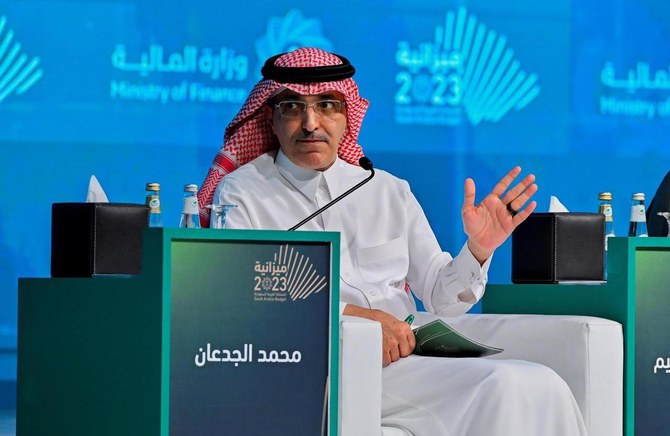
Saudi Finance Minister Mohammed Aljadaan spoke during the 2023 Budget Forum organized to review the performance of the government for the year 2022. (SPA)
Short Url
Updated 12 December 2022
Follow

Saudi Finance Ministry calls for greater private participation as it reviews 2023 budget  

  • Private sector key driver in boosting Saudi Arabia’s gross domestic product

RIYADH: The private sector is considered a key driver in boosting Saudi Arabia’s gross domestic product and helping it become a productive economy, said Saudi Finance Minister Mohammed Aljadaan during the 2023 Budget Forum organized to review the performance of the government for the year 2022. 

The two-day event that began on Dec. 11 was attended by as many as 30 officials from the government and private speakers to discuss the impact of government services on citizens and the private sector besides addressing the plans and future projects of the entities present. 

Saudi Minister of Economy and Planning Faisal Alibrahim agreed that the private sector has a vital role to play in the long run, considering that it’s a chief propeller of the Kingdom’s economic development.  

While 60 percent of the Kingdom’s population is under the age of 30, he pointed out that 41 percent are under the age of 25, which is an opportunity to create productive elements. 

“The public finances are somewhat independent, but as oil prices fluctuate, we try to keep them stable by controlling spending,” the minister added. 

Furthermore, he revealed that Saudi Arabia has managed to control inflation by capping energy prices as they spent tens of billions of dollars to compensate Saudi Aramco for selling fuel locally at lower than the international price. 

“We moved from the Fiscal Balance Program to the Fiscal Sustainability Program,” Aljadaan emphasized. 

Meanwhile, he revealed that the government's non-oil revenues covered 40 percent of its spending by the end of 2021, after covering only 10 percent previously. 

ACWA Power Chairman Mohammad Abunayyan who also participated in the forum revealed that the Kingdom has the cheapest renewable energies in the world. 

He stressed that the promotion of local content requires the empowerment of the private sector, and “this is what I recommend and am passionate about.”  

"The government's role is to legislate, but we are the ones who will implement and invest,” the ACWA Power chairman added.  

Expressing his views on the general budget, the Saudi National Bank Chairman Ammar Alkhudairy said there are several things that reflect positively on the citizens and economic system in the Kingdom including the fact that jobs have been created as well as small and medium enterprises growing by 10 percent. 

He said that tourism, food, and beverages, privatization, and SMEs are the next group of sectors that will require some sort of collaboration between the private and public sectors.  

Alkhudairy stressed that SME Bank will have a crucial role to play in the process. 

Talking about the Kingdom's housing sector, the country’s Minister of Municipal and Rural Affairs and Housing Majed Al-Hogail revealed that it has served 1.4 million families, with home ownership rates going as planned. He added that next year they will increase to 1 percent. 

With regard to families most in need of housing, the minister said they were able to pump more than 30,000 housing units, and “we will continue with this approach until we reach 70,000 housing units this year and next.” 

The first day of the forum comprised six sessions covering themes on financial sustainability and drivers of economic growth, sustainable energy, basic services in light of the national transformation, and the role of infrastructure and logistics services in supporting economic development. It also touched upon issues relating to the impact of enabling investment on economic growth, and strengthening the technology sector to enable the digital economy. 

The second day of the forum will witness the holding of five dialogue sessions revolving around the national industry and its role in facing risks, business facilitation and its role in the economy, the impact of tourism and culture on economic development, and the impact of the budget on empowering women. 

This comes as Saudi Arabia’s bumper budget surplus received thumbs up from the Kingdom’s governors as they term it a reflection of “the strength and durability” of the economy that will go long way to improve the lives of its citizens.   

Saudi Arabia on Wednesday announced a larger-than-expected budget surplus of SR102 billion ($27.13 billion) for 2022 — SR12 billion higher than previously forecast. 

The Kingdom also upwardly revised the growth of its gross domestic product to 8.5 percent for 2022, compared with the 7.5 percent estimated in December 2021 and the 8 percent forecast in the pre-Budget statement published at the end of September. 


First EU–Saudi roundtable on critical raw materials reflects shared policy commitment

Updated 16 January 2026
Follow

First EU–Saudi roundtable on critical raw materials reflects shared policy commitment

RIYADH: The EU–Saudi Arabia Business and Investment Dialogue on Advancing Critical Raw Materials Value Chains, held in Riyadh as part of the Future Minerals Forum, brought together senior policymakers, industry leaders, and investors to advance strategic cooperation across critical raw materials value chains.

Organized under a Team Europe approach by the EU–GCC Cooperation on Green Transition Project, in coordination with the EU Delegation to Saudi Arabia, the European Chamber of Commerce in the Kingdom and in close cooperation with FMF, the dialogue provided a high-level platform to explore European actions under the EU Critical Raw Materials Act and ResourceEU alongside the Kingdom’s aspirations for minerals, industrial, and investment priorities.

This is in line with Saudi Vision 2030 and broader regional ambitions across the GCC, MENA, and Africa.

ResourceEU is the EU’s new strategic action plan, launched in late 2025, to secure a reliable supply of critical raw materials like lithium, rare earths, and cobalt, reducing dependency on single suppliers, such as China, by boosting domestic extraction, processing, recycling, stockpiling, and strategic partnerships with resource-rich nations.

The first ever EU–Saudi roundtable on critical raw materials was opened by the bloc’s Ambassador to the Kingdom, Christophe Farnaud, together with Saudi Deputy Minister for Mining Development Turki Al-Babtain, turning policy alignment into concrete cooperation.

Farnaud underlined the central role of international cooperation in the implementation of the EU’s critical raw materials policy framework.

“As the European Union advances the implementation of its Critical Raw Materials policy, international cooperation is indispensable to building secure, diversified, and sustainable value chains. Saudi Arabia is a key partner in this effort. This dialogue reflects our shared commitment to translate policy alignment into concrete business and investment cooperation that supports the green and digital transitions,” said the ambassador.

Discussions focused on strengthening resilient, diversified, and responsible CRM supply chains that are essential to the green and digital transitions.

Participants explored concrete opportunities for EU–Saudi cooperation across the full value chain, including exploration, mining, and processing and refining, as well as recycling, downstream manufacturing, and the mobilization of private investment and sustainable finance, underpinned by high environmental, social, and governance standards.

From the Saudi side, the dialogue was framed as a key contribution to the Kingdom’s industrial transformation and long-term economic diversification agenda under Vision 2030, with a strong focus on responsible resource development and global market integration.

“Developing globally competitive mineral hubs and sustainable value chains is a central pillar of Saudi Vision 2030 and the Kingdom’s industrial transformation. Our engagement with the European Union through this dialogue to strengthen upstream and downstream integration, attract high-quality investment, and advance responsible mining and processing. Enhanced cooperation with the EU, capitalizing on the demand dynamics of the EU Critical Raw Materials Act, will be key to delivering long-term value for both sides,” said Al-Babtain.

Valere Moutarlier, deputy director-general for European industry decarbonization, and directorate-general for the internal market, industry, entrepreneurship and SMEs at European Commission, said the EU Critical Raw Materials Act and ResourceEU provided a clear framework to strengthen Europe’s resilience while deepening its cooperation with international partners.

“Cooperation with Saudi Arabia is essential to advancing secure, sustainable, and diversified critical raw materials value chains. Dialogues such as this play a key role in translating policy ambitions into concrete industrial and investment cooperation,” she added.