UN concerned after Israel refuses to grant staff visas

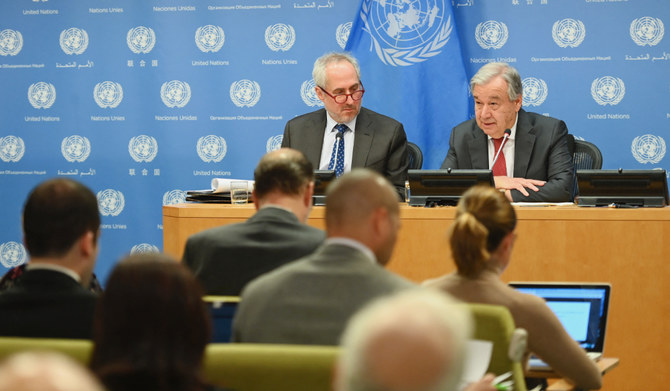
United Nations Secretary General Antonio Guterres with Stephane Dujarric (L), Spokesman for the Secretary General speaks during a press briefing at United Nations Headquarters on February 4, 2020 in New York City. (AFP)
Short Url
Updated 09 December 2022
Follow

UN concerned after Israel refuses to grant staff visas

  • Decision impacts humanitarian community's ability to support Palestinians, spokesperson says

RAMALLAH: The UN has expressed concern about an Israeli decision to refuse entry visas to its staff.

The organization warned that that the move may affect humanitarian work in Palestine and the ability of the humanitarian community to support Palestinians.

UN spokesman Stephane Dujarric said that the decision significantly impacts the humanitarian community’s ability to support Palestinians.

“We are, of course, still in contact with the Israeli authorities on this matter, and we hope it will be resolved,” Dujarric said.

The Israeli Foreign Ministry refused to issue visas to officials from the UN Office for the Coordination of Humanitarian Affairs, accusing employees from the aid agency of “undercounting” the number of Israeli civilians who are killed or injured in Palestinian attacks.

The Ministry of Foreign Affairs claimed — as reported by the Israeli Ynet website — that OCHA employees constantly count Israelis killed in Palestinian operations but fail to categorize them as “terrorist attacks.”

The ministry said: “OCHA is accused of reporting the killing or harming of Israeli civilians under disputed circumstances while taking reports of Palestinian casualties at face value and assigning blame to Israel, including in clashes between IDF forces and Palestinian militants.”

Arab News reached out to the UN, OCHA officials and Israeli Ministry of Foreign Affairs for comment, but did not receive a response.

Shawan Jabarin, director general of Al-Haq Palestinian Human Rights organization, told Arab News that he blames the UN for its inaction and negligence in protesting the previous bans of international commissions of inquiry and special rapporteurs who were prevented by Israel from entering the Palestinian territories, even though Israel is required to cooperate with the UN.

Jabarin said it was “no longer surprising” that Israel refuses to grant entry visas to the OCHA team because of its lack of protest over past Israeli actions.

“OCHA is a body concerned with humanitarian issues, and this denial of granting entry visas to its team is an Israeli message to the UN that your previous complacency will lead to a day when no UN official will be allowed to enter the Palestinian territories unless Israel approves of their presence,” Jabarin told Arab News.

The Israeli Ministry of Defense Coordinator of the Government Activities in the Palestinian territories had changed the procedures for foreigners entering the territories, stipulating that they obtain an entry visa outside Israel a month before the date of their arrival.

This Israeli policy was described by Jabarin as an attempt to “silence and prevent the work” of international institutions that criticize Israeli policy in the occupied Palestinian Territories.

“Israel wants, through this policy, to re-engineer the international community so that it does not criticize it, and the silence of the UN gave Israel a ladder to climb on its back,” said Jabarin.

Meanwhile, on the 35th anniversary of the outbreak of the first Palestinian intifada (1987-1993) that fell on Dec. 9, Israeli security and military circles warned of their fears of a third intifada in the West Bank.

The deteriorating security situation in the West Bank constitutes challenge number two after the Iranian threat.

Egypt has also expressed deep concern regarding the security deterioration in the West Bank and the continuation and escalation of Israeli killings of Palestinians.

Since the beginning of the year, 165 Palestinians have been killed in the West Bank, and another 54 were killed in the Gaza Strip.

In a related development, Israeli designated National Security Minister Itamar Ben-Gvir has warned that Palestinians could soon face unprecedented punitive measures.

He threatened in an interview with an Israeli channel on Friday to annex Palestinian lands that contain Israeli settlements, leaving Palestinians to manage their affairs without authority or privileges.

Ben-Gvir said that he does not differentiate between Palestinians in the West Bank and Gaza Strip, and the Palestinians who live in Israel.

He said that everyone who is disloyal to the state of Israel must be expelled and that he will divide Al-Aqsa Mosque between Muslims and Jews.

Dana Ben Shimon, a prominent Israeli correspondent for Israel Today newspaper, told Arab News that the expectations and estimates of the Israeli security services regarding the possibility of a third intifada have nothing to do with the election of the new Israeli government.

“It is not important whether you call it a third intifada or a wave of violence, but the problem is that the Israeli security services are concerned about the quantity, quality and development of the attacks, especially as we witnessed the double bombing attack in Jerusalem at the end of last month,” he added.


Trump says change of power in Iran would be ‘best thing’

Updated 35 min 31 sec ago
Follow

Trump says change of power in Iran would be ‘best thing’

  • Trump’s comments were his most overt call yet for the toppling of Iran’s clerical establishment
  • USS Gerald R. Ford — the world’s largest warship — would be “leaving very soon” for the Middle East

WASHINGTON: US President Donald Trump said Friday that a change of government in Iran would be the “best thing that could happen,” as he sent a second aircraft carrier to the Middle East to ratchet up military pressure on the Islamic republic.

Trump’s comments were his most overt call yet for the toppling of Iran’s clerical establishment, and came as he pushes on Washington’s arch-foe Tehran to make a deal to limit its nuclear program.

At the same time, the exiled son of the Iranian shah toppled in the 1979 Islamic revolution renewed his calls for international intervention following a bloody crackdown on protests by Tehran.

“Seems like that would be the best thing that could happen,” Trump told reporters at the Fort Bragg military base in North Carolina when a journalist asked if he wanted “regime change” in Iran.

Trump declined to say who he would want to take over in Iran from supreme leader Ayatollah Ali Khamenei, but he added that “there are people.”

He has previously backed off full-throated calls for a change of government in Iran, warning that it could cause chaos, although he has made threats toward Khamenei in the past.

Speaking earlier at the White House, Trump said that the USS Gerald R. Ford — the world’s largest warship — would be “leaving very soon” for the Middle East to up the pressure on Iran.

“In case we don’t make a deal, we’ll need it,” Trump said.

The giant vessel is currently in the Caribbean following the US overthrow of Venezuela’s Nicolas Maduro. Another carrier, the USS Abraham Lincoln, is one of 12 US ships already in the Middle East.

‘Terribly difficult’

When Iran began its crackdown on protests last month — which rights groups say killed thousands — Trump initially said that the United States was “locked and loaded” to help demonstrators.

But he has recently focused his military threats on Tehran’s nuclear program, which US forces struck last July during Israel’s unprecedented 12-day war with Iran.

The protests have subsided for now but US-based Reza Pahlavi, the son of Iran’s last shah, urged international intervention to support the Iranian people.

“We are asking for a humanitarian intervention to prevent more innocent lives being killed in the process,” he told the Munich Security Conference.

It followed a call by the opposition leader, who has not returned to his country since before the revolution, for Iranians at home and abroad to continue demonstrations this weekend.

Videos verified by AFP showed people in Iran this week chanting anti-government slogans as the clerical leadership celebrated the anniversary of the Islamic revolution.

Iran and the United States, who have had no diplomatic relations since shortly after the revolution, held talks on the nuclear issue last week in Oman. No dates have been set for new talks yet.

The West fears the program is aimed at making a bomb, which Tehran denies.

The head of the UN nuclear watchdog, Rafael Grossi, said Friday that reaching an accord with Iran on inspections of its processing facilities was possible but “terribly difficult.”

Reformists released

Trump said after talks with Israeli Prime Minister Benjamin Netanyahu earlier this week that he wanted to continue talks with Iran, defying pressure from his key ally for a tougher stance.

The Israeli prime minister himself expressed skepticism at the quality of any agreement if it didn’t also cover Iran’s ballistic missiles and support for regional proxies.

According to the US-based Human Rights Activists News Agency, 7,008 people, mostly protesters, were killed in the recent crackdown, although rights groups warn the toll is likely far higher.

More than 53,000 people have also been arrested, it added.

The Norway-based Iran Human Rights (IHR) NGO said “hundreds” of people were facing charges linked to the protests that could see them sentenced to death.

Figures working within the Iranian system have also been arrested, with three politicians detained this week from the so-called reformist wing of Iranian politics supportive of President Masoud Pezeshkian.

The three — Azar Mansouri, Javad Emam and Ebrahim Asgharzadeh — were released on bail Thursday and Friday, their lawyer Hojjat Kermani told the ISNA news agency.