Saudi Arabia warns global humanitarian crisis will escalate in 2023

1 / 2
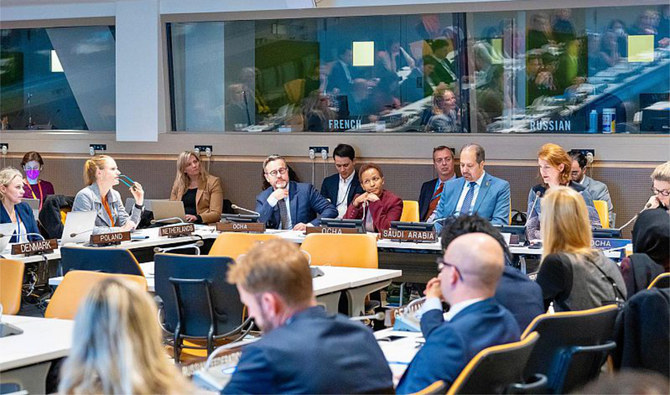
Aqil Al-Ghamdi, who chaired the meeting, said the OCHA will have to confront greater challenges in 2023. (SPA)
2 / 2
(SPA)
Short Url
Updated 09 December 2022
Follow

Saudi Arabia warns global humanitarian crisis will escalate in 2023

  • Area worst affected by the escalating crisis will be the Horn of Africa, the Sahel region, the Great Lakes, Haiti and Ukraine

NEW YORK: Humanitarian needs will increase worldwide in the year ahead, Saudi aid experts warn, requiring solidarity among the international community and the continued support of donors within the UN, the Saudi Press Agency reported on Thursday.

Aqil Al-Ghamdi, the assistant supervisor general director for planning and development at the King Salman Humanitarian Aid and Relief Center, also known as KSRelief, said the areas worst affected by the escalating crisis will be the Horn of Africa, the Sahel region, the Great Lakes, Haiti and Ukraine.

Their situations will get worse because of factors such as economic disparity, climate change, food shortages, rising prices of fuel and fertilizer, the COVID-19 pandemic, ebola and cholera outbreaks, all of which will have crippling effects on the humanitarian situation.

He was speaking at a high-level meeting of the donor support group for the UN Office for the Coordination of Humanitarian Affairs in New York on Wednesday.

Al-Ghamdi, who chaired the meeting, said the OCHA will have to confront greater challenges in 2023, which will require a united response and the continued support of the group. He gave details of the OCHA’s strategic plan for the period 2023 to 2026, and the office’s budget for coming year. He praised the progress it has made, especially with regard to setting priorities and establishing a budget steering committee to help allocate resources based on levels of need.

Joyce Msuya, OCHA’s assistant secretary-general for humanitarian affairs and deputy emergency relief coordinator, said the office appreciates the offers by members of the donor group to mobilize their support, especially in terms of funding, in light of the economic conditions that most countries are experiencing and the effects of the COVID-19 pandemic. She stressed the office’s efforts to use available resources efficiently.

Julie Billings, head of strategic planning, budgeting and finance at the OCHA, discussed the office’s 2023 budget and some of the steps it is taking. She said it constantly evaluates its bureaus around the world to establish financial needs, and reduces the support to areas in which the humanitarian situation has improved so that the funding can be transferred to address priority needs elsewhere.

Al-Ghamdi, the head of the donor group and the Kingdom’s representative on it, thanked the OCHA representatives and the members of the donor group for attending the two-day meeting and their valuable contributions. He invited them to the fourth meeting of the high-level group, which is scheduled to take place in Riyadh in February, alongside the Riyadh International Humanitarian Forum.



Threat to Kingdom’s security is ‘red line’ that will be ‘addressed and neutralized,’ Saudi envoy says

Updated 14 January 2026
Follow

Threat to Kingdom’s security is ‘red line’ that will be ‘addressed and neutralized,’ Saudi envoy says

  • Abdulaziz Alwasil tells UN Security Council the situation in southern Yemen is ‘a just cause with social and historic dimensions’ that can only be resolved through dialogue
  • Recent military activity in the south was unilateral, resulting in an escalation that harms the interests of Yemeni people and undermines efforts to address issues in the south, he said

NEW YORK CITY: Any attempt to threaten Saudi Arabia’s national security is a “red line” and will be met with decisive action, the Kingdom’s ambassador to the UN told the Security Council on Wednesday.

Speaking during a meeting of the council to discuss Yemen, Abdulaziz Alwasil said the situation in the south of the country is “a just cause with social and historic dimensions” that can only be resolved through dialogue.

“We stress that any attempt to threaten our national security is a red line, and we will not hesitate to take the necessary actions and steps to address it and neutralize it,” he added.

Alwasil reaffirmed Saudi Arabia’s support for Yemeni President Rashad Al-Alimi, the Presidential Leadership Council, and the Yemeni government in their efforts to achieve security, stability, development and peace while preserving national unity.

He said military activity by Southern Transitional Council forces in Hadramout and Al-Mahra on Dec. 2, 2025, was unilateral, did not have the approval of the Presidential Leadership Council, and was not carried out in coordination with the Coalition to Restore Legitimacy in Yemen.

It had resulted in an unjustified escalation that harmed the interests of the Yemeni people, undermined efforts to address the issues in the south, and ran counter to the coalition’s objectives, Alwasil added.

The Kingdom, working with its coalition partners, the Presidential Leadership Council and the Yemeni government, had moved to contain the situation by dispatching a military force to coordinate arrangements with the Southern Transitional Council in Aden, he said.

The aim was to ensure the return of the southern council’s forces to their previous positions outside of Hadramout and Al-Mahra, and the handover of camps to legitimate government forces and local authorities in line with agreed procedures, Alwasil added.

He expressed regret over the military operations that took place in Hadramout and Al-Mahra, close to Saudi Arabia’s southern border, which he said posed a direct threat to the Kingdom’s national security, as well as the security of Yemen and regional stability. Such steps were extremely dangerous, he added, and contradicted the principles on which the Coalition to Restore Legitimacy in Yemen had been founded.

Alwasil welcomed a prisoner and detainee exchange agreement signed in Muscat on Dec. 23, which he described as an important humanitarian measure to alleviate suffering and build confidence.

He praised Oman for hosting and sponsoring the consultations and supporting negotiations, and commended the efforts of UN’s special envoy for Yemen, Hans Grundberg, the International Committee of the Red Cross and all others that has played a part.

Regarding the political efforts to resolve the crisis, Alwasil said Saudi Arabia welcomed President Al-Alimi’s call for an inclusive conference in Riyadh to bring together all stakeholders to discuss just solutions to the situation in southern Yemen.

Preparations for the conference have begun, he added, in cooperation with the Yemeni government and southern representatives, reflecting the close ties between the two countries and their shared interests in stabilizing Yemen.

He urged all southern stakeholders to participate actively and constructively in the talks, to help find comprehensive and just solutions that meet the legitimate aspirations of the people of southern Yemen.

Alwasil called on all Yemeni forces and stakeholders to cooperate and intensify their efforts to reach a lasting political settlement that would ensure security and stability.

He described the southern issue as “a just cause with social and historic dimensions,” adding that “the only way to address it is through dialogue that leads to a comprehensive political solution” based on nationally and internationally agreed terms of reference.