

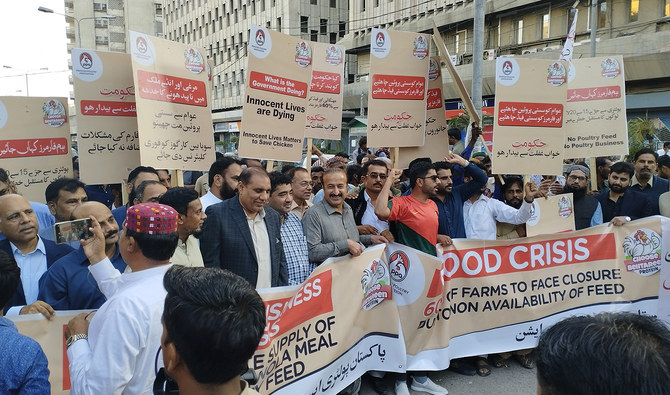

KARACHI: Pakistani poultry farmers have said they are running out of feedstock and it may disrupt supply of chicken and eggs in the coming weeks, after authorities held soybean shipments at the Karachi port over a lack of certification.
Around 600,000 tons of soybean are stuck at the port and await clearance from Pakistani authorities, according to poultry farmers.
The clearance of shipments was suspended after importers were told they required a certification from the Ministry of National Food Security and Research (MNFS&R) to import genetically-modified organism (GMO) oilseeds.
“Around 600,000 tons of soybean is stuck at the port, out of which 150,000 tons have been offloaded and lay in the open space, while shipments containing 450,000 tons are still docked, awaiting permission to unload,” Chaudhry Muhammad Ashraf, chairman of the Pakistan Poultry Association (PPA), said at a press conference in Karachi on Monday.
“As of today, the daily production of chicken is around 4 million and 35 million of eggs. The decline in production may increase the prices of chicken and cut down the production by 1.8 million and that of eggs by 20 million.”
Imported soybean and canola seeds are the main ingredients of poultry feed and have no substitute in the South Asian country, according to Ashraf. They make up around 35 percent of the chicken feedstock.
Farmers say authorities, including the Ministry of Food Security, need to take immediate measures to address the issue and save the poultry sector from a collapse.
The oilseed importers, including the All-Pakistan Solvent Extractors’ Association (APSEA), say they have already made huge payments for the stock held at the port.
“The importers have already paid $44 billion to the sellers,” Mian Muhammad Ahmed, the APSEA chairman, said at Monday’s press conference.
Poultry farmers feared that if the issue was not resolved, the price of chicken could go above Rs1000 ($4.4) per kilogram from the current Rs300 ($1.3) and the South Asian country might be forced to import poultry products to meet local demand.
“The floods have already destroyed a large number of poultry farms and now the feedstock issue has further dragged the sector to the verge of a collapse,” said Ghulam Khaliq, a former chairman of the PPA.
“We will be compelled to import, affecting the livelihood of around 2.5 million people directly or indirectly associated with the poultry business.”
Pakistan’s Minister for National Food Security Tariq Bashir Cheema did not respond to repeated requests by Arab News for a comment.
However, Muhammad Saleem Baloch, a lawmaker and secretary for local government in southern Sindh province, said at the press conference he was in contact with the federal government to get the issue resolved.


