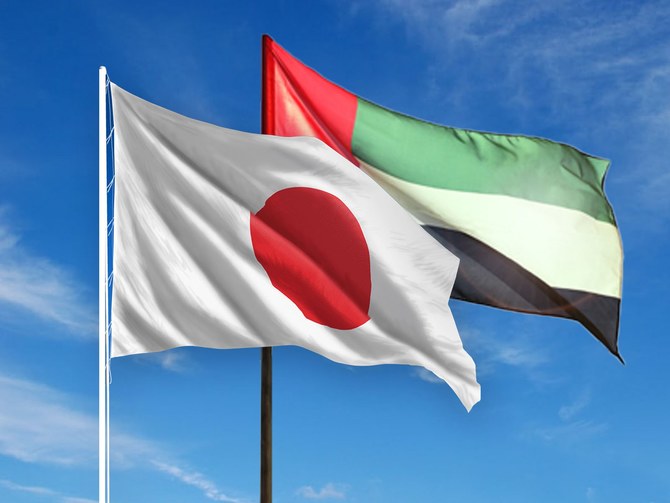

RIYADH: In an effort to increase trade ties, the UAE and Japan agreed to set up a joint business council that will promote cooperation and facilitate greater movement of business communities between both countries.
The Federation of UAE Chambers of Commerce and Industry, and Japan External Trade Organization in Dubai, also known as JETRO Dubai, signed an agreement to set up the proposed bilateral business council by the first quarter of 2023, the Emirates News Agency reported.
The council will work toward developing joint projects and exchanging the expertise of the two sides.
This came during a meeting that brought together Humaid Mohammed bin Salem, secretary general of FCCI, and Masami Ando, managing director of JETRO Dubai, in the presence of officials from both sides.
Bin Salem urged Japanese companies to invest in the UAE and take advantage of government incentives, as well as the favorable investment climate and legislation. He called on Emirati and Japanese businesses to explore business opportunities in the two countries and develop active partnerships to boost trade exchange.
Dubai Future Labs signs 3 deals
Dubai Future Labs, a part of Dubai Future Foundation, signed three agreements with Emirates, DP World, and dnata to deploy advanced future technologies across aviation and logistics – two vital non-oil sectors for Dubai and the UAE.
These national partnerships aim to activate the Dubai Robotics and Automation Program that was launched last September to boost the development, testing and adoption of robotics and automation and accelerate its deployment in key economic sectors, WAM reported.
Dubai Future Labs’ deal with DP World will include developing smart, autonomous electric vehicles for terminal operations that can serve as a more sustainable, reliable, efficient and safer alternative.
Its agreement with Emirates work will facilitate various innovative pilot projects including a robot check-in agent that leverages facial recognition and interacts with passengers as well as a robot waiter serving in airport lounges.
Whereas the deal between Dubai Future Labs and dnata will promote research, development and trial innovations to further improve safety, efficiency and sustainability across the company’s ground handling and cargo operations at Dubai International and Dubai World Central airports.
Integrated platform for investment
Dubai ruler Sheikh Mohammed bin Rashid Al Maktoum approved the establishment of an integrated national platform that highlights opportunities for investors in various sectors, such as financial technology, tourism, manufacturing, and renewable energy.
The platform will be supervised by the Ministry of Economy.
He also approved the national building regulations and standards, which includes sustainability standards for roads, buildings, and housing, to decrease the consumption of natural resources and reduce the carbon footprint of the UAE.
The UAE Cabinet meeting also approved the foreign investor compass project, which represents one of the transformative projects of the Ministry of Economy, WAM reported.
The new project includes an electronic platform, guides and promotional tools that highlight various opportunities for foreign investors in the sectors of financial technology, agricultural technology, healthcare, education among others.