

Indonesia’s Mt. Semeru unleashes lava river in new eruption

1 / 2
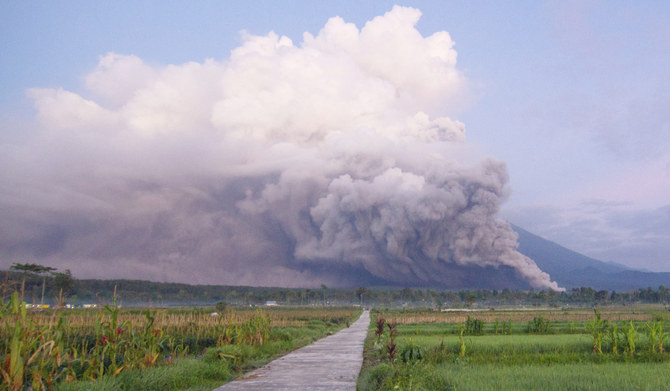
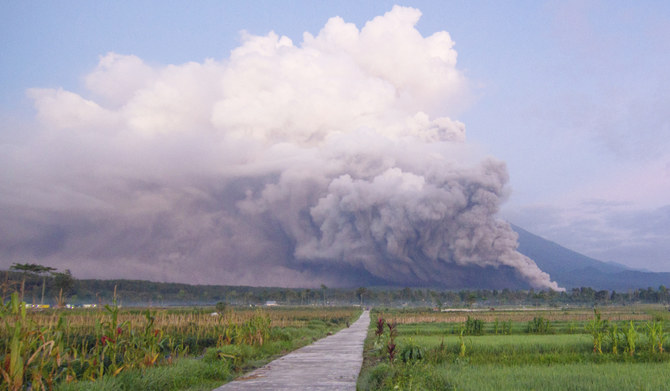
Mount Semeru releases volcanic materials during an eruption on Sunday, Dec. 4, 2022 in Lumajang, East java, Indonesia. (AP)
2 / 2
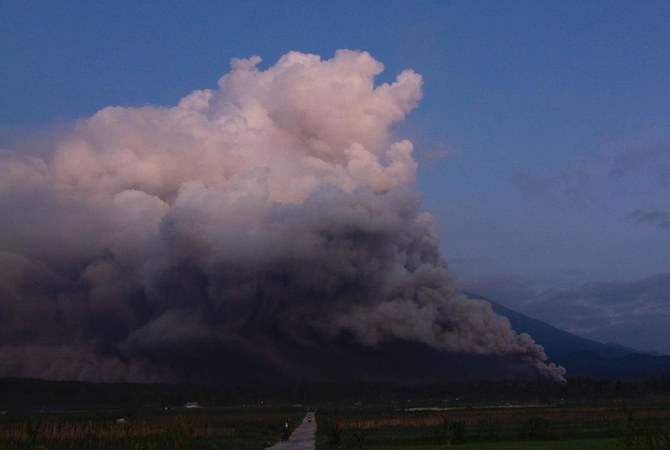
Indonesia’s disaster mitigation agency warned residents not to conduct any activities within 5km of Semeru volcano eruption center. (AFP)
Short Url
Updated 05 December 2022
Follow

Indonesia’s Mt. Semeru unleashes lava river in new eruption

  • Semeru volcano on Java island spews a column of ash 1.5km into the air
  • Indonesia has the largest population globally living in close range to a volcano

JAKARTA, Indonesia: Indonesia’s highest volcano on its most densely populated island released searing gas clouds and rivers of lava Sunday in its latest eruption.
Monsoon rains eroded and finally collapsed the lava dome atop 3,676-meter (12,060-foot) Mount Semeru, causing the eruption, according to National Disaster Management Agency spokesperson Abdul Muhari.
Several villages were blanketed with falling ash, blocking out the sun, but no casualties have been reported. Several hundred residents, their faces smeared with volcanic dust and rain, fled to temporary shelters or left for other safe areas.
Thick columns of ash were blasted more than 1,500 meters (nearly 5,000 feet) into the sky while searing gas and lava flowed down Semeru’s slopes toward a nearby river.
Increased activities of the volcano on Sunday afternoon prompted authorities to widen the danger zone to 8 kilometers (5 miles) from the crater, said Hendra Gunawan, who heads the Volcanology and Geological Hazard Mitigation Center.
He said scientists raised the volcano’s alert level to the highest and people were advised to keep off the southeastern sector along the Besuk Kobokan River, which is in the path of the lava flow.
Semeru’s last major eruption was in December last year, when it blew up with fury that left 51 people dead in villages that were buried in layers of mud. Several hundred others suffered serious burns and the eruption forced the evacuation of more than 10,000 people. The government moved about 2,970 houses out of the danger zone.
Semeru, also known as Mahameru, has erupted numerous times in the last 200 years. Still, as is the case with many of the 129 active volcanoes in Indonesia, tens of thousands of people continue to live on its fertile slopes.
Indonesia, an archipelago of more than 270 million people, sits along the Pacific “Ring of Fire,” a horseshoe-shaped series of fault lines, and is prone to earthquakes and volcanic activity.


Fourth pair of Filipino twins set to fly to Riyadh next week for separation surgery

Updated 4 sec ago
Follow

Fourth pair of Filipino twins set to fly to Riyadh next week for separation surgery

  • Born in April 2024, Olivia and Gianna Manuel are joined from the chest to the abdomen
  • Their mother learned about Saudi Conjoined Twins Program from social media updates

MANILA: As they prepare to travel to Riyadh next week for separation surgery, the parents of Olivia and Gianna Manuel have renewed hopes that their children will grow up like others, as they have become the fourth pair of Filipino twins to be taken care of by the Saudi Conjoined Twins Program.

The girls from the town of Talavera in the central Philippine province of Nueva Ecija were born in April 2024.

They are joined from the chest to the abdomen, a condition known as omphalopagus.

“They can’t eat properly. It’s really difficult for them. When one is lying down, the other often gets pinned down because the bigger one is very hyper. The smaller one is usually underneath,” the children’s mother, Ginalyn Manuel, told Arab News.

“When they’re lying down or sleeping, even if one still wants to sleep, she’s forced to wake up because the other keeps moving.”

She first learned about the Saudi Conjoined Twins Program when she followed social media updates on Akhizah and Ayeesha Yusoph, the second pair of Filipino twins to undergo separation surgery in Saudi Arabia.

At that time, she was still in the hospital with the girls, closely monitored by doctors for three months after they were born. She then reached out to the King Salman Humanitarian Aid and Relief Center, which runs the conjoined twins program, and in July last year, a hospital in Riyadh got in touch with her.

After various steps of medical qualification, the Saudi Embassy in Manila announced the girls would soon travel to the Kingdom with their parents to undergo the separation procedure.

They are scheduled to fly to Riyadh on Jan. 26.

“Out of so many people, we were given the chance for our twins to be separated. If it were just us, we really couldn’t afford it. The help from the Saudi government is truly enormous,” Manuel said.

“I imagine them playing here, already apart, walking on their own. It feels so good just thinking about it. That’s what I always include in my prayers — that their separation surgery will be successful.”

Saudi Arabia is known as a pioneer in the field of separation surgery. KSrelief was established by King Salman in 2015 and is headed by Dr. Abdullah Al-Rabeeah, one of the world’s most renowned pediatric surgeons.

Since 1990, he and his team have separated more than 140 children from 27 countries who were born sharing internal organs with their twins.

The first pair of Filipino conjoined twins, Ann and Mae Manzo, were separated under the program in March 2004. They were joined at the abdomen, pelvis and perineum.

They were followed by the Yusoph twins, who were joined at the lower chest and abdomen and shared one liver. Their successful separation procedure was in September 2024.

The third pair of Filipino conjoined twins, Maurice Ann and Klea Misa, who are joined at the head, flew to Riyadh in May and are currently being prepared for their surgery.