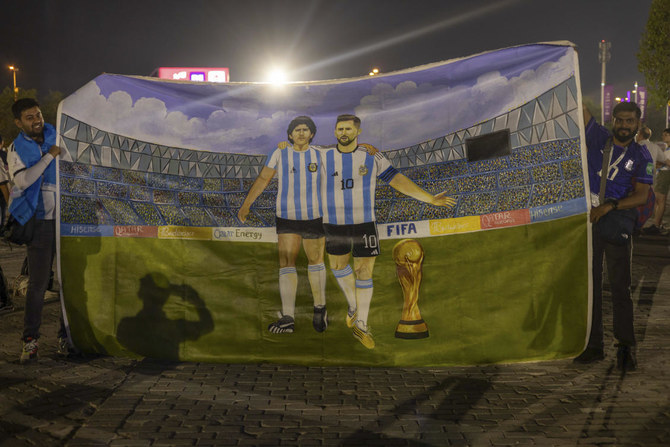
DOHA: On their way to Argentina’s decisive game against Poland, Mohit Daga and Aayush Verma approached the stadium carrying a massive painting of their heroes Lionel Messi and Diego Maradona with the World Cup trophy.
Daga had spent 17 days painting it. It weighed 5 kilograms. An offering. Anything for Messi.
“He is the epitome of everything. He is the source of inspiration and happiness,” said Daga, who is from Kolkata, India. “He brings happiness to our life.”
Argentina are finding a legion of passionate superfans from India, Bangladesh and other Asian countries at the World Cup in Qatar.
Thousands have traveled to the Gulf nation specifically to see Messi and his team with their own eyes, while many others are among migrant workers that make up about 90 percent of the emirate’s population of 3 million.
Other Argentina fans cheered from afar. In Indonesia, social media showed hundreds of people celebrating Argentina’s team’s 2-0 win over Poland after watching the game on large screens. They paraded on motorbikes waving flags after Argentina secured progress to the knockout stages. A newsreader wore an Argentina shirt during a broadcast.
Smitha Issac, originally from India, now living in Qatar, was attending the game with her family, including two sons who were “too excited” to see Messi.
Isaac said: “We are expecting that he will just make something like magic today.”
Outside Stadium 974 shortly before kickoff on Wednesday, Argentina fans were still scrambling for any spare tickets to see the game. Demand far outstripped supply for the 44,000-capacity stadium.
Mohammed Haque from Bangladesh, now living in Australia, was one of the lucky ticket holders. He waved a large Argentina flag as he walked toward the flood-lit stadium made of shipping containers, approaching it like a holy shrine.
“It’s unbelievable,” Haque said of seeing Messi for the first time. “I’ve actually been preparing for the last two or three weeks for this. I had a sleepless night last night.”
Argentina has had a big following in Bangladesh since the days of Maradona, one of the greatest to play the game, and an icon to fans around the world.
“Diego Maradona, he was exceptional. And from then I just loved this country and especially the soccer every time,” Haque said. “Then later, (Gabriel) Batistuta, (Hernan) Crespo, every Argentine player, and now Messi is the legend.”
Bangladesh, India and Pakistan — where cricket is king — have never played a World Cup. So when the tournament comes along, many soccer fans typically root for Argentina or Brazil, soccer powerhouses admired for their attacking style of play and a long line of international stars, including Messi, Maradona and Pele.
Fans who had traveled from Argentina to support their team in Qatar were delighted with the support from non-Argentines.
“We love to see other countries showing their love for Messi and Maradona,” said Mauricio Neraj from Mendoza, Argentina. He posed for pictures next to the Messi and Maradona painting by Daga outside the stadium.
Some of the South Asian fans in Qatar said they were deeply hurt by speculation on social media and in some Western media before the tournament that they were hired actors, paid by Qatar to fill the stadiums. The World Cup organizing committee rejected the reports as false.
“It is coming from the bottom of our hearts. It is not coming from any outside forcing or anything like that,” said Binoy John, and Indian worker in Qatar who has been an Argentina fan since childhood when he saw Maradona lead Argentina to win the 1986 World Cup. “All the fans are true fans. There is nothing like fake fans out here.”
Argentina have a following among Arab soccer fans, too. Messi-devotion brought Ahmed Qassim Nasher from Yemen to see his favorite player as Argentina advanced.
“Football is a festival, joy, celebrations. It connects people from different nationalities, different languages, and different ethnicities,” Nasher said. “You will find Arabs and non-Arabs coming to cheer for Messi. It’s common sense that he will have the best audience and fans, because he is the best player throughout history.”

Messi fans from Asia cheer on Argentina at World Cup
https://arab.news/zmhqu
Messi fans from Asia cheer on Argentina at World Cup
- Bangladesh, India and Pakistan — where cricket is king — have never played a World Cup
- Fans who had traveled from Argentina to support their team in Qatar were delighted with the support from non-Argentines
Saudi rally driver sets her sights on the fast lane
- With podium finishes at home and ambitions abroad, Mashael Al-Saad is ready for the next race
- Rally Jameel remained a defining chapter in Al-Saad’s journey, exposing her to the demands of desert racing and pushing her beyond familiar limits
MAKKAH: What began as a chance encounter with motorsport has evolved into a growing rallying career for Saudi driver Mashael Al-Saad.
With a growing list of domestic achievements and ambitions that extend beyond the Kingdom’s borders, Al-Saad is carving out her place in a discipline defined by endurance, precision and mental resilience.
Her first exposure to rally driving came as she emceed the second Rally Jameel in 2023, the region’s first women-only navigational rally.
Witnessing the participants’ determination and competitiveness sparked Al-Saad’s curiosity about motorsport and encouraged her to explore the possibility of competing herself.
A recommendation from Saudi rally driver Abdullah Bakhashab opened the door to her first professional opportunity with Lexus, marking the start of her rally career during the fourth Rally Jameel in 2024.
That quickly translated into results. As a Lexus team driver, Al-Saad secured first place in her category and sixth overall among more than 40 participants.
Rally Jameel remained a defining chapter in her journey, exposing her to the demands of desert racing and pushing her beyond familiar limits. She continued to compete in subsequent editions, later earning second place overall and first in her category, before taking part in events at other race circuits across Saudi Arabia and the wider Middle East and North Africa region.
Despite entering a traditionally male-dominated sport, Al-Saad says she did not perceive her path as a challenging one.
Instead, she highlights the extensive support she received on multiple fronts, from Saudi Arabia’s leadership and the Saudi Automobile and Motorcycle Federation to corporate backing from Lexus.
She also credits her family, particularly her mother, for playing a vital role in shaping her confidence and determination long before she entered competitive racing.
Among her domestic successes, Al-Saad considers her Time Attack victory in Jeddah last year as one of the most significant milestones of her career. One of her earliest races, it saw her progress steadily to first place in the Women’s Cup, reinforcing her belief in her own capabilities.
Another pivotal moment came in 2024, during the Racing Hill Climb, where she raced on mountainous terrain for the first time in Taif. The unfamiliar conditions tested her technical skills and adaptability, ultimately accelerating her development as a driver.
Competing at a high level has reshaped Al-Saad both on and off the track. Racing alongside experienced champions has, she says, been both humbling and motivating.
Over time, she has developed a deeper understanding of the technical side of motorsport, spending increasing amounts of time studying vehicle dynamics and kinematics to better synchronize her driving style with the car. Personally, the sport has made her more confident in facing uncertainty, strengthening her ability to approach new challenges with focus rather than fear.
Al-Saad is often viewed as a role model for Saudi women entering motorsport, something which makes her feel humble. She says she would be honored to inspire just one woman but believes role models exist across all levels of the industry. For her, progress comes from observing the strengths of others and applying those lessons to one’s own journey — a philosophy she sees as relevant far beyond motorsports.
Managing pressure and risk is an integral part of rallying, and Al-Saad relies on preparation and composure to navigate intense stages. Planning ahead helps her mitigate challenges, while calm decision-making becomes crucial when conditions change unexpectedly.
In a sport where every second counts, she emphasizes that clarity and decisiveness often make the difference between success and setback.
Looking ahead, Al-Saad has set her sights firmly on international competition. She aims to compete in the Middle East Rally Championship and hopes one day to line up at the start of the Dakar Rally in Saudi Arabia.
She is also eager to explore other racing formats, viewing the learning process itself as one of the most rewarding aspects of her career.
To young Saudi women who aspire to follow a similar path but hesitate because they fear failing, Al-Saad offers a simple word of advice — start.
She believes progress begins with the first step, learning through experience and allowing confidence to grow over time.
In a rapidly evolving motorsports scene, her journey stands as a reflection of what is increasingly possible in Saudi Arabia — both on the road and beyond it.


