


AL-MUKALLA, Yemen: Two Yemeni children were killed by a landmine laid by the Houthis in the central province of Marib on Tuesday, increasing the total number of civilians killed or injured by Houthi landmines in one week to nine.
The news comes as a government body confirmed the discovery of wide tracts of ground extensively polluted by Houthi landmines in six provinces.
Yemeni Landmine Monitor reported that two brothers, Abbad and Saleh Abdullah Al-Muradi, were killed and their sister Nemah was severely injured in a landmine explosion in the Rahbah district in Marib, bringing the total number of civilians killed in one week to four and the total number of civilians wounded to five.
The Yemeni group said that two additional individuals were killed and two more were injured in a landmine and ordnance explosion in the western province of Hodeidah, in addition to a child who was injured after touching a landmine in the central province of Al-Bayda.
The Iran-backed Houthis have buried thousands of landmines at previous flashpoints around the country over the last eight years to impede the military advances of their opponents.
The landmines have been planted in farms, schools, health institutions and residential areas and hindered individuals from reaching their places of employment or gaining access to food.
The UN-brokered truce that went into effect on April 2 has restored relative calm to certain hot battlefields, like the city of Marib, enabling some displaced individuals to return home.
Despite the cessation of hostilities, the threat of death and danger posed by Houthi landmines has not abated.
Locals have accused the Houthis of placing landmines in Marib and other Yemeni cities as retaliation against anyone who resisted their military ambitions.
“The Houthi battle in a specific territory does not stop with their loss. Instead, they plant landmines …to make the inhabitants of this area pay dearly for their persistent opposition,” Dhayfullah Al-Dahmashi, a Marib resident, said on Facebook.
Karama Naji, a 7-year-old from the Al-Juthan’an area of Marib, said that while playing outside her home, she tampered with a piece of metal she discovered. The metal was an explosive device left by the Houthis in her village, which detonated, injuring and paralyzing the child’s legs.
“I hope to be able to walk, receive treatment, and find a ride to my distant school,” the child said, according to the Saudi-funded demining program Masam in Yemen.
Yemeni government officials said that this year they uncovered landmine fields planted by the Houthis in the provinces of Abyan, Lahj, Aden, Taiz, Hodeidah and Dhale.
Ameen Saleh Al-Aqeli, director of the Yemen Executive Mine Action Center, praised the efforts of Saudi Arabia to help Yemenis clear Houthi mines.
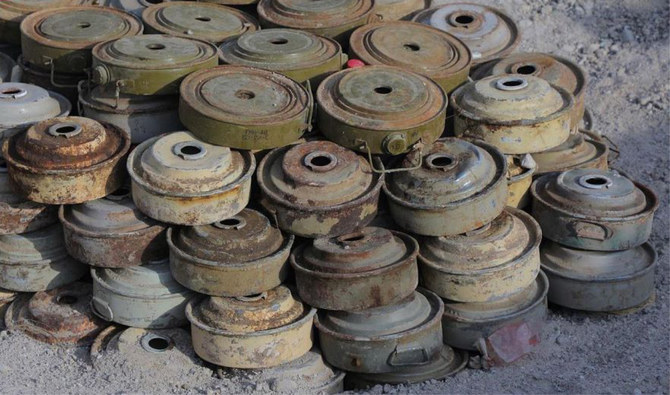
During his speech on Saturday at the 20th meeting of signatory countries to the Ottawa Treaty, which aims to eliminate landmines around the world, he said the Saudi demining program, which operates in 29 Yemeni districts, has retrieved and destroyed roughly 70,000 anti-personnel mines, anti-vehicle mines and explosive devices since early this year.
Al-Aqeli said that this year 487 non-technical survey trips by deminers in Yemen’s mine-contaminated regions in six provinces uncovered 68 potentially hazardous locations with a total area of 16,571,000 square meters and 21 verified problematic areas with a total area of 25,917,000 square meters.


