


Review: ‘The Guardians of Galaxy Holiday Special’ brings festive cheer to MCU

1 / 3
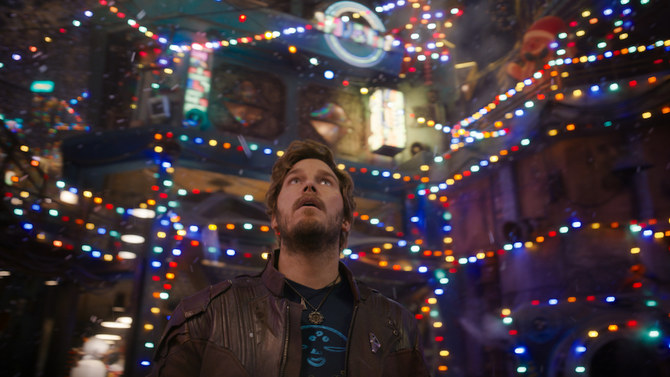
This festive ‘Guardians of the Galaxy’ installment is as slick as the wider cinematic universe. (Supplied)
2 / 3
This festive ‘Guardians of the Galaxy’ installment is as slick as the wider cinematic universe. (Supplied)
3 / 3
This festive ‘Guardians of the Galaxy’ installment is as slick as the wider cinematic universe. (Supplied)
Short Url
Updated 28 November 2022
Follow

Review: ‘The Guardians of Galaxy Holiday Special’ brings festive cheer to MCU

LONDON: Viewers over a certain age may find that the phrase “Holiday Special” sends a shiver down their spine, but fear not — James Gunn and the Marvel factory are here to cleanse your palette. Gunn, recently announced as the new head of the DC cinematic universe, still has one more Marvel movie on the horizon, but before “Guardians of the Galaxy Volume 3” hits cinemas in 2023, the director has reunited with the ragtag group of heroes for a seasonal one-shot on the Disney+ streaming platform — the latest in Marvel’s series of Special Presentations after October’s “Werewolf by Night.”

In an attempt to cheer up fellow Guardian Peter Quill (Chris Pratt), Mantis and Drax (Pom Klementieff and Dave Bautista) set out to give their friend an Earth-style Christmas, complete with lights, decorations and gifts. Except that their idea for a gift is to journey to Earth and kidnap actor Kevin Bacon, star of Quill’s favorite childhood movie, “Footloose.” Cue a series of comic interactions between the superhero Guardians and Earth’s population as they chase down and abduct Bacon and whisk him into space.

Unlike the now infamous 1978 “Star Wars Holiday Special,” this festive “Guardians” installment is as slick as the wider cinematic universe. For starters, it has excellent production values, appearances from all the Guardians (including Bradley Cooper as Rocket, Karen Gillan as Nebula, Vin Diesel as Groot, Sean Gunn as Kraglin, and Maria Bakalova as new member Cosmo), and a story that, while light and throwaway, still fits into the wider MCU narrative. If anything, this is more of a scene-setting exercise for “Volume 3” than a seasonal cash-in. Gunn, and his ensemble cast, have clearly grown to love these characters as much as anyone, so there’s a feeling of playful reverence about this “Holiday Special” — not to mention a welcome sense that, while it’s silly and festive, this is as important to the Marvel timeline as any of the big-screen movies.


Lebanese filmmaker turns archival footage into a love letter to Beirut

Updated 28 February 2026
Follow

Lebanese filmmaker turns archival footage into a love letter to Beirut

LONDON: Lebanese filmmaker Lana Daher’s debut feature “Do You Love Me” is a love letter of sorts to Beirut, composed entirely of archival material spanning seven decades across film, television, home videos and photography.

The film premiered at the 82nd Venice International Film Festival in September and has since traveled to several regional and international festivals.

Pink Smoke (2020) by Ben Hubbard. (Supplied)

With minimal dialogue, the film relies heavily on image and sound to reconstruct Lebanon’s fragmented history.

“By resisting voiceover and autobiography, I feel like I had to trust the image and the shared emotional landscape of these archives to carry the meaning,” Daher said.

A Suspended Life (Ghazal el-Banat) (1985) by Jocelyne Saab. (Supplied)

She explained that in a city like Beirut “where trauma is rarely private,” the socio-political context becomes the atmosphere of the film, with personal memory expanding into a collective experience — “a shared terrain of emotional history.”

Daher said: “By using the accumulated visual representations of Beirut, I was, in a way, rewriting my own representation of home through images that already existed."

Whispers (1980) by Maroun Bagdadi. (Supplied)

Daher, with editor Qutaiba Barhamji, steered clear of long sequences, preferring individual shots that allowed them to “reassemble meaning” while maintaining the integrity of their own work and respecting the original material, she explained.

The film does not feature a voice-over, an intentional decision that influenced the use of sound, music, and silence.

The Boombox (1995) by Fouad Elkoury. (Supplied)

“By resisting the urge to fill every space with dialogue or score, we created room for discomfort,” Daher said, adding that silence allows the audience to sit with the image and enter its emotional space rather than being guided too explicitly.

 The film was a labor of love, challenging Daher personally and professionally.

“When you draw from personal memory, you’re not just directing scenes, you’re revisiting parts of yourself and your childhood,” she said. “There’s vulnerability in that.”