

Saudi singer Tamtam embraces home with new music release
Tamtam launches ‘Ismak’ EP in Riyadh
Rising star recently collaborated on World Cup anthem
Updated 25 November 2022
Nada Alturki
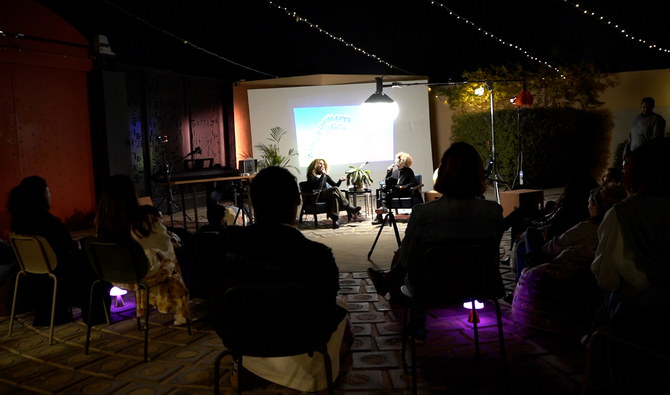
RIYADH: Saudi singer Tamtam launched her latest Extended Play offering titled “Ismak” during an intimate backyard session here recently, and also spoke about her journey as an artist and the inspiration behind her work.
As part of their “Auditorium Session” series, Al-Mashtal Creative Incubator created a space for Tamtam to connect with her hometown and perform her songs on the EP live to fans and friends, accompanied by the sounds of Lambda and B-Element.
“One of my favorite songs from the EP is ‘Repetition,’” Tamtam said. The EP was co-executive produced by Abu Dhabi Music and Arts Foundation.
“I swear this song changed my life. After I wrote it, I would wake up every day and I would say: I’m ready now … I’m so tired of people telling me like, ‘you’re going to be ready tomorrow, you’re going to be ready in two years.’ I’m ready now.”
It certainly is Tamtam’s time now, having just recently released the 2022 Coca Cola World Cup anthem in collaboration with Egyptian rapper Felukah and Mexican singer Danna Paola, remaking Queen’s 1986 hit “A Kind of Magic.”
She also performed at the annual light festival Noor Riyadh and has an upcoming appearance at Saudi Arabia’s largest music festival MDLBEAST’s Soundstorm.
“When the community knows that there’s going to be XP, a music conference, or Soundstorm, a music festival, they’re gonna feel inspired, and they’re gonna have a goal in their mind. Like, ‘oh, I can play there one day; I want to do this one thing,’” Tamtam told Arab News.
The singer described having “chills” when the opportunity arose to host a release party in her home country. As the Kingdom embraces opportunities for cultural exchange and economic development, Tamtam urged a greater focus on the importance of local music representation in the region.
“I think that’s so important to not just see it outside of Saudi Arabia or outside of the Middle East. It’s so beautiful that it’s in the country, and (that these music platforms are) happening here,” she said.
Since the artist grew up in a multicultural environment, bridging those cultures came naturally. She described listening to Western music as an escape that she needed from her surroundings.
As her playlist diversified to Britney Spears, Spice Girls, and Fairuz, her eclectic taste manifested in her own sound, as her latest EP uniquely mixes Arabic and English lyrics.
“I loved the lyrics and the beautiful language of the Arabic music and I loved the … (I) don’t know if I should say confidence or the stage presence of the Western side, of the Western artists.
“I wanted to combine the two because I’m influenced by both, so that’s what I’m doing with this EP,” she said.
While becoming a female musician in the Saudi music industry may still be somewhat “taboo,” Tamtam said she has received nothing but “support.” She welcomes collaborations with other artists and hopes to see local creatives on a global stage one day.
“It’s just so beautiful to create together as a community.
“I know there aren’t a lot of female musicians on the main stages now, but I see them, they’re working on their craft, they’re working on their music, and soon they’re gonna be there,” she said.
She attributes her positivity, which she certainly radiates, to her parents.
Deeply personal, her EP examines themes of rising from adversity, finding one’s voice, and embracing confidence on five tracks — “Ismak,” “Run,” “Insak,” “Repetition” and “Liberation.”
“It’s a really beautiful time to be in Saudi Arabia and to be creating art and music and we should all celebrate this moment together. So I’m really grateful to do this, something like this because it’s different than going on stage and doing a big show. This is more intimate and it’s great to celebrate intimately with the community,” she said.
After an insightful chat about her creative process with Elham Ghanimah, Al-Mashtal’s creative labs curator, she performed the set of songs, ending with her favorite “Repetition,” which resonated with the assembled audience.
Prompting members of the audience to pull out their phones and write down something they wanted to achieve, the night ended with Tamtam chanting in unison with them: “I’m ready now.”
Creativity, heritage and technology converge in a new generation of artists
Updated 5 min 53 sec ago
Nada Alturki
RIYADH: As Saudi Arabia’s Vision 2030 places creativity, culture and technological innovation at the core of national development, the impact of these priorities is becoming increasingly visible across a wide range of disciplines and practices.
Through the use of artificial intelligence, young Saudis are integrating technology into their creative work both as a practical tool and as a medium in its own right. In doing so, they are expanding their capabilities, exploring personal and collective identity, and finding new ways to preserve and reinterpret cultural heritage.
“AI gives young Saudis a new way to interact with their own cultural inheritance,” said Dmitry Zaytsev, founder of Dandelion Civilization, a platform designed to help individuals shape unique professional paths.
Dmitry Zaytsev, founder of Dandelion Civilization. (Supplied)
“Traditional design elements such as calligraphy or geometric motifs were once difficult to modify. Experimentation required resources and formal approval. AI removes that barrier and makes exploration immediate. A creator can test many versions of a pattern and see which ones still feel authentic to them,” he told Arab News.
According to Zaytsev, this emerging form of expression does not signal a rejection of tradition, but rather a deeper engagement with it. “The young creator discovers what can change and what must remain constant. AI becomes a sketchbook that allows culture to evolve through curiosity rather than fear. When creators correct a model or push it toward local rhythm, they strengthen rather than dilute cultural identity,” he explained.
Sarah AlBaiz, an art adviser, researcher and artist, uses code to blend visual art with concepts drawn from culture and philosophy. While her early practice focused primarily on painting, her trajectory shifted during the 2020 AI Artathon, a pioneering international event highlighting collaboration between humans and machines in artmaking, where she discovered how to merge her engineering background with her creative work.
DID YOU KNOW?
• Saudi youth are using AI as a creative tool to reinterpret heritage, from calligraphy to folklore.
• AI is helping artists experiment faster without the traditional barriers of resources or formal approval.
• The Kingdom is backing creative AI nationally, with programs like SAMAI aiming to empower 1 million Saudis for an AI-driven future.
Operating within the field of computational creativity, where technology actively participates in the artistic process, AlBaiz explores themes of finance and faith. “Because they’re two sides of who I am,” she said. “When you talk about values, for example, that is both a term used in finance and trade from an objective perspective, but also moral and spiritual value.”
“When you understand prompting in AI, you can get it to produce almost anything. But it’s also informed by the training data it has,” she said.
Sarah Albaiz's "Diriyah II (2020)" melds a traditional Saudi landmark with the avant-garde. This generative artwork rejuvenates the historic Alsalwa Palace in Diriyah. By infusing Munira AlTheeb's artistry through GAN style transfer, the piece stands as a testament to the evolving narrative of Saudi heritage. (Supplied)
Rather than relying on a single platform, AlBaiz experiments with multiple AI models to test their limitations and audience reception. “I work a lot with language as well, so large language models are right up my street when it comes to computational creativity.”ee
Her work has gained international recognition. At the 2022 Islamic Arts Biennale in Jeddah, she co-created an artwork under the banner of Super Artistic AI that generated Al-Qatt Al-Asiri motifs from southern Saudi Arabia. The piece received an Audience Award.
Beyond her artistic practice, AlBaiz is developing an intelligent art advisory system aimed at helping users navigate the Saudi art landscape. Designed as an initial point of contact, the system would guide users through potential pathways before they engage with a human adviser.
Inverting established gender norms, Sarah Albaiz's digital collage reimagines masculinity. Set against a generative backdrop, its core message "real men cry" challenges familial WhatsApp discourses. (Supplied)
“It’s about understanding what role AI plays in the pursuit of what you want,” she said. “When I decided to focus on Qantara and building the advisory, I recognized that many of the systems required would need to be intelligent systems that offload a lot of work from me and the team.”
“When AI is an enabler rather than the end result, it becomes less intimidating because it feels risk-free for the end user,” she added.
Zaytsev echoed this idea, describing AI as a kind of rehearsal space. “Young people practice conversations, explore sensitive topics and organize their thoughts without social risk. This builds emotional clarity and confidence,” he said.
While generative tools such as large language models attract much of the attention, AI’s creative applications extend far beyond text and image generation.
Fairooz Alawami, trained as both an architect and engineer, uses AI to create self-expressive visual works inspired by dance.
Fairooz AlAwami's work. (Supplied)
“My practice is focused on contextualizing movement,” she said. “Because of my architectural training, I work with 3D modeling software called Rhino, which includes a visual coding language. Within that environment, you can also write code in Python, JavaScript or C#.”
Alawami employs OpenPose to analyze videos of her dancing by mapping points across her body. She then applies another computer vision model, MIDAS, which converts images or videos into depth frames. “If OpenPose gives me a skeleton, MIDAS gives me depth,” she explained. The resulting data is fed into 3D modeling software, where it is refined and manipulated into finished artworks.
She began dancing at a young age. “I didn’t find it, it found me,” she said. Movement later became the foundation of her artistic practice, leading to her first major project around three years ago while completing her master’s degree using the Grasshopper plugin. At the time, the workflow was slow and fragmented, but the arrival of ChatGPT helped streamline the process by making it easier to write and learn code.
Fairooz AlAwami's work. (Supplied)
“I think my love for dance and my love for art and design came together in a way that felt uniquely me,” she said. “Once I found that space, I just ran with it. It is my singular voice.”
Her work also draws heavily on cultural and musical heritage. One recent project was inspired by folklore referenced in the iconic song “Al Leila wa Leila” by Umm Kulthum. Alawami extracted musical stems from the track and mapped them to characters within the narrative. “The vocals were Shahrazad, the storyteller, and each stem represented a different narrative element,” she said. Earlier works were influenced by Islamic architecture and the geometric patterns found throughout Saudi Arabia and the wider Arab world.
“There are some incredible artists using generative AI to do very impressive things, and I don’t think I fall into that camp,” she said. “For me, AI is more like a skills-gap tool that helps me reach where I want to go.
“As humans, whether we realize it or not, the act of creating feeds us in some way. Lowering the barrier to entry makes creativity less intimidating.”
Opinion
This section contains relevant reference points, placed in (Opinion field)
Today, Saudi Arabia’s creative sector is supported by expanding national infrastructure. Initiatives such as the Cultural Scholarship Program place Saudi students in more than 60 universities worldwide, spanning disciplines from archaeology and literature to design, filmmaking and culinary arts. In parallel, the Kingdom launched the SAMAI initiative last year, aiming to equip 1 million Saudis with the skills needed to engage confidently in an AI-driven world.
Within Vision 2030, culture, tourism, digitalization and AI are treated as strategic sectors rather than peripheral concerns. As Saudi Arabia develops its creative economy as a form of soft power, its youth are becoming increasingly digitally fluent. AI tools are now embedded within creative workflows, enabling a new generation to explore heritage, remix traditional aesthetics and develop narratives that resonate on a global stage.