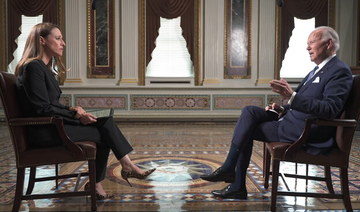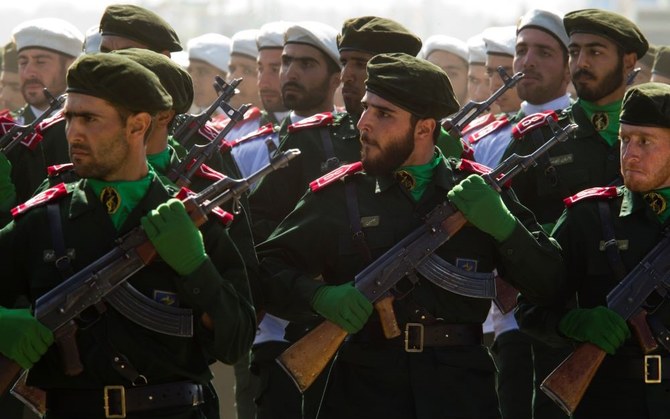

LONDON: A cross-party committee of British MPs and lords on Thursday called for the immediate designation of Iran’s Islamic Revolutionary Guard Corps as a terrorist organization, and the closure of a UK charity linked to the regime in Tehran.
Addressing the president of the National Council of Resistance of Iran, Maryam Rajavi, at a London event attended by Arab News and hosted by the British Committee for Iran Freedom, Conservative MP Theresa Villiers, said: “It’s vital we see a dossier of human rights abuses committed by the mullahs in Iran referred to the UN Security Council.
“This will increase the diplomatic pressure on the regime, but as part of that pressure the UK should shutdown the political office of the supreme leader, the Islamic Centre in Maida Vale. It’s astonishing this is allowed to continue.”
Believed to be funded by government authorities in Tehran, the Islamic Centre of England has faced a series of scandals in recent years, with claims it forms part of a network with close links to the regime.
Villiers added: “We all want to see Iran move towards a free and democratic future. We share the aspirations of those brave protesters and I want that reflected in a robust approach from our government.”
As International Day for the Elimination of Violence Against Women, the committee pushed the pivotal role of women in forcing the regime to what many now believe is its end point.
Today also marks the 70th day of protests sparked by the murder of 22-year-old Kurdish woman Mahsa Amini while in the custody of Iran’s notorious morality police, igniting a tinderbox of pent-up frustrations over falling living standards and discrimination against women and minorities.
Although some questioned the “stomach” of protestors to withstand what was expected to be, and has been, a violent response from the regime, there appear no signs of it slowing down.
“A democratic revolution is occurring in Iran, religious fascism is on its last leg, and Iranian people and their uprisings are the decisive force, yes, the regime has resorted to widespread arrests and killings, but it cannot change the course of the uprisings,” said Rajavi.
“The Iranian people and protesters urge both houses of the British Parliament to lead a bold initiative to encourage the UK government to take necessary steps.”
Rajavi explicitly called on the UK to not only reject the authority of the regime but also urged support for a fact-finding mission to document human rights violations perpetrated by the IRGC.
To date, 60,000 people in Iran have been arrested, 14,000 detained, over 600 have been killed — including a 10-year-old — and as of last week, the regime has begun handing out death sentences.
Bob Blackman, Conservative MP for Harrow East, said: “I join the call from the others here today for our government to finally proscribe and confiscate the assets of the IRGC in the UK — in truth, I’m not sure what else the IRGC need do to be designated a terrorist organization.
“And if the government won’t do this, we will use the mechanisms available to MPs to bring this to the floor of the house and do it as a collective.”
Former parliamentary undersecretary of state for Asia and the Pacific, Lord Bellingham, also called for more stringent focus on Iran’s embassies, describing their activities as “nefarious,” adding that they have been engaged in promoting banned organizations.
Pointing to an attempt on Rajavi’s life during an event in France in 2018 by Iranian diplomat Assadollah Assadi, Blackman added: “Iranian officials have shown they cannot be trusted.”
The committee also used the event to criticize the UN’s “totally ridiculous” decision last year to elect Iran to a four-year term on its top women’s rights body, the Commission on the Status of Women.
That Amini’s murder was in response to an alleged infringement of the regime’s “medieval” hijab laws only further compounded condemnation that Iran remains on the commission.
Lord Polak noted: “The key reason we’re here today is to talk about the brave women of Iran. I called on the government to take immediate action to remove Iran from the UN Commission on women’s rights.
“It’s incredibly concerning Iran was ever elected to the commission; how did the UN actually allow this to happen? It is also concerning that there was no response to this appointment.”