

DUBAI: It has been quite a year for family firm Ermenegildo Zegna Group. The Italian company last week announced it had signed an agreement to enter into a long-term license for Tom Ford fashion with the Estee Lauder Companies.
The news came as Estee Lauder revealed its acquisition of Tom Ford for $2.8 billion.
In December last year, the company went public on the New York Stock Exchange with a market cap of $2.4 billion. The luxury menswear label also significantly rebranded, adopting a singular name, Zegna, and a minimalist logo.
For the heritage brand, the future is as important as maintaining its Italian roots.
And the group’s chairman and chief executive officer, Gildo Zegna, told Arab News about Zegna’s expansion plans for Saudi Arabia.
With the Middle East and Africa reporting recent quarterly growth of 86.4 percent year-on-year, the region is considered a key market for the company.
Zegna said: “Our Dubai Mall store has become the benchmark for our business – 30 different nationalities shop there daily – it’s just unbelievable.”
With Dubai expecting 1 million visitors for the FIFA World Cup in Qatar, he anticipated it would be a profitable month.
And following a trip to Saudi Arabia, Zegna revealed that expansion plans for the Middle East were in full swing.
“It was a very exciting trip – I am amazed to see the resources the people are putting into the country – they want to invest in the future and modernity.
“The key is to be there with good partners which we have (Al-Malki Group), and I think we’re going to get great locations and get super busy,” he added.
In 2023, Saudi Arabia will see the opening of two Zegna boutiques, with several more in the pipeline within the next three to five years in yet more expansion for the 112-year-old label.
It was in 1910 when Ermenegildo Zegna established Lanificio Zegna, a wool mill making the finest textiles from natural fibers, in his hometown of Trivero, Italy.
The business grew into a luxury group including menswear, Thom Browne, acquired in 2018, and one-of-a-kind Made in Italy Luxury Textile Laboratory Platform.
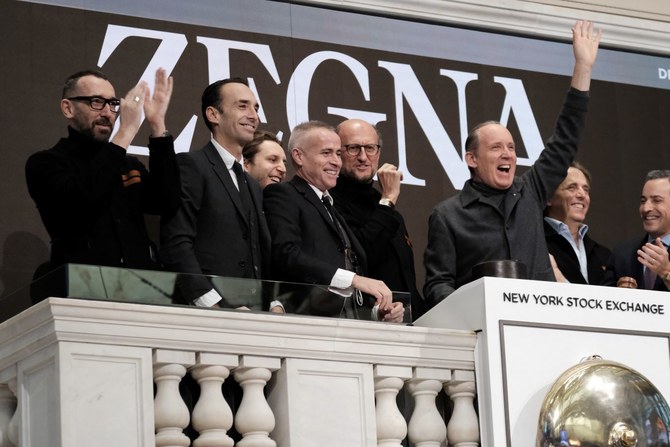
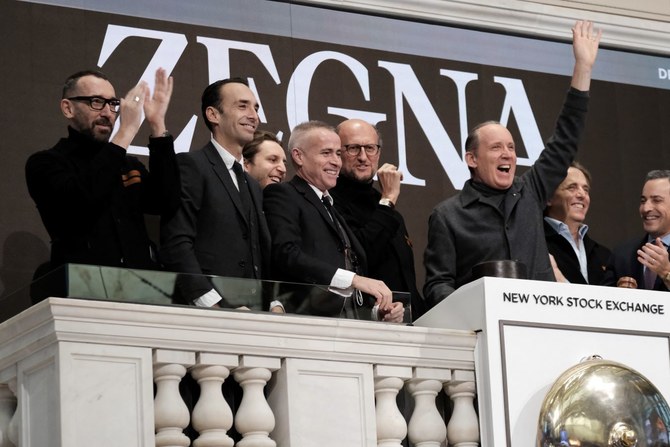
On Dec. 20 last year, Zegna rang the bell at the New York Stock Exchange, making history as the firm became the first Italian fashion brand to list there.
“Going public was probably the biggest and hardest decision of my life – I was putting the firm and the family at stake,” he said.
After much research and planning, the deal went ahead in agreement with Investindustrial Acquisition Corp., a special-purpose acquisition corporation sponsored by investment subsidiaries of Investindustrial VII L.P.
“I also think that it was the best way to prepare the company for the next generation – with the right governance and resources,” Zegna added.
The founding family remains major shareholders with a 62 percent stake. And this year’s financial records would appear to confirm that Zenga’s move was the right one.
For the third quarter of this year, the group posted revenues of 357 million euros ($366 million), up 27.6 percent year-on-year, taking the revenues for the first nine months of 2022 to 1.09 billion euros.
Ahead of the initial public offering, the company rebranded itself by putting all three clothing lines under one umbrella.
Zegna said: “We decided to consolidate and have one brand – Zegna.”
Brand equity had always been a strong focus at Zegna, and the latest move has created a more streamlined identity for the label, as did its new logo featuring a double-stripe signifier.
Although known for its made-to-measure suits using top-quality fabrics, the brand has branched out into creating luxury leisure wear under the creative direction of Italian fashion designer Alessandro Sartori.
“Before the coronavirus pandemic hit, I called in the executive committee to launch a new project that changed the perception of Zegna from tailoring to luxury leisure wear – that was the beginning of a new era and probably one of the smartest decisions I made,” Zegna added.
Through focusing on category management and creating iconic products such as the triple stitch sneaker and knitwear, Zegna has become more accessible to different age groups.
Referring to the overshirt and casual pants he was wearing for the Arab News interview, the company boss said it was the new Zegna norm and an approach that appealed to loyalists and younger generations.
“It’s about creating excellent products with a contemporary style in innovative fabrics,” he added.
With its made-to-measure service, everything from sneakers to knitwear, outerwear and suits can be customized in various materials and colors.
This year, Zegna also unveiled an exclusive partnership with Real Madrid as its official travel wear partner – a move capitalizing on football’s growing relationship with high fashion. Dior, Moncler, and Off-White are some of the other big brands that have signed deals with major football clubs.
Footballers make influential brand ambassadors. In the Zegna campaign, the Real Madrid players are seen wearing the brand’s signature overshirt and triple stitch sneakers, highlighting its timeless yet contemporary approach to design.
Italian-made menswear aside, its textiles division remains a global benchmark for luxury fabrics and one of the company’s most significant growth drivers.
Third-quarter financial results showed textile revenues hitting $31 million, up 33.3 percent year-on-year. The firm continues to supply its textiles to some of the most premium high-end brands, including Gucci and Tom Ford.
With a vertically integrated supply chain, the brand has strong control over its suppliers. Last year, alongside Prada, it acquired an Italian cashmere producer.
Zegna said: “Filati Biagioli Modesto is a company I bought with Mr. Bertelli of Prada to make sure we have a good supply of traceable cashmere that is becoming very scarce. From sheep to shop, we are the only luxury company that is fully integrated.”
Elsewhere, from its Achill farm in New South Wales, Australia comes the finest merino wool, shipped to the firm’s Italian mills and then onto shops.
He pointed out that through its supply chain, the company was stronger in terms of sustainability with traceable fiber.
Zegna noted that the firm had always attempted to give back to the environment, whether through its Oasi Zegna forest reserve in Italy, or upcycling.
“Our #UseTheExisting project utilizes leftovers of existing fibers and fabrics to minimize waste,” Zegna added.
Items from the eco-conscious collection can be purchased online and in store.


