

Indonesian earthquake death toll rises to 268 as search for survivors continues

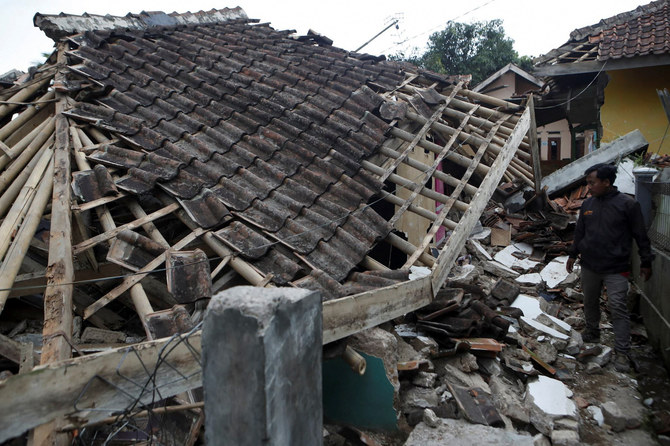
A damaged house is pictured after an earthquake in Cianjur, West Java province, Indonesia, November 22, 2022. (Reuters)
Short Url
Updated 22 November 2022
Follow

Indonesian earthquake death toll rises to 268 as search for survivors continues

  • Over 1,000 people injured and 151 still missing, latest data shows
  • Cianjur, the quake’s epicenter, is one of Indonesia most disaster-prone areas

JAKARTA: The death toll from an earthquake that hit Indonesia’s main island of Java has risen to 268, the National Disaster Management Agency said on Tuesday, as rescue workers raced to reach survivors trapped under the rubble.

At least 151 people are still missing after the 5.6 magnitude earthquake struck the mountainous West Java province on Monday afternoon. The quake had struck at a depth of 10 km, injuring over 1,000 people as it triggered landslides and damaged more than 22,000 buildings.

Efforts to reach the victims were hampered by power outages, damaged roads and landslides, with local hospitals reportedly treating hundreds of the injured on stretches outside main buildings, in parking lots and open spaces.

Officials are still working on identifying the victims, said Suharyanto, the chief of the National Disaster Management Agency, or BNPB.

“We have identified at least 122 bodies … aside from that there are still victims who are missing and we are continuing our search,” Suharyanto said during a press conference, adding that some of those who have been identified were children.

President Joko Widodo visited the epicenter of the earthquake in Cianjur on Tuesday, and said that the government would hand out compensation to victims and their families to reconstruct damaged homes, adding that housing must be built to be earthquake-resistant.

“For the victims who are still trapped, I have instructed for their evacuation and rescue to be prioritized,” Widodo told reporters.

Dwikorita Karnawati, the head of Indonesia’s meteorological, climatology and geophysical agency (BMKG), said that 145 aftershocks were recorded as of Tuesday afternoon, adding that they would reduce in frequency in the next four days.

“This earthquake, based on research and analysis by BMKG, is an earthquake with a return period of about 20 years,” Karnawati said.

“What this means is that an earthquake would likely occur again within an estimated 20 years, so during the reconstruction period it is very crucial to ensure that the buildings will be earthquake-resistant,” she added.

The Indonesian archipelago lies on the so-called “Ring of Fire,” an arc of volcanoes and fault lines along the Pacific Basin that lead to a high frequency of earthquakes and volcanic eruptions.

Cianjur district is considered one of the most disaster-prone areas in Indonesia, suffering frequent floods, landslides, droughts and also geological hazards. Monday’s quake had been felt in other parts of Java, including Bandung city and the Indonesian capital Jakarta, where people left tall office buildings and reported shaking and furniture moving.

In 2004, a 9.1 magnitude quake off Sumatra island triggered a tsunami that killed almost 230,000 people in more than a dozen countries, most of them in Indonesia.


Philippines eyes closer cooperation on advanced defense tech with UAE

Updated 7 sec ago
Follow

Philippines eyes closer cooperation on advanced defense tech with UAE

  • Philippine-UAE defense agreement is Manila’s first with a Gulf country
  • Philippines says new deal will also help modernize the Philippine military

MANILA: The Philippines is seeking stronger cooperation with the UAE on advanced defense technologies under their new defense pact — its first such deal with a Gulf country — the Department of National Defense said on Friday.

The Memorandum of Understanding on Defense Cooperation was signed during President Ferdinand Marcos Jr.’s visit to Abu Dhabi earlier this week, which also saw the Philippines and the UAE signing a comprehensive economic partnership agreement, marking Manila’s first free trade pact with a Middle Eastern nation.

The Philippines-UAE defense agreement “seeks to deepen cooperation on advanced defense technologies and strengthen the security relations” between the two countries, DND spokesperson Assistant Secretary Arsenio Andolong said in a statement.

The MoU “will serve as a platform for collaboration on unmanned aerial systems, electronic warfare, and naval systems, in line with the ongoing capability development and modernization of the Armed Forces of the Philippines,” he added.

It is also expected to further military relations through education and training, intelligence and security sharing, and cooperation in the fields of anti-terrorism, maritime security, and peacekeeping operations.

The UAE’s Ministry of Foreign Affairs has described security and defense as “very promising fields” in Philippine-UAE ties, pointing to Abu Dhabi being the location of Manila’s first defense attache office in the Middle East.

The UAE is the latest in a growing list of countries with defense and security deals with the Philippines, which also signed a new defense pact with Japan this week.

“I would argue that this is more significant than it looks on first read, precisely because it’s the Philippines’ first formal defense cooperation agreement with a Gulf state. It signals diversification,” Rikard Jalkebro, associate professor at the Anwar Gargash Diplomatic Academy in Abu Dhabi, told Arab News.

“Manila is widening its security partnerships beyond its traditional circles at a time when strategic pressure is rising in the South China Sea, and the global security environment is (volatile) across regions.”

Though the MoU is not an alliance and does not create mutual defense obligations, it provides a “framework for the practical stuff that matters,” including access, training pathways, procurement discussions and structured channels” for security cooperation, he added.

“For the UAE, the timing also makes sense, seeing that Abu Dhabi is no longer only a defense buyer; it’s increasingly a producer and exporter, particularly in areas like UAS (unmanned aerial systems) and enabling technologies. That opens a new lane for Manila to explore capability-building, technology transfer, and industry-to-industry links,” Jalkebro said.

The defense deal also matters geopolitically, as events in the Middle East and the Indo-Pacific region have ripple effects on global stability and commerce.

“So, a Philippines–UAE defense framework can be read as a pragmatic hedge, strengthening resilience and options without formally taking sides,” Jalkebro said.