

Saudi Arabia expresses solidarity with Indonesia after West Java earthquake

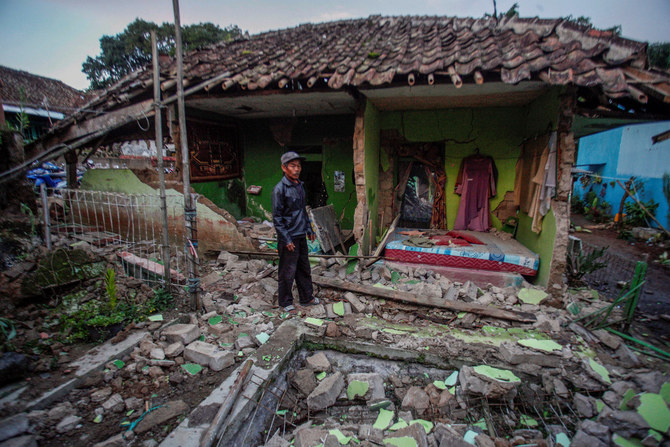
A local stands in front of his house, damaged after earthquake hit in Cianjur, West Java province, Indonesia, November 21, 2022. (Reuters)
Short Url
Updated 21 November 2022
Follow

Saudi Arabia expresses solidarity with Indonesia after West Java earthquake

  • The Kingdom’s foreign ministry offered its condolences and sympathy to Indonesia and the families and relatives of victims

RIYADH: Saudi Arabia expressed support for and solidarity with the government and people of Indonesia after a powerful earthquake killed more than 160 people in the country’s West Java province on Monday.

West Java governor Ridwan Kamil said on Instagram that 162 people had been killed and 326 were injured.

The Kingdom’s foreign ministry offered its condolences and sympathy to Indonesia and the families and relatives of victims. The ministry also wished the injured a speedy recovery.

The epicentre of the 5.6 magnitude quake was near the town of Cianjur in mountainous West Java, about 75 kilometers southeast of the capital, Jakarta. The region is home to over 2.5 million people.


History lives in stone in AlUla’s ancient city of Dadan

Updated 4 sec ago
Follow

History lives in stone in AlUla’s ancient city of Dadan

ALULA: The ancient city of Dadan is “one of the most significant historical discoveries in AlUla governorate and a key landmark reflecting the depth of human history in northwest Arabia,” according to an article published by the Saudi Press Agency on Saturday.

Dadan served as the capital of the Kingdom of Dadan and later of the Kingdom of Lihyan, from the late ninth century to the early first century B.C., the report stated.

Among the site’s most striking features are tombs carved into red rock cliff faces. Some are distinguished by rectangular facades crowned with lion carvings, a symbol often associated with power. “These structures reflect a sophisticated level of artistic and architectural skill, highlighting the advanced craftsmanship of the region’s ancient inhabitants,” the SPA wrote.

Constructed primarily from local stone, the city developed into an important hub for agriculture and trade. Its strategic position along the Incense Route — one of the most vital trade routes in the ancient world — enabled Dadan to flourish economically while facilitating cultural exchange.

Merchants, travelers and envoys passing through the city contributed to the circulation of goods and ideas across the Arabian Peninsula and beyond.

Archeological excavations at Dadan are ongoing, with teams of specialists conducting “systematic research in successive scientific phases to uncover additional structures, inscriptions and artifacts that may further clarify the city’s historical role and daily life,” according to the SPA.

AlUla’s recorded history spans more than 7,000 years of human presence. Discoveries at Dadan — including inscriptions and written records — continue to reshape understanding of the region’s social, economic and political development, “reinforcing AlUla’s status as an open-air archive of ancient civilization,” the SPA concluded.