

Pakistan court ends proceedings in assets-beyond-means case against finance minister

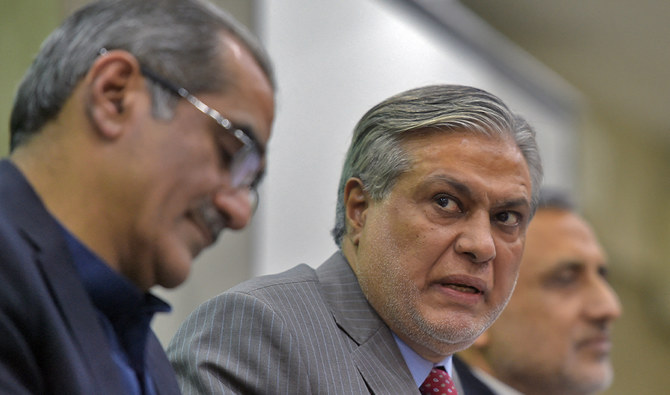
Pakistani Finance Minister Ishaq Dar (C) gives a press conference in Islamabad, Pakistan, on July 11, 2017. (AFP/File)
Short Url
Updated 22 November 2022
Follow

Pakistan court ends proceedings in assets-beyond-means case against finance minister

  • The case against Ishaq Dar was filed by Pakistan’s anti-corruption watchdog in December 2017
  • Court observes after amendment to accountability laws, case does not fall under its jurisdiction

ISLAMABAD: An accountability court in the Pakistani capital of Islamabad on Tuesday ended proceedings in a case against Finance Minister Ishaq Dar for allegedly amassing wealth beyond his known sources of income, local media reported, with the judge observing the matter no longer falls under the court’s jurisdiction. 

The case against Dar, a close aide of Pakistan’s ruling party supremo Nawaz Sharif, was filed by Pakistan’s anti-corruption watchdog, the National Accountability Bureau (NAB), in December 2017. It was among a slew of cases against the veteran politician, who was declared a proclaimed offender after he failed to show up for a number of court hearings the same year. 

The court suspended the arrest warrants after Dar, a 72-year-old chartered accountant, returned to the country in September after staying in London for five years in self-exile. The minister previously pleaded not guilty in the case, while his lawyer Qazi Misbah said NAB could not prove the allegations that Dar possessed assets beyond his means of income. 

An accountability, which reserved the verdict a day earlier, on Tuesday quashed the case on the basis of National Accountability (Second Amendment) Act 2022, which sought to reduce the scope of NAB. 

“After the [National Accountability (Second Amendment) Act 2022], this case does not fall under the jurisdiction of this court,” Pakistan’s Geo News channel quoted Judge Mohammad Bashir as saying at Tuesday’s proceedings. 

“We can neither announce a decision in favor of NAB nor can we issue a decision in favor of the suspect. The trial against Ishaq Dar ends here.” 

The National Accountability (Second Amendment) Act 2022, passed by both houses of Pakistan parliament in May, states that all “pending inquiries, investigations, trials or proceedings under this ordinance, relating to persons or transactions... shall stand transferred to the authorities, departments and courts concerned under the respective laws.” 

It restricts the country’s anti-corruption watchdog, the National Accountability Bureau (NAB) from acting on federal, provincial or local tax matters and removes regulatory bodies from NAB’s domain. The bill reduces the four-year term of the NAB chairman and prosecutor-general to three years, sets a three-year term for judges of accountability courts, and makes it mandatory for them to decide a case within a year. 

Following the amendment, the report said, a number of accountability courts withdrew around 50 corruption cases against the accused, including Prime Minister Shehbaz Sharif, former Punjab chief minister Hamza Shahbaz, National Assembly Speaker Raja Pervez Ashraf and former prime minister Yousuf Raza Gillani. 


Pakistan, Bangladesh discuss cooperation on overseas employment, human resource development

Updated 6 sec ago
Follow

Pakistan, Bangladesh discuss cooperation on overseas employment, human resource development

  • The development comes as both countries looking to strengthen institutional linkages, share expertise in workforce mobility
  • Officials exchange views on shared challenges faced by overseas labor force, skills development and training for expatriates

ISLAMABAD: Pakistani and Bangladeshi officials have discussed expanding cooperation in overseas employment and human resource development, the Pakistani information ministry said on Sunday, amid warming relations between the two countries.

The statement followed a meeting between Minister for Overseas Pakistanis and Human Resource Development Chaudhry Salik Hussain and Dr. Asif Nazrul, adviser to the Ministry of Expatriates’ Welfare and Overseas Employment of Bangladesh on the sidelines of the Abu Dhabi Dialogue 2026.

It comes amid Islamabad’s efforts to rebuild relations with Bangladesh since the ouster of former prime minister Sheikh Hasina, with both countries looking to strengthen institutional linkages and share expertise to improve skills training and workforce mobility.

Pakistani officials at the meeting briefed on the role and initiatives of the National Vocational and Technical Training Commission (NAVTTC), while the Bangladeshi side shared insights into the operational framework of its Technical Training Centers.

“The two sides exchanged views on shared challenges faced by their overseas labor force and discussed best practices in skills development and training for expatriate workers,” the Pakistani information ministry said.

“Both sides expressed keen interest in learning from each other’s experiences and best practices in human resource development and labor export, including recruitment processes, skills training, and reintegration mechanisms for returning workers.”

Pakistan and Bangladesh were part of the same country until Bangladesh’s secession following a bloody civil war in 1971, an event that long cast a shadow over bilateral ties. Both countries have moved closer since August 2024, following the ouster of Hasina who was considered an India ally.

As Pakistan-Bangladesh ties warm up, relations between Dhaka and New Delhi have remained strained over India’s decision to grant asylum to Hasina.

Pakistani and Bangladeshi officials also explored avenues for enhancing bilateral cooperation in the fields of education, health, tourism and trade.

“Both sides expressed their commitment to continued engagement and constructive dialogue to strengthen cooperation in areas of shared interest,” the Pakistani information ministry added.