

Hunt for buried survivors after Indonesia quake kills 162

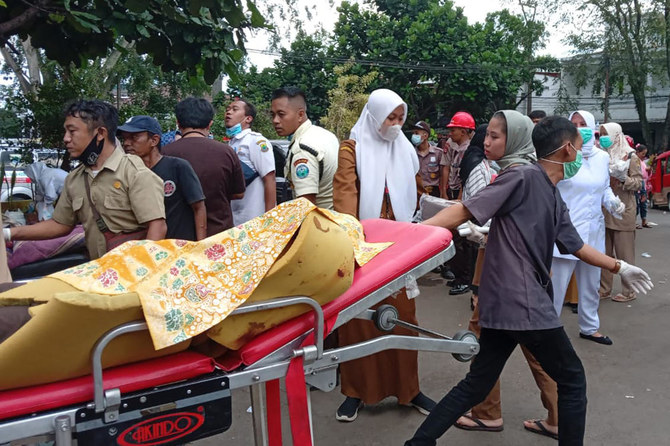
A hospital worker carries an earthquake victim on a gurney outside a hospital in Cianjur, West Java, Indonesia, Monday, Nov. 21, 2022. (AP)
Short Url
Updated 22 November 2022
Follow

Hunt for buried survivors after Indonesia quake kills 162

  • West Java governor Ridwan Kamil said on Instagram that 162 people had been killed and 326 were injured
  • The epicenter of the 5.6 magnitude quake was near the town of Cianjur in mountainous West Java, about 75 km southeast of the capital

CIANJUR, Indonesia: Rescuers on Tuesday searched for survivors buried under rubble after an earthquake on Indonesia’s main island of Java killed 162 people, injured hundreds and left more feared trapped in collapsed buildings.
The epicenter of the shallow 5.6-magnitude quake on Monday was near the town of Cianjur in Indonesia’s most-populous province West Java, where most of the victims were killed as buildings collapsed and landslides were triggered.
As bodybags emerged from crumpled buildings, rescue efforts turned to the missing and any survivors still under debris in areas made hard to reach by the mass of obstacles thrown onto the town’s roads by the quake.
One of the dozens of rescuers, 34-year-old Dimas Reviansyah, said teams were using chainsaws and excavators to break through piles of felled trees and debris to reach areas where civilians were believed trapped.
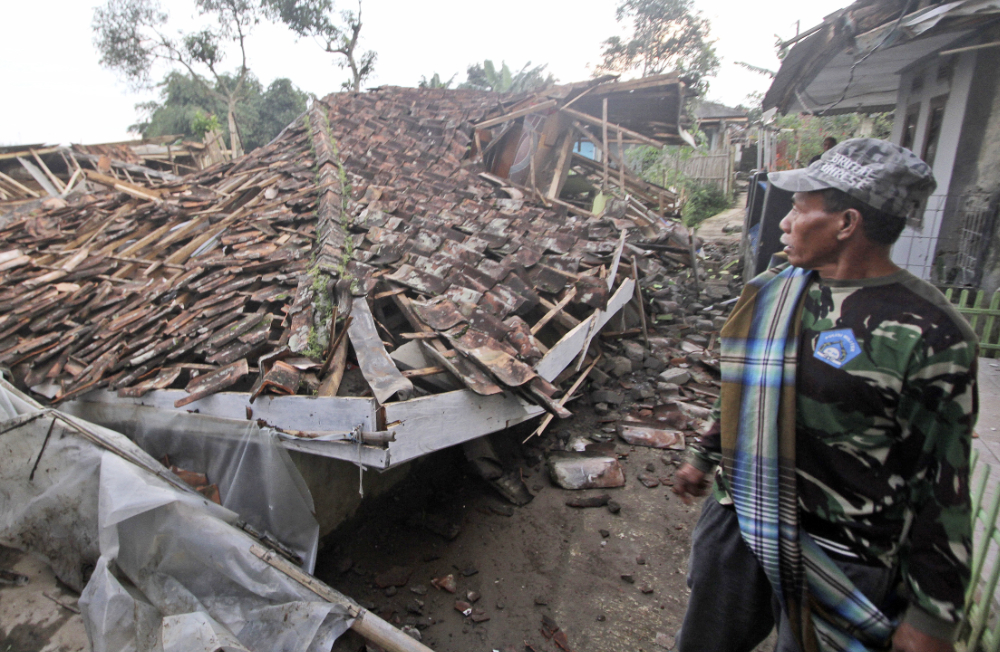


A man walks past a house ruined by an earthquake in Cianjur, West Java, Indonesia, Monday, Nov. 21, 2022. (AP)

“I haven’t slept at all since yesterday, but I must keep going because there are victims who have not been found,” he said.
“Today our focus is to evacuate victims who were buried by the landslide,” Rudy Saladin, a local military chief, told AFP.
“There’s a possibility there are still more.”
Indonesia’s national disaster mitigation agency, or BNPB, said at least 25 people were still buried under the rubble in Cianjur as darkness fell Monday.
Some of the dead were students at an Islamic boarding school while others were killed in their homes when roofs and walls fell in on them.
“The room collapsed and my legs were buried under the rubble. It all happened so fast,” 14-year-old student Aprizal Mulyadi told AFP.
He said was pulled to safety by his friend, Zulfikar, who later died after getting trapped under rubble.
“I was devastated to see him like that, but I could not help him,” he said.
The search operation on Tuesday was made more challenging because of severed road links and power outages in parts of the largely rural, mountainous region.
By Tuesday morning, 89 percent of power to Cianjur had been recovered by state-owned electricity company PLN, according to state news agency Antara.
West Java governor Ridwan Kamil said more than 300 people had been injured and over 13,000 taken to evacuation centers.
Those who survived camped outside in near-total darkness surrounded by fallen debris, shattered glass and chunks of concrete.
Doctors treated patients outdoors at makeshift wards after the quake, which was felt as far away as the capital Jakarta.
Grieving relatives waited for authorities to release bodies from morgues to bury their loved ones in accordance with their Islamic faith.
One father carried his dead son wrapped in white cloth through the streets of his village near Cianjur.
Others searched for their missing relatives in the chaos.
Rahmi Leonita’s father was riding a motorbike to Cianjur when the quake struck.
“His phone is not active. I am in a state of shock now. I am very worried but I am still hopeful,” said the 38-year-old, tears falling down her face as she spoke.
At a shelter in Ciherang village near Cianjur, evacuees sat on tarpaulins stretched over the cold morning ground.
Babies and children slept while their exhausted mothers kept watch.
Nunung, a 37-year-old woman who like many Indonesians goes by one name, had pulled herself and her 12-year-old son out of the rubble of their collapsed home.
“I had to free ourselves by digging. Nothing is left, there is nothing I could save,” she told AFP from the shelter, her face covered in dried blood.
The devastation caused by the quake was made worse by a wave of 62 smaller aftershocks — with magnitudes ranging from 1.8 to 4 — that relentlessly shook Cianjur, a town of about 175,000 people.
Indonesian President Joko Widodo has yet to respond to the quake but broadcaster Metro TV said he would visit the area on Tuesday.
Indonesia experiences frequent seismic and volcanic activity due to its position on the Pacific “Ring of Fire,” where tectonic plates collide.
A 6.2-magnitude quake that shook Sulawesi island in January 2021 killed more than 100 people and left thousands homeless.


WHO chief says reasons US gave for withdrawing ‘untrue’

Updated 25 January 2026
Follow

WHO chief says reasons US gave for withdrawing ‘untrue’

  • US Secretary of State Marco Rubio and US Health Secretary Robert F. Kennedy Jr. announced in a joint statement Thursday that Washington had formally withdrawn from the WHO
  • And in a post on X, Tedros added: “Unfortunately, the reasons cited for the US decision to withdraw from WHO are untrue”

GENEVA: The head of the UN’s health agency on Saturday pushed back against Washington’s stated reasons for withdrawing from the World Health Organization, dismissing US criticism of the WHO as “untrue.”
Tedros Adhanom Ghebreyesus warned that US announcement this week that it had formally withdrawn from the WHO “makes both the US and the world less safe.”
And in a post on X, he added: “Unfortunately, the reasons cited for the US decision to withdraw from WHO are untrue.”
He insisted: “WHO has always engaged with the US, and all Member States, with full respect for their sovereignty.”
US Secretary of State Marco Rubio and US Health Secretary Robert F. Kennedy Jr. announced in a joint statement Thursday that Washington had formally withdrawn from the WHO.
They accused the agency, of numerous “failures during the Covid-19 pandemic” and of acting “repeatedly against the interests of the United States.”
The WHO has not yet confirmed that the US withdrawal has taken effect.

- ‘Trashed and tarnished’ -

The two US officials said the WHO had “trashed and tarnished” the United States, and had compromised its independence.
“The reverse is true,” the WHO said in a statement.
“As we do with every Member State, WHO has always sought to engage with the United States in good faith.”
The agency strenuously rejected the accusation from Rubio and Kennedy that its Covid response had “obstructed the timely and accurate sharing of critical information that could have saved American lives and then concealed those failures.”
Kennedy also suggested in a video posted to X Friday that the WHO was responsible for “the Americans who died alone in nursing homes (and) the small businesses that were destroyed by reckless mandates” to wear masks and get vaccinated.
The US withdrawal, he insisted, was about “protecting American sovereignty, and putting US public health back in the hands of the American people.”
Tedros warned on X that the statement “contains inaccurate information.”
“Throughout the pandemic, WHO acted quickly, shared all information it had rapidly and transparently with the world, and advised Member States on the basis of the best available evidence,” the agency said.
“WHO recommended the use of masks, vaccines and physical distancing, but at no stage recommended mask mandates, vaccine mandates or lockdowns,” it added.
“We supported sovereign governments to make decisions they believed were in the best interests of their people, but the decisions were theirs.”

- Withdrawal ‘raises issues’ -

The row came as Washington struggled to dislodge itself from the WHO, a year after US President Donald Trump signed an executive order to that effect.
The one-year withdrawal process reached completion on Thursday, but Kennedy and Rubio regretted in their statement that the UN health agency had “not approved our withdrawal and, in fact, claims that we owe it compensation.”
WHO has highlighted that when Washington joined the organization in 1948, it reserved the right to withdraw, as long as it gave one year’s notice and had met “its financial obligations to the organization in full for the current fiscal year.”
But Washington has not paid its 2024 or 2025 dues, and is behind around $260 million.
“The notification of withdrawal raises issues,” WHO said Saturday, adding that the topic would be examined during WHO’s Executive Board meeting next month and by the annual World Health Assembly meeting in May.
“We hope the US will return to active participation in WHO in the future,” Tedros said Saturday.
“Meanwhile, WHO remains steadfastly committed to working with all countries in pursuit of its core mission and constitutional mandate: the highest attainable standard of health as a fundamental right for all people.”