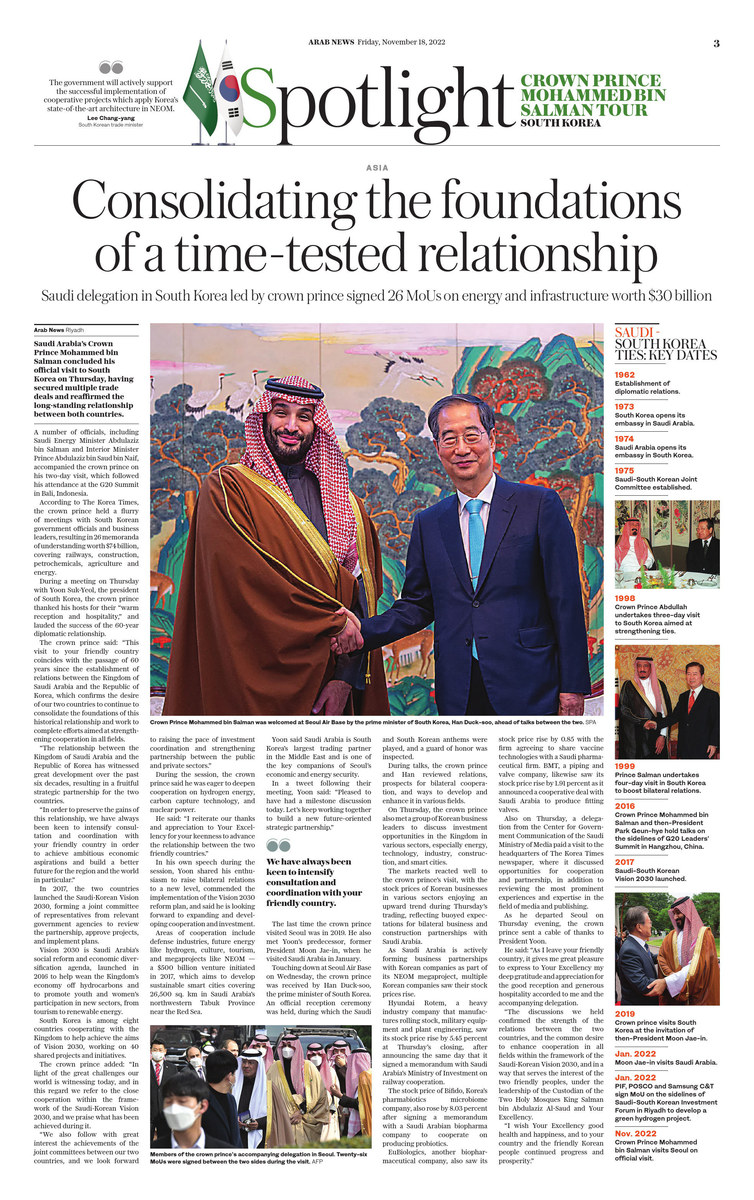
RIYADH: Saudi Arabia’s Crown Prince Mohammed bin Salman concluded his official visit to South Korea on Thursday, having secured multiple trade deals and reaffirmed the long-standing relationship between both countries.
A number of officials, including Saudi Energy Minister Abdulaziz bin Salman and Interior Minister Prince Abdulaziz bin Saud bin Naif, accompanied the crown prince on his two-day visit, which followed his attendance at the G20 Summit in Bali, Indonesia.
The crown prince held a number of meetings with South Korean government officials and business leaders, resulting in 26 memoranda of understanding worth $30 billion, covering railways, construction, petrochemicals, agriculture and energy.
During a meeting on Thursday with Yoon Suk-yeol, the president of South Korea, the crown prince thanked his hosts for their “warm reception and hospitality,” and lauded the success of the 60-year diplomatic relationship.
The crown prince said: “This visit to your friendly country coincides with the passage of 60 years since the establishment of relations between the Kingdom of Saudi Arabia and the Republic of Korea, which confirms the desire of our two countries to continue to consolidate the foundations of this historical relationship and work to complete efforts aimed at strengthening cooperation in all fields.
“The relationship between the Kingdom of Saudi Arabia and the Republic of Korea has witnessed great development over the past six decades, resulting in a fruitful strategic partnership for the two countries.
“In order to preserve the gains of this relationship, we have always been keen to intensify consultation and coordination with your friendly country in order to achieve ambitious economic aspirations and build a better future for the region and the world in particular.”
SAUDI-SOUTH KOREATIES: KEY DATES
1962: Establishment of diplomatic relations.
1973: South Korea opens its embassy in Saudi Arabia.
1974: Saudi Arabia opens its embassy in South Korea.
1975: Saudi-South Korean Joint Committee established.
1998: Crown Prince Abdullah’s three-day visit to South Korea aimed at strengthening ties.
1999: Prince Salman’s four-day visit to South Korea to boost bilateral relations.
2016: Crown Prince Mohammed bin Salman and then-President Park Geun-hye hold talks on the sidelines of G20 Leaders’ Summit in Hangzhou, China.
2017: Saudi-Korean Vision 2030 launched.
2019: Crown prince visits South Korea at the invitation of then-President Moon Jae-in.
Jan. 2022: Moon Jae-in visits Saudi Arabia.
Jan. 2022: PIF, POSCO and Samsung C&T sign MoU on the sidelines of Saudi-South Korean Investment Forum in Riyadh to develop a green hydrogen project.
Nov. 2022: Crown Prince Mohammed bin Salman visits Seoul.
As a part of the official visit, a Saudi Korean Investment Forum was hosted in Seoul by the Saudi Ministry of Investment on Thursday. The meeting was supported and attended by leading members of the Saudi Federation of Chambers and the Korean Chambers of Commerce and Industry.
Among those in attendance were Khalid Al-Falih, the Saudi minister of investment; Faisal Al-Ibrahim, Saudi minister of economy and planning; Lee Chang-yang, South Korea’s minister of trade, industry and energy; and officials of related government entities and leading private sector companies from both countries.
The main presentation and discussion topics was energy and sustainability, with a panel session on “Future Clean Energy.” The forum also discussed Saudi Arabia’s economic diversification, localization and privatization efforts as well as manufacturing.

Saudi Crown Prince meets with a group of heads of Korean companies, reviews promising investment opportunities in various fields. (SPA)
In 2017, the two countries launched the Saudi-Korean Vision 2030, forming a joint committee of representatives from relevant government agencies to review the partnership, approve projects, and implement plans.
Vision 2030 is Saudi Arabia’s social reform and economic diversification agenda, launched in 2016 to help wean the Kingdom’s economy off hydrocarbons and to promote youth and women’s participation in new sectors, from leisure and tourism to renewable energy.
South Korea is among eight countries cooperating with the Kingdom to help achieve the aims of Vision 2030, working on 40 shared projects and initiatives.
The crown prince added: “In light of the great challenges our world is witnessing today, and in this regard we refer to the close cooperation within the framework of the Saudi-Korean Vision 2030, and we praise what has been achieved during it.
“We also follow with great interest the achievements of the joint committees between our two countries, and we look forward to raising the pace of investment coordination and strengthening partnership between the public and private sectors.”

Saudi Crown Prince Mohammed bin Salman and S. Korea's President Yoon Suk-yeol and their delegations meeting in Seoul on Nov. 17, 2022. (Bandar Algaloud/via SPA)
During the session, the crown prince said he is eager to deepen cooperation on hydrogen energy, carbon capture technology, and nuclear power.
He said: “I reiterate our thanks and appreciation to Your Excellency for your keenness to advance the relationship between the two friendly countries.”
In his own speech during the session, Yoon shared his enthusiasm to raise bilateral relations to a new level, commended the implementation of the Kingdom’s Vision 2030 reform plan, and said he is looking forward to expanding and developing cooperation and investment.
These areas of cooperation include defense industries, future energy, such as hydrogen, culture, tourism, and megaprojects like NEOM.
NEOM is a $500 billion venture initiated in 2017, which aims to develop sustainable smart cities covering 26,500 sq. km in Saudi Arabia’s northwestern Tabuk Province near the Red Sea.

Among the areas of cooperation in NEOM include production of clean energy, such as solar, wind and hydrogen. (Supplied/file photo)
Yoon said Saudi Arabia is South Korea’s largest trading partner in the Middle East and is one of the key companions of Seoul’s economic and energy security.
In a tweet following their meeting, Yoon said: “Pleased to have had a milestone discussion today. Let’s keep working together to build a new future-oriented strategic partnership.”
The last time the crown prince visited Seoul was in 2019. The crown prince also met Yoon’s predecessor, former President Moon Jae-in, when he visited Saudi Arabia in January this year.
Touching down at Seoul Air Base on Wednesday, the crown prince was received by Han Duck-soo, the prime minister of South Korea. An official reception ceremony was held, during which the Saudi and South Korean anthems were played, and a guard of honor was inspected.
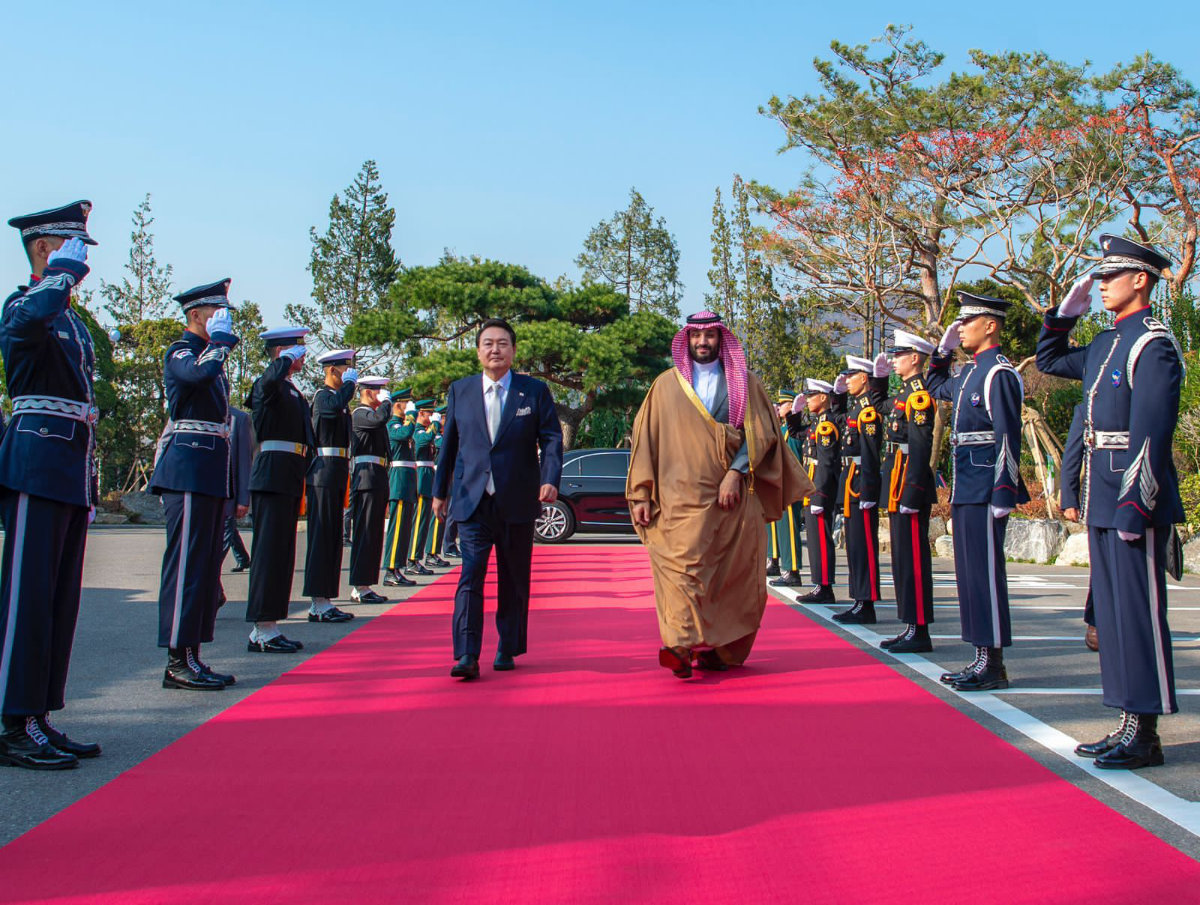
Crown Prince Mohammed bin Salman walks with South Korea's President Yoon Suk-yeol during a welcome ceremony in Seoul on Nov. 17, 2022. (Bandar Algaloud/Saudi Royal Court photo via SPA)
During talks, the crown prince and Han reviewed relations, prospects for bilateral cooperation, and ways to develop and enhance it in various fields.
On Thursday, the crown prince also met a group of Korean business leaders to discuss promising investment opportunities in the Kingdom in various sectors, especially energy, technology, industry, construction, and smart cities.
The markets reacted well to the crown prince’s visit, with the stock prices of Korean businesses in various sectors enjoying an upward trend during Thursday’s trading, reflecting buoyed expectations for bilateral business and construction partnerships with Saudi Arabia.
As Saudi Arabia is actively forming business partnerships with Korean companies as part of its NEOM megaproject, multiple Korean companies saw their stock prices rise.
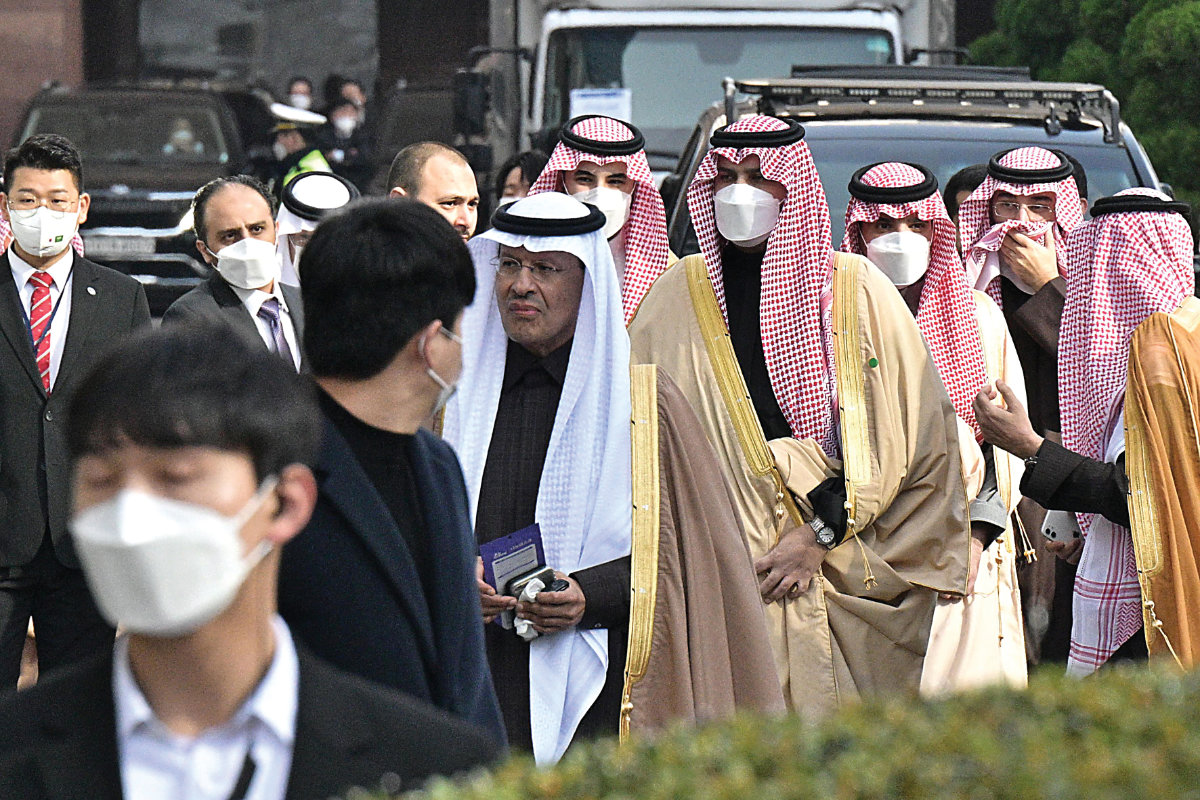
Members of the crown prince’s accompanying delegation in Seoul. Twenty-six MoUs were signed between the two sides during the visit. (AFP)
Hyundai Rotem, a heavy industry company that manufactures rolling stock, military equipment and plant engineering, saw its stock price rise by 5.45 percent at Thursday’s closing, after announcing the same day that it signed a memorandum with Saudi Arabia’s Ministry of Investment on railway cooperation.
The stock price of Bifido, Korea’s pharmabiotics microbiome company, also rose by 8.03 percent after signing a memorandum with a Saudi Arabian biopharma company to cooperate on producing probiotics.
EuBiologics, another biopharmaceutical company, also saw its stock price rise by 0.85 with the firm agreeing to share vaccine technologies with a Saudi pharmaceutical firm. BMT, a piping and valve company, likewise saw its stock price rise by 1.91 percent as it announced a cooperative deal with Saudi Arabia to produce fitting valves.
Also on Thursday, a delegation from the Center for Government Communication of the Saudi Ministry of Media paid a visit to the headquarters of The Korea Times newspaper, where it discussed opportunities for cooperation and partnership, in addition to reviewing the most prominent experiences and expertise in the field of media and publishing.
As he departed Seoul on Thursday evening, the crown prince sent a cable of thanks to President Yoon.
He said: “As I leave your friendly country, it gives me great pleasure to express to Your Excellency my deep gratitude and appreciation for the good reception and generous hospitality accorded to me and the accompanying delegation.
“The discussions we held confirmed the strength of the relations between the two countries, and the common desire to enhance cooperation in all fields within the framework of the Saudi-Korean Vision 2030, and in a way that serves the interest of the two friendly peoples, under the leadership of the Custodian of the Two Holy Mosques King Salman bin Abdulaziz Al-Saud and Your Excellency.
“I wish Your Excellency good health and happiness, and to your country and the friendly Korean people continued progress and prosperity.”