

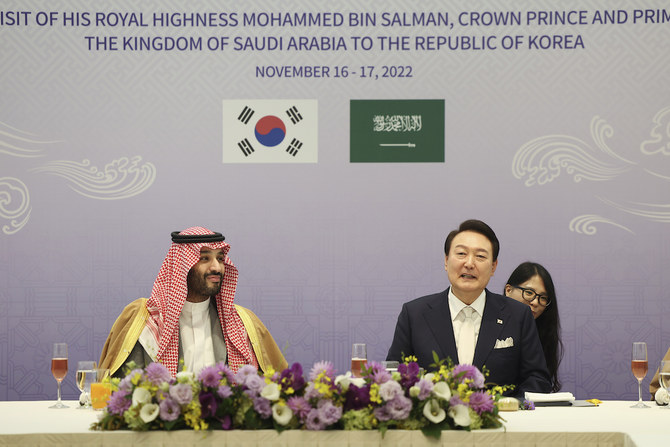

RIYADH: The arrival of Saudi Arabia’s Crown Prince Mohammed bin Salman in Seoul on an official visit to South Korea has underscored the depth of the bilateral relationship 60 years after the two countries established diplomatic ties.
The crown prince and South Korean President Yoon Suk-yeol held talks on Thursday, during which they both pledged to strengthen relations in the fields of energy, defense industry and building projects.
Clearly, relations between the two G20 members have come a long way since 1962, when Saudi Arabia forged formal ties with the Republic of South Korea during the reign of King Saud bin Abdulaziz Al-Saud and the presidency of Park Chung-hee.
South Korea opened its embassy in Saudi Arabia in 1973, while the Kingdom’s diplomatic mission in Seoul opened the following year.

South Korea’s Prime Minister Han Duck-soo, left, welcoming Saudi Crown Prince Mohammed bin Salman in Seoul. (Saudi Royal Palace)
The partnership assumed a strategic dimension in 2016 when the Saudi crown prince held talks with then-South Korean President Park Geun-hye, on the sidelines of the G20 Leaders’ Summit in Hangzhou, China.
The two leaders acknowledged the need to activate the work of the Saudi-Korean Joint Committee to enhance cooperation in various fields and encourage stronger trade relations. The committee was established more than 40 years ago to strengthen relations and common interests.
In 2017, the two countries launched the Saudi-Korean Vision 2030, forming a joint committee of representatives from relevant government agencies to review the partnership, approve projects, and implement plans.
Vision 2030 is Saudi Arabia’s social reform and economic diversification agenda, launched in 2016 to help wean the Kingdom’s economy off hydrocarbons and to promote youth and women’s participation in new sectors, from leisure and tourism to renewable energy.
South Korea is among eight countries cooperating with the Kingdom to help achieve the aims of Vision 2030, working on 40 shared projects and initiatives.
INNUMBERS
• 60 years since Saudi Arabia and South Korea established formal ties
• $26,506m volume of trade between the countries in 2021
• 132 South Korean investments in Saudi Arabia valued at $3.66 billion
These projects are divided into five sub-groups: energy and industrialization; infrastructure and smart infrastructure; digital transformation and capacity building; healthcare and life sciences; and small- and medium-sized enterprises.
The crown prince’s visit to South Korea in June 2019, at the invitation of then-President Moon Jae-in, marked another important turning point in relations, with an agreement to expand the scope of cooperation in all aspects of bilateral relations.
Those efforts appear to be paying off. The volume of trade between the Kingdom and South Korea in 2021 amounted to roughly $26,506 million.

S. Korea’s strengths in shipping and manufacturing underpin trade ties with Saudi Arabia, and plans to boost investment in energy, defense and green initiatives will forge wider economic links. (AFP)
The balance of trade that year recorded a surplus in favor of the Kingdom at a value of $19,646 million, with Saudi exports worth $23,076 million and imports from South Korea valued at $3,430 million.
Three of the most prominent Saudi companies have made investments in South Korea worth $6.35 billion. Chief among these is Saudi Aramco, which is active in the coal, oil and gas sectors, with investments worth $5.18 billion.
Others include SABIC, which is active in the chemicals sector, with investments worth $1 billion, and the Advanced Petrochemical Company, which works in the plastics sector and has investments amounting to $168 million.
South Koreans have made 132 investments in the Kingdom with a total value of approximately $3.66 billion. These cover sectors as varied as mining and quarrying, electricity, gas, air conditioning, transportation and storage, manufacturing and construction.
The companies involved in the investments include Samsung, International Maritime Industries, Rabigh Electricity Company, Alia Polymers Company, and Saudi Steel Pipes Company.
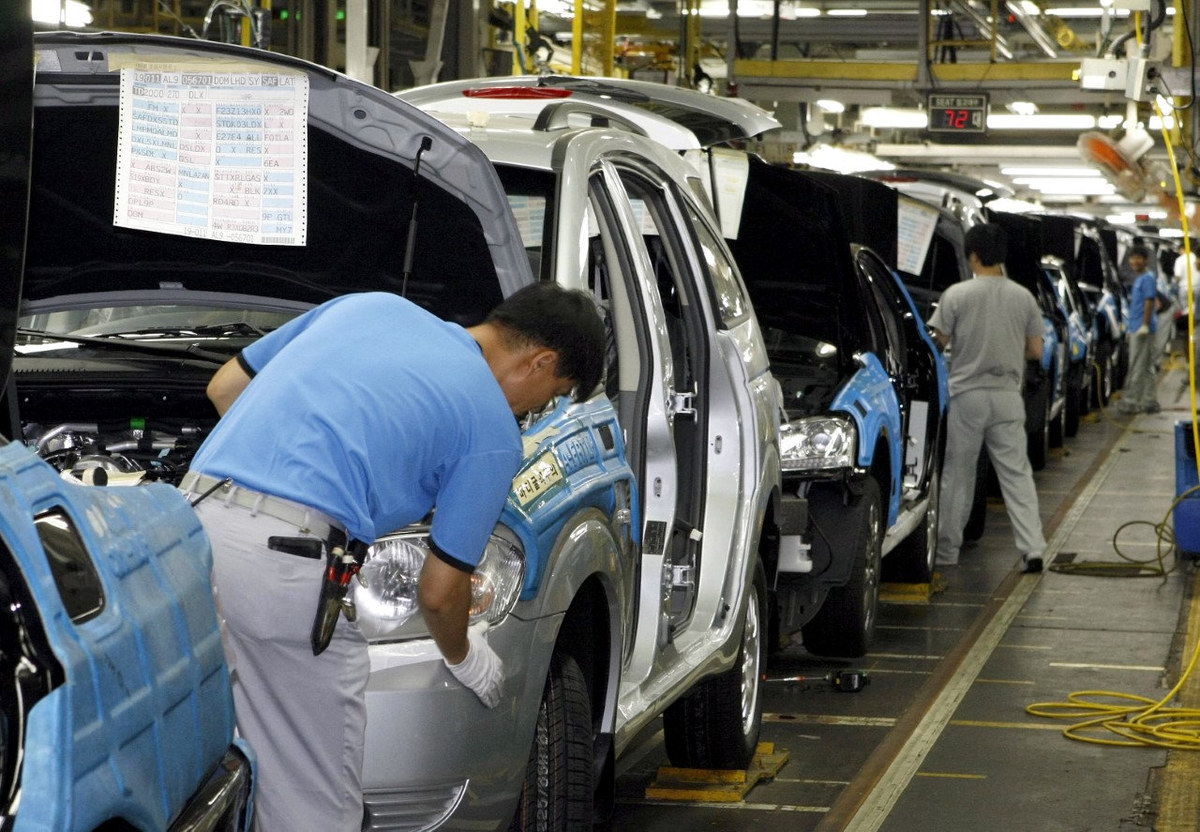
Transport makes up a sizeable chunk of trade between Saudi Arabia and South Korea. (AFP file photo)
Samsung Engineering and Hyundai Group obtained a contract to implement work at the Jafurah gas field project in Saudi Arabia with a value of more than $11 billion.
In 2021, the Saudi Authority for Intellectual Property registered 447 industrial models, 2,881 trademarks, and 543 patents among the filings of Korean companies. Samsung Electronics alone has 145 registered industrial models, while Daewoong Pharmaceutical has the highest number of registered patents, 16 in total.
Saudi Arabia and South Korea also share compatible plans to combat climate change, with the latter aiming to achieve net-zero carbon emissions by 2050 and the Kingdom aiming for the same goal by 2060.
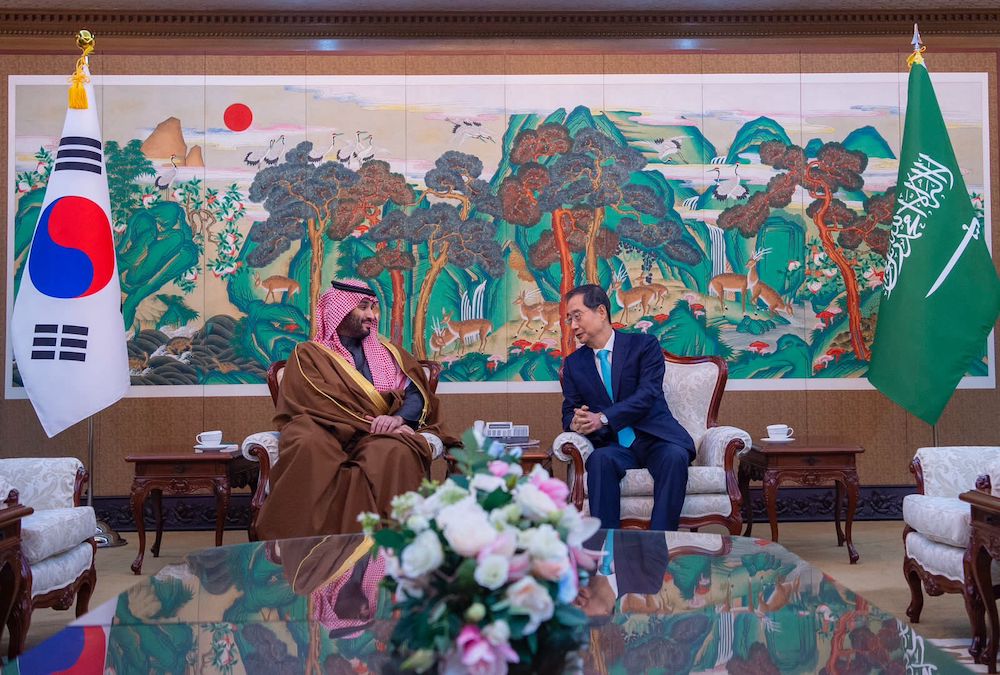
South Korea’s Prime Minister Han Duck-soo, right, with Saudi Crown Prince Mohammed bin Salman in Seoul during their meeting.
In January of this year, on the sidelines of the Saudi-Korean Investment Forum in Riyadh, attended by former President Moon Jae-in, the Saudi Public Investment Fund, Korea’s POSCO, and the Construction Division of Samsung C&T announced a tripartite memorandum of understanding to develop a green hydrogen export project.
There is more to the relationship than business and investments, however. The two nations have forged significant cultural ties since the Kingdom opened its doors to entertainment, concerts and world cinema.

South Korean K-pop bands are frequent performers in the Kingdom, a sign of stronger cultural ties between the two countries. (AFP file photo)
K-pop stars Super Junior and BTS have performed in the Kingdom and Korean films and television series have graced its screens, provoking a growing interest in South Korea’s cultural offerings among young Saudis.
Around 175 Saudi students are now studying in South Korea, including many on special scholarships.
Given this scale of investment and the number of cultural exchanges underway, the Saudi-South Korean relationship is likely to be further strengthened by the crown prince’s ongoing visit.


