

Saudi crown prince arrives in Indonesia to participate in G20

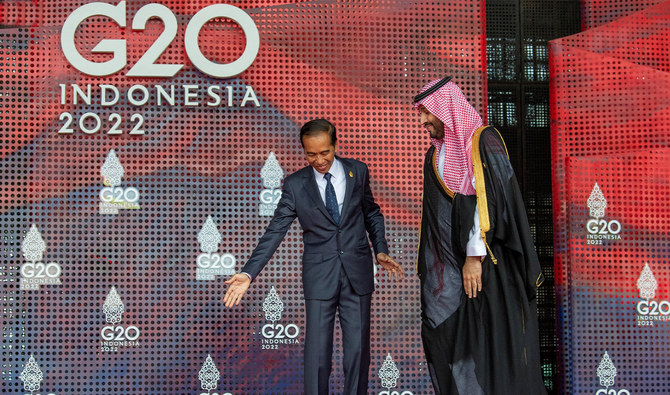
Saudi Arabia's Crown Prince and Prime Minister Mohammed bin Salman (R) meets Indonesia's President Joko Widodo as he arrives for the G20 leaders' summit in Nusa Dua, on the Indonesian resort island of Bali on November 15, 2022. (SPA)
Short Url
Updated 15 November 2022
Follow

Saudi crown prince arrives in Indonesia to participate in G20

  • World leaders are gathering in Bali for the G20 summit
  • Must avoid 'another world war,' Indonesia leader tells G20

RIYADH: Saudi Arabia’s Crown Prince Mohammed bin Salman arrived in Indonesia to participate in the G20 summit as leaders gathered Tuesday morning to discuss a number of issues facing the world, including the war in Ukraine, a global economic downturn and food security, among other topics.

At Ngurah Rai International Airport in Bali, the Saudi delegation was received by Indonesia’s Coordinating Minister for Maritime Affairs and Investment Luhut Binsar.

The delegation included ministers and senior officials.

G20 chair Indonesian President Joko Widodo called on Tuesday for unity at the bloc's 2022 summit and said that the group must not allow the world to fall into another cold war and that conflict must end.
If the war did not end, it would be difficult for the world to move forward, he said, without referring directly to the war in Ukraine at his opening speech to the summit.

Saudi Arabia’s Crown Prince also met with Turkish President Recep Tayyip Erdogan on the sidelines of the summit in Indonesia. 
The two leaders discussed bilateral ties, regional and international developments, and cooperation across various fields.

The G20 summit is taking place in Bali, on Nov. 15 and 16, marking the culmination of Indonesia’s presidency of the G20 biggest economies and more than 200 working group meetings and side events held throughout the year.

World leaders meet to discuss key issues affecting the stability of the global market, with talks likely to be affected by tensions over the war in Ukraine and its economic fallout.

(With input from Reuters)


The founding economy: A blueprint for stability in the First Saudi State

Updated 23 February 2026
Follow

The founding economy: A blueprint for stability in the First Saudi State

  • The establishment of the First Saudi State created a secure environment that facilitated the arrival of caravans, secured vast trade routes, and revived commerce across the Arabian Peninsula

RIYADH: The economy during the founding stage of the First Saudi State served as a fundamental pillar in building the nation, consolidating its influence, and ensuring its stability. This early economic growth was inextricably linked to achieving security, unifying regions, and organizing society—factors that directly stimulated trade, stabilized markets, and enhanced the foundations of daily life in Diriyah and its surrounding areas.
According to Dr. Abdullah Al-Saleh Al-Othaimeen's "Diriyah: Origins and Development during the First Saudi State," published by the King Abdulaziz Foundation for Research and Archives (Darah), the founding economy stands as a historical model reflecting the reciprocal relationship between political stability and early economic prosperity.

Beyond its political and intellectual prominence, Diriyah emerged as a vibrant economic hub. (SPA)

The establishment of the First Saudi State created a secure environment that facilitated the arrival of caravans, secured vast trade routes, and revived commerce across the Arabian Peninsula.
Beyond its political and intellectual prominence, Diriyah emerged as a vibrant economic hub. Its active markets attracted merchants and students from across the region, all of whom benefited from the state-provided stability. The local society relied on diverse activities for its livelihood, including trade, agriculture, and livestock breeding, with horses and camels playing crucial roles in transportation, commerce, and securing roads.
The social and administrative organization upon which the state was founded ensured the continuous availability of goods and sustained market stability. Ultimately, the close relationship between public security and economic growth during this founding phase solidified Diriyah's position as a premier political and commercial center in the Arabian Peninsula.