


RIYADH: The third Diriyah Contemporary Art Biennale, which runs until May 2, features works by more than 70 artists from across the globe, exploring themes of movement, migration, and transition.
Artistic directors Nora Razian and Sabih Ahmed worked with a group of curators on the biennale, titled “In Interludes and Transitions,” to explore the intersections of geographies, histories and cultures that have connected the Arab region to the world while centering the main motif of procession.
The biennale is divided into five galleries, as well as various activations, installations and performances.

Petrit Halilaj's 'Very volcanic over this green feather.' (AN/ Huda Bashatah)
In the show’s Disjointed Choreographies gallery, artists “grapple with their relationships to the past, celebrate the legacy of historical and cultural figures, and tell the stories that shape their worlds.Here, the past does not recede, but strides alongside the present,” the show catalogue states.
In Disjointed Choreographies, Kosovan artist Petrit Halilaj revisits drawings he made as a child in a refugee camp in Albania, remembering both the beauty and violence around him, in his installation “Very volcanic over this green feather,” while Puerto Rican artist Daniel Lind-Ramo’s cast of assembled sculptures celebrates the enduring bond of a community. Together the works in this gallerycelebrate the collective over the individual.

Rajesh Chaitya Vangad's untitled work. (Supplied)
In the A Hall of Chants gallery, Ahmed said during a media tour of the biennale, “we’re looking at who the voices are and how muted or amplified we allow them to be. We want to invoke the various voices we’re surrounded by.” He added that Gayatri Spivak's original essay “Can the Subaltern Speak?” was a reference point through which to pose questions: “Are we listening? When do we choose to listen and when do we not? Whose voices become noise, and whose voices remain voices? These often change in history and over time,” he said.
Although the biennale’s focus is on global movements, the artistic directors have approached the subject choreographically instead of cartographically.

Pio Abad's 'Vanwa.' (AN/ Huda Bashatah)
For example, in Rajesh Chaitya Vangad’s untitled work, created in the Warli style of painting, we see a choreography of community: a procession of people in celebration, others seeking refuge, children playing, birds flying, rivers flowing, worshippers chanting, the phases of the moon changing. The more you look, the more voices you hear.
Saudi artist Mohammad Al-Ghamdi mixes his interest in mechanics with traditional artifacts such as doors and windows to form something akin to an aerial image in his untitled mixed media on wood works. Here, discarded items become a language to translate the continuously changing nature of Earth and its cultures.
Also using earthly items to form a literal language is Filipino artist Pio Abad. His installation “Vanwa” consists of letters carved out of mud bricks created from sand from Riyadh to assemble a traditional poem in Ivatan, a language that is becoming minoritized within the Philippines. Translated, it reads: “Bury me under your fingernails/That I may be eaten along with every food you eat/That I may be drunk along with every cup of water you drink.”
Ahmed explained: “We wanted it to be in a scenographic conversation with the valley, Wadi Hanifa (which can be seen behind the work), almost as if the Earth is asking us ‘Are we reading between the lines?’”
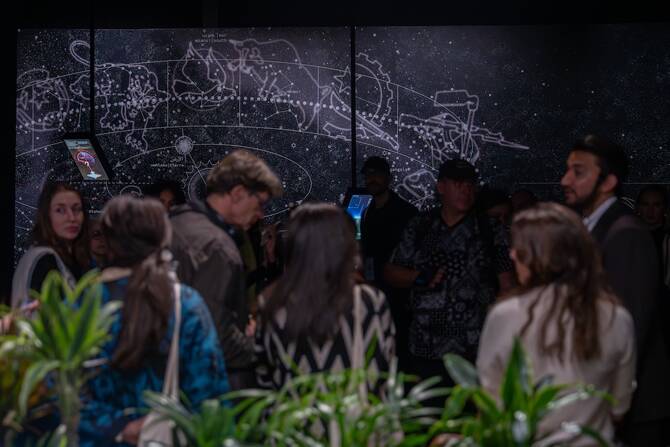
The A Collective Observation gallery focuses on diverse knowledge systems and technologies that “shape how we sense the world, from interpreting the cosmic and the geologic, to reading data points and Al-generated models,” examining “the tools and concepts through which we orient ourselves in the present, querying their … infallibility,” the catalogue states.
In the gallery A Forest of Echoes, there are processions that are poetic, mythological, spiritual, as well as microbial. The catalogue bills it as “a polyphonous transmission of enlivened pasts and possible futures.”
“Forests are various microhabitats jostling with each other. It’s various forms of life —airborne, landborne, and waterborne — sometimes in generative and regenerative relationships, but sometimes in violent and parasitical relationships. Those are the densities we wanted to include of various ecosystems and microhabitats the artworks themselves are trying to produce,” Ahmed said.
If we think of the world sonically, he explained, echoes become time capsules that carry singular and collective selves, carry them out, reverberate, and bring them back to us. In that sense, the exhibition also tackles time and coincidence of the past and the present.
Saudi artist Faisal Samra’s commissioned work “Immortal Moment III,” for example, contemplates his position in the world within cosmic time. On a tent cloth, he performs gestures and improvised choreography to paint a physical representation of abstracted human action.
Oscar Santillan’s “Anthem,” meanwhile, centralizes tree tumors as a main motif that responds to sounds produced by visitors to create animal-like noises, complemented by AI and synthetic biology, while Shadia Alem’s “Transformation Jinniyat Lar” is a series of acrylic paintings of female Jinns drawing from local and regional folklore that depicts them as custodians and protectors of the river Lar.
Throughout the biennale, Ahmed said, “we want to invoke processions that are planetary; the sandstorms, the hurricanes, the tectonic plates moving: all of that level of procession, as well as procession that’s social, which means processions of people moving together, having to move by circumstance or by choice, sometimes due to displacement, and sometimes (to seek) better opportunities.”


